An outpost of Gujarat under the grey sky in north London

EALING ROAD RUNS south from near Wembley Central station to Alperton station. At the north end of the road is the vegetarian Gujju Dhaba Express, which offers a range of Gujarati and other Indian dishes including Indo-Chinese food. Nearby, there are other restaurants (mostly South Indian and Sri Lankan) and several jewellery shops with signs and notices both in English and Tamil. A little south of these there is the Wembley Central Masjid, which is housed in an old church. Next door to this mosque is a Hindu Shiva temple. And a little further south, there is a branch of ICICI, an Indian bank. Further along the road there is a modern building covered with colourful paintings from top to bottom. This is Brent Indian Association, which looks from its website to be primarily concerned with Gujarati and Gujaratis.  The lampposts along the northern part of the road are decorated with large notices discouraging the use of paan, and spitting this substance onto the road.

After walking along a section of the road without shops, one reaches a long stretch of shops and eateries. Almost all of them cater to the Gujarati population. Almost without exception, the shop assistants and the managers speak Gujarati. During the few months before I first went to India, Lopa, who is now my wife, took me to this Gujarati area of London a few times, maybe to familiarise me with Indian things. Often, we used to eat at Sakonis, where South Indian vegetarian dishes were served, along with some items commonly eaten by Gujaratis who hailed from East Africa.
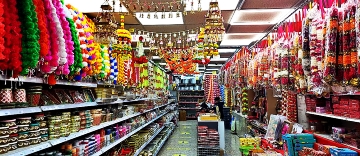
Inide Popat store

Yesterday, 7 March 2026, we revisited Ealing Road after not having been there for several years. Sakonis is still in business but looks fancier than it did more than 30 years ago. And to our great delight, Popat, a wonderful hardware and household goods shop, is still going strong. So strong that it has opened a new branch a few yards away.  While wandering around Popat, I found a collection of framed images of Hindu deities. Rummaging through them, I hoped to find an image of Shrinathji, a form of Krishna that is favoured by my wife’s mother’s family. When we have visited various members of this family, all devoted to Shrinathji, we have always seen images of this deity hanging in several rooms of their homes.

I could not find an image amongst all the pictures on offer. So, we asked one of the friendly assistants in Popat. She searched through the stock, and found one. She was delighted that we should want to obtain an image of Shrinathji, as she is devoted to him. She told us that she had visited his shrine, a temple at Nathdwara, which is not far from Udaipur in Rajasthan. Full of enthusiasm, this lady related that she had spent more than two days at the shrine, and had attended many pujas and darshans each day. She said it was the most wonderful experience, and that we should also visit Nathdwara because Shrinathji would enrich our lives and change them for the best. After she had extolled the virtues of the deity and the benefits that would surely follow a visit to his shrine at Nathdwara, we purchased the image. As we did so, I thought that it is not every day one enters a shop and receives a lesson in theology.

Apart from Popat, there are shops selling clothes for everyday use and weddings, jewellery shops, vast fruit and vegetable stores, other shops selling ingredients for south Asian cooking, and shops selling freshly made snacks, which most Gujaratis love. This part of Ealing Road is an ‘outpost’ of Gujarat that is frequently beneath a dismal grey sky. Despite the bad weather, the crowd of shoppers, mostly speaking Gujarati, is good humoured, as are those who serve in the shops. Visiting Ealing Road provides a taste of India without needing to purchase an air ticket. Having said that and having visited Gujarat many times, I felt that the Gujarati section of Ealing Road was even livelier than many places in Gujarat itself.
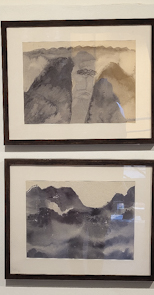
The first exhibition we visited at the Kochi Muziris biennale in Kerala

OUR FIRST EXHIBITION IN FORT KOCHI (KERALA) 2026

WE HAVE COME to Fort Kochi (Fort Cochin) in the south of India to view art in the town’s Kochi Muziris Biennale. This art show is housed in a wide variety of places in Fort Kochi and its environs. There is a main exhibition area and numerous peripheral venues. The first show we visited in housed in Burgher Street, almost opposite the popular Kashi Art café. At this location, Gallerie Splash from New Delhi was hosting images created by Naina Dalal, who was born at Vadodara, Gujarat, in 1935.

Ms Dalal studied art first at MS University in Vadodara, then at London’s Regent Street Polytechnic, and later at Pratt Graphic Center in New York City. She was one of the first Indian women artists to explore the nude artistically.

The exhibition in Fort Kochi, “An Empathetic Eye”, includes watercolours, oil paintings, and various types of print including collographs. According to Wikipedia:
Collagraphy (sometimes spelled collography) is a printmaking process in which materials are glued or sealed to a rigid substrate (such as paperboard or wood) to create a plate. Once inked, the plate becomes a tool for imprinting the design onto paper or another medium. The resulting print is termed a collagraph.

The works on display in the exhibition were attractive and visually intriguing. Dalal provides fine examples of Indian Modernism that demonstrate her independence from the previously powerful influence of Western European artistic styles on Indian modern art.

Seeing this exhibition made a great start to our exploration of what is on offer during the Biennale that runs until the end of March 2026.

The “Native Library” in Ahmedabad (Gujarat)

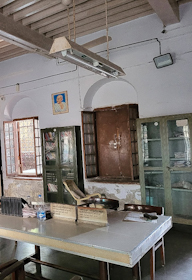
AN OLD BUILDING stands near the Bhadra Fort in the heart of old Ahmedabad. This is the Himabhai Institute. Its origin dates back to 1849 when Alexander Kinloch Forbes, an administrator in the British East India Company, set up the Gujarati Vernacular Society which aimed at carrying out social reforms, enriching the Gujarati language and its literature, and to promote ‘useful knowledge’.

The Society set up a library in the building now known as the Himabhai Institute. A leading light in establishing the library was the Gujarati poet Dalpatram, a friend of Forbes and his teacher of the Gujarati language.

Dalpatram, whose full name was Dalpatram Dahyabhai Travadi, lived from 1820 to 1898. According to Wikipedia, he:
“… led social reform movements in Ahmedabad, and wrote articles against superstitions, caste restrictions and child marriage. He dealt with the problem of widow remarriage at length in his poem, Vencharitra … In 1885, Dalpatram was made a Companion of the Most Eminent Order of the Indian Empire.”

The library, named after the philanthropist Himabhai (Vakhatchand) who lived from 1785 to 1858, is one of Gujarat’s oldest. It contained a valuable collection of books and manuscripts. Today, unfortunately, the place is in a sad condition. The number of people using it has declined considerably. This is to some extent due to the Internet having become a major source of information, and as a consequence people depend less on books than they used to. The Institute has a peaceful rear garden and on the first floor there is a hall that can be used for meetings and other functions.

A preserved historical building, the now melancholic Himabhai Institute was known as the “Native Library” in the nineteenth century.

A young Parsi travelled the world and then fought in WW1

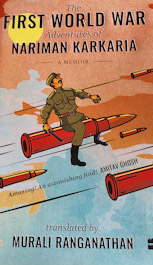
I HAVE JUST FINISHED reading a fascinating book gifted to me by my wife’s cousin. Most of the text is a Parsi’s experiences of fighting for the British during the First World War. Unlike other books about Indian soldiers who fought during that conflict, which deal with statistics and a general overview, this one contains the personal reminiscences of an individual who experienced the battlefronts first-hand.

The book is a translation from Gujarati of the memories of a Parsi (a Zoroastrian) from the town of Navsari in Gujarat – Nariman Karkaria (1895-1949). At the age of only 15, Nariman, wishing to see the world, ran away from home, and with hardly any money in his pocket, reached Hong Kong. From there, he slowly travelled through China to Siberia. His impressions of the places he visited are recorded in his often entertaining book.

When WW 1 broke out, Nariman travelled across Russia and through Scandinavia before embarking on a ship to Newcastle in the UK. From there, he reached London, where he enlisted in an English regiment. After detailing the training he received, he describes his journey to the Western Front in France.

In addition to describing the conditions on the battlefields of France, Egypt, Palestine, and Greece, vividly and often in great detail, Nariman portrays his fascination for seeing new places and people in a delightful way. Reading his memoir, I was infected with his enthusiasm for seeing the world.

Near the end of WW, Nariman spent time in Jerusalem, which he describes most interestingly. His accounts of Tbilisi, Istanbul, Baku, and post-WW1 London are fascinating. I was intrigued reading about daily life in Tbilisi and Baku as they were only a short time before the Russian Revolution.

Nariman’s writings portrayed him as a a genial person, whom it would have been fun to have met. His prose is easy to read and never dull. As the translator, Murali Ranganathan, explained in his introduction to the book, what Nariman wrote is a rare account of the travels and wartime experiences of an adventurous young Indian man from Gujarat.

This is a book well worth reading not only because of its unique perspective of WW1 but also its highly agreeable narrative style.

A stroll along Gujarati Road

SOME YEARS AGO, I bought a book in the antique shop on Princess Street in Fort Kochi. It is a modern reproduction of a book published in about 1910. Its subject matter, mostly in English, is a detailed description of the benefits of living in Cochin. Its intended audience was Gujarati speaking people thinking of settling in the area. It was aimed at Hindus, Moslems, Jains, and Parsis.

A few days ago (in February 2023), I purchased a recently published book by Bony Thomas called “Kochiites”. It describes the many different communities that have settled in Kochi. One brief chapter is about the small group of Dawoodi Bohri, Shia Moslems, who live south of the historic centre of Kochi. Another is about the Hindu and Jain Gujaratis (and Kutchis), whose communal activities are centred along the 1 mile long Gujarati Road. As my wife has roots in Kutch and the rest of Gujarat and we enjoy visiting those parts, we decided to take a stroll along Gujarati Road, which is in the Mattancherry District of Fort Kochi. It was Sunday morning.

Gujarati Road runs in a north south direction. We began our exploration at the Jain temple and moved southwards. At the Jain temple, we were not the only tourists. My wife was the only visitor who could speak in Gujarati with the lady who showed us around the spotlessly clean Mandir. Its interior has a beautiful inlaid multicoloured floor and the inside of the main dome was a replica of the kind of domes with concentric ridges that one sees in mediaeval Hindu and Jain temples, as well as in mosques constructed during that period. Photography was not permitted within the temple.

Our next port of call was the shop of Chamanlal H Mithalwala. For many generations, this shop, owned by Gujaratis, has been selling Gujarati sweets and farsan (savoury snacks). We were able to buy some freshly made dhokla. However, we were told that khandvi always runs out in the early morning on a Sunday, soon after it has been made. The owner is Kutchi, as are many of the folk who live near Gujarati Road.

The Sri Jalaram Dham, a Hindu temple frequented by Gujaratis and financed by them, is almost opposite the sweet shop. Built quite recently (2012), it is not particularly noteworthy architecturally. It contains several brightly coloured idols and a small tulsi tree grows outside. The priest (pandit) told us he came from Rajkot, and almost all of the worshippers are Kutchis.

Just to the south of the Jalaram Dham, we reached the Sri Cochin Gujarati Vidyalaya, a Gujarati school in which most of the teaching is done in English. Founded in 1920, it has about 3000 pupils and covers education from lower kindergarten to college entry.

Within the school’s compound, there is a Hindu temple – about 140 years old. Its ceiling is decorated with larger than life bas-relief lotus flowers. We spoke with a trustee of the temple, who showed us some of the original idols and explained that in the area there are about 200 Gujarati families. Of these, 48 are Kutchi Bhatias, about 100 are other Hindu Gujaratis, and the rest are Jain. The temple is Shaivite. Our informant told us about another temple, which is Vaishnav and is frequented by the local Kutchi Bhatias. This interested us because my wife’s mother was a Kutchi Bhatia.

As can be seen all over Gujarat, there is a chabutra (dovecote) next to the temple. There is another one at the Jain temple, mentioned above

We continued south along Gujarati Road, passing the Gujarati Bhavan (which we did not enter) and several wonderful fruit and vegetable stalls.

Near the fruit and veg shops, which are located near the southern end of Gujarati Road, there is yet another temple – the Shri Navneeta Krishna Mandir. This is the Vaishnav temple used by many of the Kutchi Bhatias. The main temple was locked up, but behind it there was a lot of activity. This was centred around the mandir’s gaushala (cow shelter), where cows are provided with a pleasant home.

Worshippers were feeding the cows and calves. They were also placing cloths on the cows before handing them to the priest who was standing amongst the congregation. We were asked to touch one of these cloths before it was handed to the priest. The congregants took it in turns to touch the priest’s feet, and receive a blessing.

Near to the temple, there is a large housing compound, all of whose residents are Kutchi Bhatias. One sweet couple invited us into their ground floor flat, saying to us: “Welcome to our home. As guests, you are gods.”
We chatted with them both in English and Gujarati. They gave us lovely cups of chhaas (buttermilk, a typical Kutchi drink). They offered to cook us lunch, but we declined because we had to get somewhere else. This charming couple, Deepika and Harish, did not want us to leave. When we did eventually go, I felt that we had been in the company of genuinely warm-hearted loving people.

Before setting off for Gujarati Road, I was worried that it might offer little of interest. How wrong I was! Although I have only briefly summarised our experiences, we saw many interesting places and met many friendly people. Over the years I have been falling in love with Gujarat and Kutch. This small outpost of people from that part of India in Kerala has only increased my affection for Kutch and Gujarat.

[NB Kutch, which is now a large district in the State of Gujarat, was an independent kingdom until 1947. Even today, no self-respecting Kutchi likes to be called a Gujarati!]