NOT FAR FROM the Bhadra Fort in Ahmedabad (India), on Bhadra Road, there are two shops that sell tasty, crystallised fruits (my favourites are orange slices with their rinds and pineapple) and a large selection of imported: sweets, biscuits, dates, nuts, and other mainly edible items suitable for gifts. In one of the shops, I noticed that there was a wide range of spice mixes made by a company called Shan. As we have used this excellent brand often at home, I looked at them.
Now, Shan is a Pakistani company (founded in Karachi in 1981), and at present Pakistan and India are not on the best of terms. So, I was interested to note that a Pakistani brand was on sale in a shop in India. When I looked at the packaging, I noticed that they were not labelled ‘Product of Pakistan’, but instead ‘Product of the UAE’. After looking at several boxes, I notice that one or two of the many that were on the shelf had the words ‘Product of Pakistan’. I wondered whether the shop owners had noticed this.
PS: The company has factories in UK, Pakistan, Saudi Arabia, and UAE
EALING ROAD RUNS south from near Wembley Central station to Alperton station. At the north end of the road is the vegetarian Gujju Dhaba Express, which offers a range of Gujarati and other Indian dishes including Indo-Chinese food. Nearby, there are other restaurants (mostly South Indian and Sri Lankan) and several jewellery shops with signs and notices both in English and Tamil. A little south of these there is the Wembley Central Masjid, which is housed in an old church. Next door to this mosque is a Hindu Shiva temple. And a little further south, there is a branch of ICICI, an Indian bank. Further along the road there is a modern building covered with colourful paintings from top to bottom. This is Brent Indian Association, which looks from its website to be primarily concerned with Gujarati and Gujaratis. The lampposts along the northern part of the road are decorated with large notices discouraging the use of paan, and spitting this substance onto the road.
After walking along a section of the road without shops, one reaches a long stretch of shops and eateries. Almost all of them cater to the Gujarati population. Almost without exception, the shop assistants and the managers speak Gujarati. During the few months before I first went to India, Lopa, who is now my wife, took me to this Gujarati area of London a few times, maybe to familiarise me with Indian things. Often, we used to eat at Sakonis, where South Indian vegetarian dishes were served, along with some items commonly eaten by Gujaratis who hailed from East Africa.
Inide Popat store
Yesterday, 7 March 2026, we revisited Ealing Road after not having been there for several years. Sakonis is still in business but looks fancier than it did more than 30 years ago. And to our great delight, Popat, a wonderful hardware and household goods shop, is still going strong. So strong that it has opened a new branch a few yards away. While wandering around Popat, I found a collection of framed images of Hindu deities. Rummaging through them, I hoped to find an image of Shrinathji, a form of Krishna that is favoured by my wife’s mother’s family. When we have visited various members of this family, all devoted to Shrinathji, we have always seen images of this deity hanging in several rooms of their homes.
I could not find an image amongst all the pictures on offer. So, we asked one of the friendly assistants in Popat. She searched through the stock, and found one. She was delighted that we should want to obtain an image of Shrinathji, as she is devoted to him. She told us that she had visited his shrine, a temple at Nathdwara, which is not far from Udaipur in Rajasthan. Full of enthusiasm, this lady related that she had spent more than two days at the shrine, and had attended many pujas and darshans each day. She said it was the most wonderful experience, and that we should also visit Nathdwara because Shrinathji would enrich our lives and change them for the best. After she had extolled the virtues of the deity and the benefits that would surely follow a visit to his shrine at Nathdwara, we purchased the image. As we did so, I thought that it is not every day one enters a shop and receives a lesson in theology.
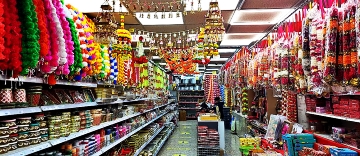
Apart from Popat, there are shops selling clothes for everyday use and weddings, jewellery shops, vast fruit and vegetable stores, other shops selling ingredients for south Asian cooking, and shops selling freshly made snacks, which most Gujaratis love. This part of Ealing Road is an ‘outpost’ of Gujarat that is frequently beneath a dismal grey sky. Despite the bad weather, the crowd of shoppers, mostly speaking Gujarati, is good humoured, as are those who serve in the shops. Visiting Ealing Road provides a taste of India without needing to purchase an air ticket. Having said that and having visited Gujarat many times, I felt that the Gujarati section of Ealing Road was even livelier than many places in Gujarat itself.
WHEN WE WERE in Ahmedabad in November 2025, we saw a superb exhibition at the Kasturbhai Lalbhai Museum. It was housed in a separate, contemporarily designed annex of the museum, the Rahul Mehrotra gallery, within the grounds. This was built on the site of the Lalbhai family’s former tennis court.
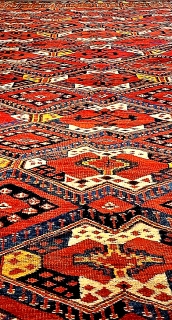
The show we had come to see was called “Bukhara”. It was an exhibition of 19th century traditional textiles from Central Asia, including decorative examples of suzani (needle-crafted hand embroidery using silk or cotton), ikats (weaving using complexly dyed threads), and rugs. The textiles and items (e.g., clothing) made by craftsmen living near to the Silk Routes in Central Asia were magnificently coloured, often with dramatically vivid patterns. On one piece of fabric, decorated with six identical circles, we noticed that one of the circles had a smaller one sewn within it. This, we were told by our guide, was a deliberate imperfection placed to show that only God can create something that is perfect. It might have been deliberately imperfect, but the exhibition was as near perfect as possible.
THE SIKH RELIGION was founded by Guru Nanak (1469-1539). During his lifetime, he made pilgrimages to Mecca. On two of these, he travelled through the port of Lakhpat in Kutch (Kachchh, Gujarat). In his lifetime, Lakhpat was a thriving port, but now it is a ghost town.
Lakhpat contains a fully functioning gurdwara (Sikh place of worship), the Lakhpat Gurdwara Sahib. It was established by the descendants of the Sikhs who hosted Guru Nanak during his two stays in Lakhpat. The sanctuary of the gurdwara contains relics that were used by Guru Nanak while he spent time in Lakhpat.
The sanctuary is housed in a large compound in which one must walk barefoot and with one’s head covered. The place is very clean.
As with all gurdwaras, pilgrims and other visitors are offered (free of charge) vegetarian food and drinks (eg tea) in the ‘langar’ (=kiitchen) hall. We drank tea from metal cups and saw others, seated on the floor, eating food from metal thalis. After finishing ones food and drinks, visitors must was the metal vessels with soap and water so that they are ready for use by others.
Although the sanctuary building is nineteenth century or older, the rest of the gurdwara is newer. We entered a huge new meeting hall to which builders were completing finishing touches. We were told that it was being got ready because there was about to be a great gathering of Sikh pilgrims at a festival.
Lakhpat and its gurdwar are close to India’s border with Sindh in Pakistan. The whole area around the erstwhile port is full of military personnel and camps. Many Indian regiments contain Sikh members. Some of these regiments have donated things to the gurdwara at Lakhpat. As one walks around, one can see plaques put up by, and to commemorate these regiments.
I enjoyed visiting the gurdwara, and we were happy to make a donation. Whatever the size of the donation, the donor receives a receipt that states the reason for making the gift. We wrote that our money was in gratitude for the refreshment offered to us in the langar hall.
By visiting the gurdwara at Lakhpat, we can truly say that we were following in the footsteps of Guru Nanak, even though our journey was most probably more comfortable than his.
AN OLD BUILDING stands near the Bhadra Fort in the heart of old Ahmedabad. This is the Himabhai Institute. Its origin dates back to 1849 when Alexander Kinloch Forbes, an administrator in the British East India Company, set up the Gujarati Vernacular Society which aimed at carrying out social reforms, enriching the Gujarati language and its literature, and to promote ‘useful knowledge’.
The Society set up a library in the building now known as the Himabhai Institute. A leading light in establishing the library was the Gujarati poet Dalpatram, a friend of Forbes and his teacher of the Gujarati language.
Dalpatram, whose full name was Dalpatram Dahyabhai Travadi, lived from 1820 to 1898. According to Wikipedia, he: “… led social reform movements in Ahmedabad, and wrote articles against superstitions, caste restrictions and child marriage. He dealt with the problem of widow remarriage at length in his poem, Vencharitra … In 1885, Dalpatram was made a Companion of the Most Eminent Order of the Indian Empire.”
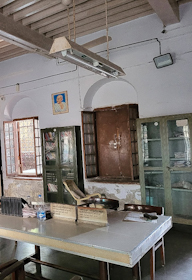
The library, named after the philanthropist Himabhai (Vakhatchand) who lived from 1785 to 1858, is one of Gujarat’s oldest. It contained a valuable collection of books and manuscripts. Today, unfortunately, the place is in a sad condition. The number of people using it has declined considerably. This is to some extent due to the Internet having become a major source of information, and as a consequence people depend less on books than they used to. The Institute has a peaceful rear garden and on the first floor there is a hall that can be used for meetings and other functions.
A preserved historical building, the now melancholic Himabhai Institute was known as the “Native Library” in the nineteenth century.
MADAM BHIKAJI CAMA (1861-1936) was an Indian freedom fighter. Aa member of the Parsi community, she is remembered for various activities including unfurling one of thee earliest versions of a flag of Indian independence at a socialist Congress in Stuttgart in 1907, several years before Gandhi returned to India to start his struggle to make India independent of the British.
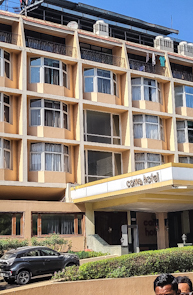
In 1960, Rustom Cama, who was related to Bikhaji Cama, opened his 26 room luxury Cama Hotel, close to the River Sabarmati in Ahmedabad. With a delightful garden, it was the city’s first hotel offering deluxe accommodation.
The hotel was one of the earliest projects of the renowned Indian architect Charles Correa (1930-2015). He designed the hotel in 1958-59. Not too far away from the hotel is the Memorial Museum at Gandhi’s Sabarmati Ashram in Ahmedabad.
I have read that the Cama Hotel has been modified over the years. So, although it is recognisable modernistic, some of what Correa designed has been changed. We visited the hotel, hoping to drink some coffee. Despite having placed the order, it never arrived, and we left thirsty. Nevertheless, I was pleased to have entered a building designed by Correa. And I was fascinated by the fact that the hotel was established by a member of Madam Bhikaji Cama’s family.
I first became aware of Madam Cama when I was researching my book, “Indian Freedom Fighters in London (1905 – 1910), which is about some Indian revolutionaries, who were active several years before Gandhi came on the scene. [The book is available from Amazon: https://www.amazon.co.uk/INDIAN-FREEDOM-FIGHTERS-LONDON-1905-1910/dp/0244270716 ]
THE PUNVARESHVAR TEMPLE is one of the oldest surviving Hindu temples in Kutch. It stands beside state highway 42 between Bhuj and Nakhatrana.
The temple is built in a style that incorporates elements of both Dravidian and Nagara styles. It was built sometime around the tenth or eleventh century. During the earthquake of 2001, part of its roof collapsed, leaving part of the temple without a roof. The temple is dedicated to Shiva.
The dripping cow head
Built on a stone podium, there is a walkway surrounding the temple. We began walking around it, and stopped to look at a carved cow’s head from which water was dripping. While I was taking a picture of this dripping sculpture, a man approached it, knelt down, let some water drip onto his fingers, and then touched his eyes with the water. He explained that we should not walk all the way around the temple, because only Ganesh, son of Shiva, is permitted to walk the whole way around. Ordinary mortals are supposed to walk up to the dripping cow, put the water in their eyes, and retrace their steps. Then, one can walk around the rest of the temple until one reaches the dripping cow. After applying water to the eyes, one retraces one’s steps.
While we were looking at the old temple, a group of ladies dressed in traditional folk costumes arrived at the temple. Each of them had what looked like a colourful pillow balanced on their heads. These were, in fact, bundles of clothes.
We learned that the ladies had walked through the night from Ratnal, which is 40 miles east of the Puneshwar Shiva Temple. According to Google maps, this walking journey takes between 13 and a half and 14 hours. We were at the temple at 10 am. The ladies would have set out on their walk early the evening before. Very kindly, they allowed me to take pictures of them.
The Punvareshvar Shiva Temple is on the way from Bhuj to the enormous temple complex called Mata no Madh. We visited this popular temple a few years ago. It was overcrowded and highly commercialised. Near the sanctum containing the highly revered deity, I spotted an ATM machine for pilgrims who had not brought enough cash to offer to the deity and the priests who perform the pujas – at very high speed. The simple, ancient Puneshwar Temple is a peaceful place, where unlike at Mata no Madh, there is a spiritual atmosphere bathing the environment.
THE BHARATIYA SANSKRUTI DARSHAN Museum in Bhuj houses a fascinating collection of artefacts which were collected from all over Kutch by Ramsinhji Kanji Rathod (1907-1997). Amongst these is an amazing collection of various kinds of textiles collected from all over the former Kingdom of Kutch (now part of Gujarat). Rathod also collected clay articles from the Harrapan site of Dholavira long before archaeologists began to take an interest in the area. I could continue by listing many other fascinating exhibits in the museum, but I will concentrate on three of them.
The three exhibits are all paintings by two Kutchi artists from Bhuj: Vadha and Lalmahad Juma. They were painted by 1884 at the latest. One of their creations hangs in Kedlestone Hall in Derbyshire, home of the Curzon family.
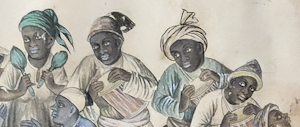
Sidi dancers
One of these three paintings in the museum depicts a folk dance being performed by Kutchi Sidis (people of Black African heritage living in India). The other two paintings depict Kutchi weddings.
What fascinated me was that these three paintings were exhibited outside Kutch: in Pune in 1888, and in London’s Wembley in 1925. They travelled over 5000 miles to Wembley to be exhibited in the British Empire Exhibition, which was held in the Empire Stadium between 9 May and 31 October 1925. The stadium later became England’s national football stadium. It was demolished by 2003, and replaced by a new one.
Interesting as this is, there are plenty of other exhibits to stimulate the admiration visitors to this wonderful museum ably curated by our friend Neeta Joshi. Undeservedly, this museum, which rivals many others I have seen in India, is not as well-known as other sights in Bhuj.
THE FIRST TIME we drove from Bhuj to Dholavira, home of Harappan ruins, the journey via Bhachau and Rapar took about six hours, not including stops for refreshments. This route runs around the large Lake of The Rann of Kutch. We made this journey in January 2020. Since then, a new road has been built. It reduces the journey to less than three hours.
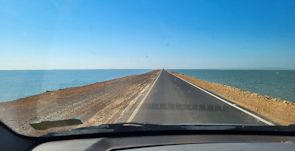
The new road, which runs roughly parallel to India’s border with Pakistan is part of a highway constructed to allow rapid movements of military vehicles. When India is under attack, or at risk from it, the thoroughfare is closed to non-military traffic. To call it a highway is a bit misleading. The new road, NH754K, consists of a single lane of tarmac, which is the width of a large lorry. The tarmac strip is flanked on each side by gravel carriageways that are wide enough for large trucks. When driving along the highway if two vehicles are approaching each other, one needs to swerve off the tarmac onto the gravel carriageway so that the two vehicles do not collide head to head. Many drivers, especially those in huge trucks and fancy SUVs expect cars approaching them to move off the tarmac and onto the gravel which is full of sharp rocks.
The new ‘highway’ traverses the Lake of The Rann of Kutch along a recently constructed causeway. This is about 30 km (18.6 miles) in length. It traverses a narrow island about half way along its length.
The Road To or Through Heaven
Known variously as ‘Way Through Heaven”, “Road to Heaven”, “Road through Heaven”, etc, the causeway is flanked on both sides by the waters of the vast lake through which it runs. Apart from the frequent swerving to make way for approaching vehicles, driving along the causeway is a magical experience. The shallow waters of the lake reflect the sun in varying ways. Far in the distance, beyond the lake, one can see hills silhouetted against the bright blue sky.
The water in the lake derives from the monsoon rains, and remains there until the end of the hot season just prior to the rains. Then, the lake dries out. When the lake is full, it attracts a variety of waterfowl. The most fascinating of these creatures are the huge number of pinkish flamingos. Because the lake is very shallow, many of the flamingos we saw were standing in the water rather than swimming.
Apart from its military purpose, the Road to Heaven has made it easier for tourists to visit the ruins at Dholavira. This has brought prosperity to the previously hardly visited island on which the archaeological site is located. On our recent visit in December 2025, we saw that Dholavira had become much more developed for tourism than it was back in 2020, when facilities in the area were rudimentary to say the least.
For many people today, the journey to Dholavira is being made not primarily because of an interest in archaeology, but to enjoy the heavenly sensations experienced while crossing the lake on the causeway. And there is nothing wrong with that: the causeway provides visitors with a wonderfully memorable experience.



 yamey
yamey 