A SMALL SIX-SIDED stone structure stands in the heart of the town of Sherborne in Dorset (UK). It is built with a yellowish stone in the mediaeval gothic style. Open to the elements on each of its six sides, its ceiling is a perfect example of gothic fan vaulting. Although it looks like a small kiosk or somewhere to shelter from the rain, it was not built as such.
Sherborne is famous for its magnificent gothic abbey church, which stands a few yards from the structure mentioned above. Until 1539, the church was attached to a Benedictine monastery. The latter was dissolved by Henry VIII in 1539, when most of the monastic buildings were either destroyed or sold. Some of them now form part of the venerable private Sherborne School.
Like most monastic institutions, that at Sherborne had cloisters. The six-sided structure, now known as ‘The Conduit’ was originally built in the early 16th century as part of the cloisters, to serve as a washing place for the monks. It survived the demolition of the monastery, and now forms pat of the quaint urban landscape of central Sherborne.
This is the tower of the 15th century St Peter Mancroft in Norwich, Norfolk. Situated next to the market place, this is the city’s parish church. It is the centre of civic worship, whereas the magnificent cathedral is the ecclesiastical centre of the city’s worship. Both this church and the cathedral make a visit to Norwich worthwhile. The city has other magnificent attractions, which I will write about soon.
I HAD PASSED it often, but never entered it until recently when I attended a concert within it. I am talking about a church on Holland Road in West London not far from Shepherds Bush, St John the Baptist. This Anglican church is an exceptional example of gothic revival style. Designed by James Brooks (1825-1901) with John Standen Adkins (an assistant of Brooks), it was constructed between 1872 and 1910.
Although the façade facing Holland Road is not exceptional, the church’s interior is highly breathtakingly decorative. Unlike mediaeval churches, which took centuries to complete, St John the Baptist was constructed in much less time. Yet, its decorative details, which imitate what is best in many older churches, rival those found within the old ones. The workmanship and fine details in St John’s remind one of the best productions of craftsmen, who flourished many centuries earlier. However, unlike the earlier churches, which inspired the designers of St John’s, the interior of the church on Holland Road looks too good to be true. Completed in a relatively short period, the variety that adds to the charm of gothic churches built in earlier times and more slowly is lacking in St John’s and other fine examples of late Victorian gothic revival buildings. What we see at St John’s is the realisation of the architects’ concept of an ideal ‘mediaeval’ church. What was achieved at St John’s is probably something like the results early creators of (mediaeval) churches hoped to create, but never lived long enough to see fully realised.
The attention to detail in the better gothic revival churches, such as St John’s, is marvellous. The result is an ensemble of decorative features rich in meticulously executed intricate details. While I was listening to the concert in St John’s, my eyes took in the details of the church, and I began thinking it was amazing that the elaborate attention to fiddly ornate minutiae was carried out only a few years before architectural trends turned through 180 degrees from excessively decorative to the greater simplicity of much 20th century architecture.
WILTON IN WILTSHIRE was capital of Wessex between the 9th and 11th centuries (AD). Today, it is famous for its carpet manufacturing and the wonderful Wilton House, which has been home to the Earls of Pembroke since 1544, when King Henry VIII gave it to them after the Dissolution of the Monasteries. The House, which contains a fabulous collection of paintings by the great masters, was built on the site of Wilton Abbey (established in 871 AD).
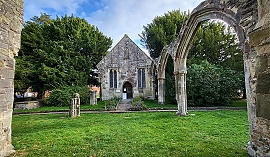
St Mary’s church in the centre of Wilton was originally the first Anglo-Saxon church in the town. It was first built in the 9th century, and then rebuilt in the 12th century. The newer church was further modified in the 15th century. However, by the 18th century it was becoming dilapidated. In 1751, the surving part of the church became used as a mortuary chapel for the Earls of Pembroke. This situation remained unchanged until 1848, when the construction of the large Italianate church of St Mary and St Nicholas was completed in nearby West Street. Then, the old St Mary’s was demolished except for the chancel and the first bay of the nave (than next to the chancel). This survivor is rarely used for services and is now cared for by the Churches Conservation Trust, which looks after historic churches of interest that have become redundant. Outside the preserved part of St Mary’s there are a few gothic arches, remains of the previously much larger church.
We have visited Wilton several times, to see both Wilton House and the Italianate church, as well as to partake of refreshments in the town’s cafés, but it was only today (7th of October 2022) that I first noticed the remains of St Mary’s. This only goes to show that revisiting a place often can be rewarding.
IN THE EARLY 1960s, the first proper self-service supermarket opened on the corner of Golders Green Road and a small service road called Broadwalk Lane. I cannot recall the name of this store, but it was soon taken over by the Macfisheries company. Later, it became a supermarket where many imported foods, especially products from Israel, were sold. Now, it has become a Tesco Express.
Facing the supermarket (across Golders Green Road) is a gothic revival style church. It has been used by a Greek Orthodox (Christian) congregation since 1968. Now, the The Greek Orthodox Cathedral of the Holy Cross & St. Michael, it was constructed as the Church of England’s ‘St Michael’s Church’ in 1914 to the design of JT Lee. A clock tower, surmounted by a delicate cupola supported by thin columns, was added to the church in 1960. On one of its walls, there is a bas-relief of St Michael with one foot on a serpent. On the northeast corner of the church, there is a plaque listing people who died in WW1. Near this, there is a crucifix standing in the garden next to the church. Its design, typical of C of E crucifixes, predates the arrival of the Greek congregation.
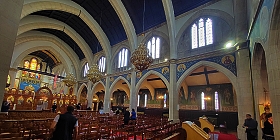
Although the interior of the church maintains some of its original Cof E fittings, such as stained-glass windows, the font designed in a mock mediaeval style, and some wall mounted memorials in English, a great deal of effort has been made to create the atmosphere of a Greek Orthodox place of worship. The walls of the side aisles have been painted with religious scenes. There is a decorated iconostasis and several framed icons. Elaborate chandeliers hang above the nave. Despite the additions to convert the church for Greek Orthodox worship, the original gothic revival features of the building’s interior are evident, but harmonise well with the later additions.
FROM THE OUTSIDE, the church of St Barnabas in Pitshanger Lane (Ealing) is not particularly attractive. Even though we visited it on a Sunday, it was locked up. However, we were fortunate to meet a lady, who had been in the church hall and happened to have the key to the church with her. Kindly, she unlocked the edifice, and we were able to enter. The church’s interior, unlike its exterior, is wonderful.
The church stands close to Brentham Garden Suburb, which was built largely between 1901 and 1915. I will write about the Suburb at a later date, but now I will concentrate on the church. Although the Suburb was built with a magnificent club house, there had been no plans to include a church. In 1907, a temporary church made from corrugated iron sheets, and dedicated to St Barnabas was constructed at the junction of Pitshanger Lane and Castlebar Park. Eventually, it was too small to accommodate its congregation in an area where plenty of housing was being constructed. For legal reasons, it was not possible to build a larger church on the site. So, in 1911 a larger plot was acquired at the corner of Pitshanger Lane and Denison Road (one of the streets within the Garden Suburb).
Ernest Shearman (1859-1939) was the architect chosen to build the larger St Barnabas Church, which can be seen today. After working in Buenos Aires and later at Sandringham, he moved to Winchester in 1907. From that year onwards, his work was mainly concerned with designing churches. According to a book by Hugh Mather about the centenary of the church of St Barnabas, all of Shearman’s churches:
“…are tall imposing buildings without spires, and their austere, simple architecture was designed so that elaborate furnishings and other adornments could be added subsequently …”
His churches represent “… almost the final flowering of the last phase of the Gothic Revival.”
All except one of his churches demonstrate Shearman’s fascination with rose windows and elaborate tracery. St Barnabas is a fine example of this.
The construction of the church began just before the start of WW1, in June 1914. It was completed in the middle of the war by June 1916, when it was consecrated.
The church has a spacious nave, which has a lovely timber ceiling. Although it was designed to reflect the heritage of the gothic era, the inside of the church feels almost contemporary. There is an enormous organ at the west end of the church. Made in 1851, it was made by the company of William Hill and originally housed in St Jude’s Church in Southsea. It was moved to St Barnabas in 2011. Some of the pipes on the south side of the central tall organ pipes do not make sounds. They were added to the organ for purely aesthetic reasons. The current organ replaced an older, less reliable instrument, which was removed in 2010.
The apse is adorned by a large painting by James Clark (1857-1943), who was living in Bedford Park not far from the church when he created it. He was one of many artists residing in Bedford Park, which was an ancestor of the Garden Suburb movement. His painting in the apse depicts the three hierarchies of angels praising and adoring the Holy Trinity. It is a magnificent addition to the church.
As we did not want to delay the lady who opened the church for us, we did not have sufficient time to examine its interior in great detail, but it did demonstrate how wrong it was to, to rephrase a well-known saying, to judge a church by its cover.
HIDDEN IN A residential crescent, Philbeach Gardens, near Earls Court is a late Victorian church, whose exterior is far from attractive. However, St Cuthbert (completed 1888) has an interior which cannot fail to amaze the visitor’s eyes. The church contains what can only be described as an ‘over-the top’ array of decorative features. Some of them are typical of the Gothic Revival style beloved of Victorian church designers, and others that are typical of the Arts and Crafts Movement, which flourished in the last decades of the 19th and the first few of the 20th century.
One item in the church, which is particularly eye-catching, is made of wrought iron and hammered (repoussé) copper. It is a lectern with two large arms on either side of the leather-covered book holder. These are supports for large candles. The lectern is approached by a small set of stairs whose treads have studs on them. The studs are arranged to spell out words, which I found difficult to decipher. The part of the base facing the congregation is an intricately decorated folded screen with Arts and Crafts Style decorative motifs. Most probably handmade, the lectern, although fantastically crafted, has a very slightly amateurish look about it. It is more unusual and eye-catching than beautiful.
I would not have visited St Cuthbert had my friend, the excellent Olsi Qinami, not been conducting the London City Philharmonic Orchestra performing a concert there. The church with its colourful marble pillars and almost surreal interior is well worth a visit even if there is no concert being performed. It is a ‘must-see’ for lovers of Victorian church architecture.
SPIRAL RAMPS LEAD up to the Ha’penny Bridge, which allows pedestrians to cross the Paddington Arm of the Grand Union Canal, where it runs between Delamere Terrace on one bank and Blomfield Road on the opposite one. A few yards west of the bridge and south of the waterway, there is a Victorian gothic church with a tall tower decorated with layers of red brickwork separated by layers of white masonry and topped with a white spire. It is St Mary Magdalene’s church.
The church was designed by George Edmund Street (1824-1881) and completed in 1878. It was built in what was then an area with poor quality housing, where several hard-up families lived crowded together under one roof. The parish in which it is located began life as an offshoot of All Saints in Margaret Street (near Oxford Circus). Like All Saints, St Mary Magdalene’s was established as an Anglo-Catholic church. Its website, grandjunction.org.uk, revealed that Anglo-Catholicism:
“… emphasises the Catholic heritage and identity of the Church of England. In the mid-nineteenth century Anglo-Catholicism was very controversial and provoked riots. Anglo-Catholic churches were often built in very poor areas, and their clergy believed that their services, full of light, colour, music and ritual, were likely to appeal to the poor.”
Like All Saints Margaret Street, the interior of St Mary Magdalene’s is a masterpiece of Victorian gothic extravaganza, a riot of colour. The nave has a magnificent painted ceiling which includes faces of various saints. This was painted by Daniel Bell, a Victorian artist. Sculptures of saints carved by Thomas Earp (1823-1893) look down on the nave. The floor of the vast nave is decoratively tiled. Street did not believe in fixed pews such as are found in many other Victorian churches and were rented out to parishioners to raise money. He believed in ‘free seating’, especially in a church like St Mary Magdelene’s that was built to serve the poor. The apse is unusual in that it is polygonal, reminiscent of apses that the widely travelled Street had seen in French and Flemish churches.
An unusual feature of this out of the ordinary church is that although the nave is flanked by a south and a north aisle, the latter is barely wide enough to accommodate one person, whereas the south one is almost as wide as the nave. The reason for the narrow north aisle was related to building regulations in force when the church was being constructed.
If it is open, and it was when I visited the church, it is worth entering the undercroft. This area beneath the church is flanked on its south side by a chapel that was undergoing restoration in February 2022. This is the chapel of the Holy Sepulchre created to commemorate the church’s founder and first vicar Fr Richard Temple West (1827-1893). Containing much decorative artwork and resembling a mediaeval chantry chapel, it was created by the architect Ninian Comper (1864-1960).
Outside the church, there is a WW1 memorial, added by Martin Travers in 1929. It is a gold-coloured crucifixion with a stone base on which are inscribed the Latin words “Infinitum est”, which is neither classical nor biblical; it means ‘It is not finished’, which are ominous words on a war memorial and are most portentous on a memorial to the first of (so far) two world wars.
Added on to the west end of the church, there is a modern extension, which houses a pleasant refreshment outlet called the Grand Junction Café. This is a good place to rest for a while after the excitement of seeing inside the spectacular church.
MANY YEARS AGO, I read “The Gothic Revival” by the art historian Kenneth Clark (1903-1983). If I recall correctly, he wrote that it was likely that in Britain, the gothic style never truly died out before it came back into fashion in the 18th century. What we call ‘revival’ was merely the flaring up of the embers of the use of gothic designs, which had persisted despite the flowering of newer forms of architecture, such as neo-classicism. By the 19th century, the use of gothic motifs and structural features had fully revived, especially in the construction of churches and many other buildings, such as London’s St Pancras Station and the Prudential Building (near Chancery Lane).
Today, the 22nd of February 2022, I revisited a slightly concealed church, All Saints, in Margaret Street, which runs north of Oxford Street and parallel to it. You can see its tall, tiled spire from afar, but the church itself is set back from the street in a courtyard. Externally, with its multi-coloured patterned brickwork it is eye-catching but inside it is fantastic.
The church was established by the Ecclesiological Society, which was founded in 1839 as ‘The Cambridge Camden Society”. The group’s aim was:
“… announced a plan to build a ‘Model Church on a large and splendid scale’ which would embody important tenets of the Society: It must be in the Gothic style of the late 13th and early 14th centuries; It must be honestly built of solid materials; Its ornament should decorate its construction; Its artist should be ‘a single, pious and laborious artist alone, pondering deeply over his duty to do his best for the service of God’s Holy Religion’ Above all the church must be built so that the ‘Rubricks and Canons of the Church of England may be consistently observed, and the Sacraments rubrically and decently administered’.”
The architect chosen was William Butterfield (1814-1900), who specialised in the ‘gothic revival’ style. The church was built on the site of a former chapel, and within the confined space available, it was accompanied by a choir school and a clergy house. The church’s spire, 227 feet high, is taller than the towers of Westminster Abbey.
The Victorian writer and art critic John Ruskin (1819-1900) was full of praise for Butterfield’s edifice in Margaret Street. He wrote about it in his “The Stones of Venice, Volume III” (published 1853), observing that it:
“…assuredly decides one question conclusively, that of our present capability of Gothic design. It is the first piece of architecture I have seen, built in modern days, which is free from all signs of timidity or incapacity. In general proportion of parts, in refinement and piquancy of mouldings, above all, in force, vitality, and grace of floral ornament, worked in a broad and masculine manner, it challenges fearless comparison with the noblest work of any time. Having done this, we may do anything; there need be no limits to our hope or our confidence; and I believe it to be possible for us, not only to equal, but far to surpass, in some respects, any Gothic yet seen in Northern countries.”
That was praise indeed.
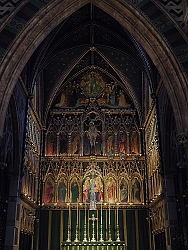
The interior of All Saints is a riot of colour. This results from the use of stones of differing hues – some inlaid to create bold patterns and others to form images of biblical scenes, glorious stained glass, gilt work, and elaborate ironwork. This feast for the eyes must be seen to be believed. And this gem of Victorian architecture, a peaceful have and a joy to see, is merely a stone’s throw from the hustle and bustle of Oxford Circus.





 yamey
yamey 