
A toilet suspended above the waters of the Arabian Sea in Bombay

THE IMPRESSIVE GATEWAY  of India stands on a short promontory surrounded on three sides by the water of the Arabian Sea.  The sea surrounding the Gateway is crowded with small, colourful vessels. Seeing  one of these craft reminded me of a story told to me by a friend many years ago.


In Bombay

My friend had just returned from Kenya. During his stay there he spent several days at sea on a local trading ship. It was a very basic vessel.  He told me that he could not find a toilet on board. Eventually,  he could no longer resist the urge, and asked the crew where he could relieve himself. He was directed to the rear of the vessel and shown a toilet seat that was suspended from it over the waters below. With some difficulty he managed to sit on the swinging toilet seat, and to his great embarrassment, the entire crew came to the back of the ship to watch him in action.


That really happened a long time ago.  Today, 17 November 2025, while visiting the Gateway of India,  I spotted a small boat. Projecting from its rear and hanging over the water, there was a small, square based cubicle with a door. On the door,  there was the word “TOILET”. Seeing this reminded me of my friend’s story. Users of this cabin are shielded from sight, unlike that swinging loo seat on the Kenyan boat.
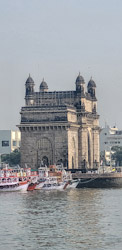
An iconic but ironic famous landmark in Mumbai

WE HAVE BEEN VERY fortunate to get a booking at the Royal Bombay Yacht Club, located next door to the world famous luxurious Taj Mahal Hotel. Our bedroom is directly opposite the front of the Gateway of India – Bombay’s best known landmark.

The Gateway was built to celebrate the arrival in India of the British King George V – Emperor of India. However, as it was only completed in 1924, the king only got to see a cardboard model of the archway. Construction of this edifice only began in 1915, when the land on which it now stands was first prepared. The Gateway’s foundations only began to be built in 1920.

The magnificent archway was designed by George Wittet (1878-1926), an architect who worked mainly in Bombay. The Gateway was designed in an Indo-Saracenic style with many features borrowed from 16TH mosques found in Gujarat.

The Gateway is a brilliant piece of architecture. In its position next to the sea, it ‘works’ successfully. It has become not only an icon of Bombay but also, I believe, of India. I find it ironic that like that other icon of India, the Taj Mahal in Agra, its construction was inspired not by Indians but by invaders of the Indian Subcontinent. Despite that, Indians love it and flock to see it.