A walk in Lambeth’s Old Paradise Gardens

WHENEVER WE VISIT the Newport Street Gallery in London’s Lambeth district, we pass the entrance to a small garden. Today (19th of June 2024), we decided to enter this little park – a peaceful haven only a few hundred yards south of Lambeth Bridge. It is called Old Paradise Gardens. Irregular in shape, it has one long main path leading from its northern entrance in a southeasterly direction towards its southern entrance, close to a busy railway line. Near the northern entrance, there is a small fenced off area, which is being developed as a community garden in collaboration with the nearby Garden Museum (next door to Lambeth Palace). Not being botanically knowledgeable, I cannot describe the wide variety of plants growing in the Gardens, but I can say that they make for an extremely pleasant green environment.

We saw a few worn, illegible tombstones propped up against one of the garden’s walls. These provide an important clue about the history of the Gardens. The place was:

“…previously a burial ground provided to the parish by the Archbishop of Canterbury in 1703. It was extended in 1816, but by 1853 was full and closed to burial. In 1880 it was decided to convert it into a public garden, which opened in 1884. Gravestones were moved to boundary walls … The recreation ground was extended in 1929 and by the 1970s was largely asphalted. Since re-landscaped, it has grassy mounds, a water feature, with shrubs and spring bulbs planted. In 2013 refurbishment was completed and the park was renamed Old Paradise Gardens. In 2023 a new community garden was introduced in the southeast corner designed by Dan Pearson Studios under the leadership of The Garden Museum nearby.” (https://londongardenstrust.org/conservation/inventory/site-record/?ID=LAM026&sitename=Old+Paradise+Gardens)

When we visited the Gardens at about 11 am today, we saw few other people. Probably, at weekends and after school is over, this delightful little open space becomes busier. It is always lovely to ‘discover’ yet another of London’s numerous green spaces – about 40% of London’s area is occupied by public green spaces.

If you happen to be in need of refreshment whilst visiting the Old Paradise Gardens, head for the elegant café attached to the nearby Garden Museum.

An almost hidden treasure on London’s Hampstead Heath

ANYONE TRAVELLING BY ROAD along North End Way between Hampstead’s Whitestone Pond and Golders Green will pass Inverforth House (on the west side of the road). Now used as a luxury apartment house, the place has an interesting history and an even more interesting garden, some of which is open to the public.

Here is what I wrote about this property in my book “Beneath a Wide Sky: Hampstead and its Environs” (available from Amazon):

“Inverforth Close, a small private road open to pedestrians, leads off North End Way. At the end of it, there is a delightful garden with a wooden pergola, The Hill Garden, which is open to the public. It was once part of the gardens of Inverforth House. The present house was built in 1895 in a ‘neo-Georgian’ style to the designs of the architectural practice of Grayson and Ould. Between 1896 and 1904, Ronald Fisher (1890-1962) lived there as a child. He was one of the ‘fathers’ of modern biological statistics.

Between 1904 and 1925, the house was owned by William Lever, Viscount Leverhulme (1851-1925). He was one of the first men to produce soap on an industrial scale (in 1884) and was an enlightened industrialist. He built Port Sunlight near to Birkenhead to house his workers in pleasant surroundings. The house’s library was designed by built by William and Segar Owen of Warrington, who also designed buildings at Port Sunlight. In 1955, Inverforth House became a convalescent home of the (now closed) Manor House Hospital, and that is how I remember it from my childhood. The hospital was not part of the NHS. It was privately run by trade unions. The edifice ceased being a hospital in 1999. Now, the house contains privately owned, luxury flats; it has become a ‘gated community’.

The gardens of Inverforth House were laid out from 1906 onwards by Thomas Hayton Mawson (1861-1933), garden designer, landscape architect, and town planner. According to one source (www.historic-uk.com), Lord Leverhulme wanted the pergola:

‘…to be the setting for extravagant Edwardian Garden parties, while at the same time being a place where his family and friends could spend long summer evenings enjoying the spectacular gardens.’

In 1960, the London County Council (‘LCC’) bought the Pergola and associated garden areas, which had by then become very dilapidated. In 1963, part of the gardens was opened to the public, and called the ‘Hill Garden’…”

Today, the 12th of June 2024, we re-visited the pergola. We had not been there for at least 10 years. Most of the long pergola (about 300 yards in length) was open to the public – more than in the past, it seemed to us. Although some of the timber trellising, which is supported by stone pillars, was looking rather weatherbeaten, walking along the raised paths was a delight because of the flowering bushes blooming all along it. From the pathway, one gets good views over Hampstead Heath and into the well-manicured private grounds of Inverforth House.

Many locals and people who used to be locals in Hampstead and Golders Green know about the Pergola and the Hill Garden next to it. However, when you reach it, you are sure to get the pleasurable feeling that you have discovered a secret garden, and unless you suffer from hay fever (and have not taken antihistamines), a wonderful experience awaits you.

A GARDEN IN HAMPSTEAD WITH A FASCINATING  HISTORY AND WONDERFUL PLANTS

GAINSBOROUGH GARDENS IS a cul-de-sac that leads southeast from Hampstead’s Well Walk, not far from one of the former homes of the artist John Constable. Houses are arranged around an attractive sloping oval garden, which was once part of the grounds of Hampstead’s once famous, now defunct, spa water centre and resort – the lost since demolished Long Room, which I have described this in my book “Beneath a Wide Sky: Hampstead and its Environs” as follows:

“These extensive premises were demolished in 1882 to make way for an estate of residential buildings. The former Pump Room and Assembly Room occupied a plot that is bounded by Well Walk, East Heath Road, and Gainsborough Gardens. Present day Gainsborough Gardens runs around an oval open space, which is shown as a pond in the gardens of the former Pump Rooms on an 1866 map. The pond was later filled in.

At the corner of Gainsborough Gardens and Well Walk, there is a tall building with attractive neo gothic windows. This was built in about 1704. Next to this house, but separated from it by Gainsborough Gardens, stands Wellside, a house built in 1892 on the site of the Pump Room.”

Yesterday, the 10th of April 2024, we visited Gainsborough Gardens with a friend of ours who introduced us to the friendly and highly informative couple, Adrian and Lynn, who look after the common garden within the oval. They had been the gardeners employed by the renowned pianist Katharina Wolpe (1931-2013), who had taken a great interest in the planting and planning of the oval garden. She had lived in Wellside, the house mentioned above. The gardeners told us that when she died, according to her wishes, she had bequeathed the plants in her garden to them, and they have since planted many of them in the oval garden.

Another famous person resided in Gainsborough Gardens. We were informed. That the author John le Carré (1931-2020) had lived in a house on the southwest part of the oval. As yet, there is no commemorative plaque for either him or Katharina Wolpe. According to Wikipedia, other notable residents of the Gardens included:

“ The family of songwriter Gary Osborne … The women’s suffrage campaigner Elizabeth Knight … The historian Bernard M. Allen … The Labour MP Arthur Greenwood … The former Governor of Northern Nigeria, George Sinclair Browne … Archibald Chisholm, the oil executive and former editor of the Financial Times … CE Maurice, who helped preserve Parliament Hill Fields and limit the expansion of construction onto nearby Hampstead Heath.”

Gainsborough Gardens, despite being a private ‘road’, is freely open to the public, and its centrally located garden is a delight to see.

[My book about Hampstead is available as a paperback and Kindle from Amazon:

https://www.amazon.co.uk/BENEATH-WIDE-SKY-HAMPSTEAD-ENVIRONS/dp/B09R2WRK92 ]

A lovely garden just east of a huge supermarket in North Kensington

IF YOU WALK EASTWARDS from the canal side of Ladbroke Grove’s huge Sainsburys supermarket, the towpath alongside the Grand Union Canal (Paddington Arm) next runs alongside Meanwhile Gardens. There are several apertures through which one can enter the gardens from the towpath, and you can also gain access to the place from the streets that surround it.

In my book “Beyond Marylebone and Mayfair: Exploring West London” I wrote:

“In 1976, the Meanwhile Gardens were conceived as a green space for the local, then generally low-income, mixed-race community, by Jamie McCollough, an artist and engineer. They were laid out on a strip of derelict land, which once had terraced housing and other buildings before WW1. The garden received financial assistance from the Gulbenkian Foundation and other organisations. The garden was, according to circular plaques embedded in its pathways, improved in 2000.

The Garden and the Sainsbury supermarket are in a part of London that used to be known as ‘Kensal Town’. Residential buildings began appearing in the 1850s and many local people were employed in laundry work and at the gasworks of the Western Gas Company that was opened in 1845. In the 1860s and 1870s, there was much housebuilding in and around the area now occupied by Meanwhile Gardens.Golborne Road was extended to reach this area in the 1880s. Many of its inhabitants were railway workers and migrants, whose homes in central London had been demolished. The area was severely overcrowded and extremely poor. Few houses had gardens and the population density was high.

After WW2, many of these dwellings were demolished and replaced by blocks of flats, including the impressive, Brutalist style Trellick Tower (designed by Ernő Goldfinger [1902-1987], opened in 1972) and smaller but salubrious shared dwellings.

A winding path links the various parts of the lovely garden including a sloping open space; a concrete skate park; a children’s play area; several sculptures; small, wooded areas; some interlinked ponds with a wooden viewing platform; plenty of bushes and shrubs; bridges; and a walled garden that acts as a suntrap. Near the latter, there is a tall brick chimney, the remains of a factory. The chimney was built in 1927 near to the former Severn Valley Pure Milk Company and the Meadowland Dairy. It was the last chimney of its kind to be built along the Paddington Arm canal and is completely dwarfed by the nearby Trellick Tower.

The Moroccan Garden, an exquisite part of the Meanwhile Gardens, was opened in 2007 by Councillor Victoria Borwick on behalf of the local Moroccan community. It celebrates the achievements of that community and is open for all to enjoy. A straight path of patterned black and white tiling leads from the main path across a small lawn to a wall. A colourful mosaic with geometric patterning and a small fountain is attached to the wall, creating the illusion that a tiny part of Morocco has been transported into the Meanwhile Gardens. Nearby, there are a few seats for visitors to enjoy this tiny enclave within the gardens.

Words are insufficient to fully convey the charm of the Meanwhile Garden, one of west London’s many little gems. If you can, you should come to experience this leafy oasis so near the busy Harrow Road.”

If this short extract from my book that explores parts of west London – both familiar and unfamiliar – head for Amazon, where you can buy the book as a paperback and as a Kindle:

https://www.amazon.co.uk/BEYOND-MARYLEBONE-MAYFAIR-EXPLORING-LONDON/dp/B0B7CR679W/

Once a real mediaeval castle, but now a garden feature

IN ABOUT 1380, Roger Ashburnam (died 1392) commenced building a castle surrounded by a moat about 6.7 miles southeast of what is now Royal Tunbridge Wells in Kent. During the centuries after the commencement of its construction, this edifice, Scotney Castle, was modified in various ways in different architectural styles.

In 1778, the cricketer and landowner Edward Hussey (1749-1816), who killed himself with a blunderbuss, purchased the estate in which the castle stands. In 1830s, Hussey’s grandson, also called Edward Hussey III, built a new and larger house on a hill overlooking the old castle. It was designed by the architect Anthony Salvin (1799-1881), who was an expert on mediaeval buildings. At the same time, the gardens surrounding the new house were landscaped. As part of the landscaping process, carefully selected parts of the old castle were demolished to create a picturesque ruin – an attractive garden feature.

In the 18th and 19th centuries, it was not uncommon for garden designers to build follies to add interest to gardens. Often, the follies look like classical or mediaeval structures – either constructed to look intact or ruined. At first sight, the old Scotney Castle looks like a grand and elaborate garden folly, but it cannot be so-described – it was not built as a folly. Although its degree of ruination was enhanced in the 19th century, it had been a real castle for several centuries, and had been built to be used as a fortification as well as a residence. Thus, what had once served to counter a possible invasion by the French ended up being an elaborate garden ornament. Maintained by the National Trust, Scotney Castle is well worth a visit. The ruined castle and its surrounding gardens make a magnificent sight. Salvin’s newer edifice, which is open to the public, does not deserve much of a visitor’s attention.

A not so peaceful garden of peace

TODAY, OUR FRIEND took us to see a part of Hampstead, which I never knew existed. Called The World Peace Garden, it is located on a sliver of sloping ground bounded to the south by Hampstead Heath Overground station and to its north by a short stretch of the western end of the road called South Hill Park. Its dimensions are approximately 95 feet in length with a maximum width of about 29 feet. It is entered by a discrete opening on South Hill Park. Some steps lead downward to a couple of paths that wind their way through the dense vegetation and past small ponds to a tiny seating area at the garden’s eastern end. The miniscule park is rich in flowers, bushes, and trees. It is a lovely place.

The World Peace Garden began to be created in about 2014 on waste land between South Hill Park and the railway station. Inspired by a local estate agent, Jonathan Bergman, the garden was designed by  Tony Panayiotou and Michael Wardle, and created by gardeners Keiko, Hugh, Laurence, Miki, and Mer. In 2016, it was awarded the ‘Time Out Love London Award for Local Culture in Hampstead’. Today, it is still delightful, although slightly overgrown. During our midday visit, we saw several people enjoying lunch in shady nooks.

Although the garden is to celebrate the idea of world peace, it is not exactly a peaceful place. Every few minutes, the peace of the garden is disturbed by noises coming from trains passing through the station beneath it. Despite speaking to many people about Hampstead, until today nobody has mentioned the Peace Garden to me.

A maze at Greys

THE METEOROLOGICAL OFFICE weather forecasting app predicted a very rainy Sunday (23rd of April 2023). Despite this dire prediction, we headed out west from London to Henley-on-Thames. Not far from this charming riverside town is the estate of Greys Court, which we had visited several times before. We were lucky because the spring flowers in the gardens were in gloriously full bloom.

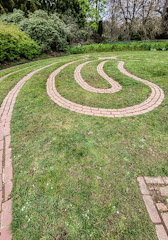
We found one part of the garden that we had not seen on earlier visits, probably because it is only open on Sundays. I believe that today was our first Sunday outing to the place. The section of the garden that is only open one day a week contains a circular maze. It consists of curving paths made of clay bricks set into the soil, and these are separated by low grassy ridges, In the centre of the maze there is a large spherical sundial, which was not working because the sky was overcast.

The maze was dedicated in 1981 by Robert Runcie (1921-2000), Archbishop of Canterbury from 1980-1991. It was created for two purposes. One was to celebrate Runcie becoming Archbishop, and the other to create what a notice described as:
“… a space for reflection, exploring the idea that we should all help each other solve the mystery of the maze of life.”
Well, whatever its intention, it is an attractive garden feature.

As for the weather, we were out of the house for about five hours, and it only rained for less than 15 minutes whilst we were driving to Greys Court. The maze there might in some way solve the mystery of life, but the Met Office needs to do a lot more work on solving the mystery of weather forecasting.