An evening prayer offering by the water of the River Ganges

THE WORD AARTI is from the Sanskrit language. It means ‘something that removes darkness’. In many pujas (Hindu ceremonies), an aarti is performed: it involves presenting a flame to appease the deity or deities. 


One evening, we were walking along the bank of the Hooghly (a part of the holy Ganges river that flows through Kolkata) just after sunset. We came across rows of plastic chairs facing the river at Babughat (one of the stepped landings used by people bathing in the river). Between them and the water there was a row of altars. We asked someone the reason for the chairs. We were informed that they were set up so that people could watch the daily Ganga Aarti, which was due to happen at 530 pm. Our daughter,  who had witnessed a Ganga Aarti at Varanasi, persuaded us to wait and watch the forthcoming aarti.


We sat down and joined the other spectators. While we waited, several hawkers walked along the rows of chairs, selling snacks of various kinds, both packaged and prepared to order (for example, jhal muri – puffed rice with flavourings). One hawker carried a tray on which a small lamp (a diya) was flickering. For a small cash offering, he blessed the ‘customer’ and placed some prasad (blessed food) into his or her right hand. Meanwhile, rotating spotlights and piped music added to the festive atmosphere. Gradually,  all the seats were occupied,  and many people were standing nearby on the sides of the ghat.


At 5.30 pm, priests dressed in shiny gold robes with wide sashes over their left shoulders began assembling, one in front of each of the altars. The latter were illuminated with hoops carrying brightly lit electric light bulbs. Then,  the ceremony began.


A pandit, dressed in white, speaking into a handheld microphone chanted prayers in Sanskrit. As he was doing this, the gold clad priests performed several visually exciting activities. These included moving containers emitting clouds of smoke. They swung them and moved them in circles, each man in synchrony with the others. After this, they did much the same thing with candelabras each carrying many small flaming oil lamps (diyas). These were then replaced by larger flaming lamps, each of which had handles shaped like cobras ready to attack.  After the balletic flame movements, the flaming lamps were carried down to the water’s edge. I could not see whether they were immersed in the river.


In addition to the movements with the flaming lamps, large conch shells were washed through with water, some of which was sprinkled on the crowd. The conches were also blown to produce a sound indistinguishable from the horns on the locomotives of the trains running every few minutes on the suburban railway track that was a few feet behind where the ceremony was being performed. 


I am very pleased we waited to watch the Ganga Aarti. Apart from being more spectacular than many theatrical performances I have seen, it was very moving. It is yet another example of how much more vibrant and fervent religious ceremonies are in India than they are in most parts of Europe.

The power of faith and a polluted river

HAPPY NEW YEAR!

ON CHRISTMAS MORNING (2024), we walked leisurely beside the Hooghly River (a stretch of the Ganges) between Prinsep Ghat and Eden Gardens, a distance of about 1.3 miles. With a good paved footpath,  this is a pleasant, picturesque, tree lined place to stroll.


Near Eden Park railway station,  there is a popular bathing ghat (a flight of steps leading into the water). From a  bridge that overlooks this, we watched people bathing in the river. Many of them immersed themselves fully several times. Others washed themselves. We saw people applying shampoo to wash their hair. I noticed a few men wading out into the water, carrying small trays containing flowers for puja. They threw these floral offerings into the fast flowing stream.

 The Ganges, of which the Hooghly is a part, is considered to be a place of great holiness by Hindus. They believe that bathing in this river conveys several benefits including: cleansing the soul; connecting with divine cosmic forces; washing away bad karma from the present or previous births; health giving and healing; and removing negativity. So, if you are a believer, bathing in the Hooghly/Ganges must be a good thing. But, must it?


Signs along the path on which we strolled exhort people not to dump rubbish in the river. But it is clearly obvious that these signs are not obeyed.  It is not only strollers’ rubbish that enters the sacred river. The river is being continuously polluted by sewage, industrial effluent, and decomposing corpses. This has resulted in high levels of toxic chemicals including heavy metals, and frighteningly large amounts  of bacterial and other microbial pathogens.


According to several official bodies, the Hooghly  has been deemed totally unsuitable for bathing. Yet despite this, there is no shortage of people entering the river to bathe, putting  their entire heads underwater, and washing themselves with this water that carries a real risk of causing ill-health. Such is the power of faith that the well-publicized risks of bathing in the river are outweighed by the belief that the water can only benefit the bather.

He took his own drinking water from India to England in 1902

THE MOST DISAPPOINTING tourist ‘attraction’ in Jaipur, is the City Palace. After more than 3 weeks travelling in Rajasthan, I can safely say that this royal palace is the least interesting place we have visited. Architecturally, it lacks the finesse seen in other royal palaces. In addition it is far less interesting historically.

Not wishing to seem too negative about the place, I will mention one item that did catch my attention. It is a huge silver vessel, a jar: possibly the largest silver jar that has ever been made. It and several others were made to carry water from the Ganges to England. The water was for the use of Maharaja Sawai Madho Singh II during his visit to England to attend the coronation of King Edward VII in 1902. Each of the jars could carry about 400 gallons of water.

While this is a fascinating exhibit, I do not believe that the palace is worth visiting. Its admission fees are exorbitant by local standards: minimum of £10 for non-Indians and minimum of £3 for Indians. Additional charges are levied to see certain exhibits within the palace compound. These prices must be compared with the admission fees for the palace’s far more beautiful and much more fascinating neighbour, the Jantar Mantar (non-Indians pay £2, and Indians pay 50 pence).

Blooms beneath a bridge in the city of Calcutta

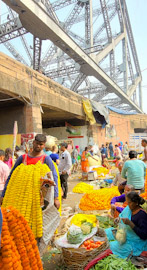
OVERLOOKED BY THE MIGHTY Howrah Bridge and straggling alongside the left bank of the Hooghly River – a stretch of the Ganges – you will find the colourful Mullick Ghat flower market. The best way to enter this busy marketplace is by descending a staircase at the southeast corner of the Howrah Bridge (completed 1943). As you go down the stairs, you will have to step aside to make way for men carrying enormous, heavy loads on their heads. Many of them make use of the stair rails to support themselves while they climb.

Part of the flower market (next to the railway track) is in the open air. The rest of it – the part nearest to the river – is under cover. Narrow, muddy passages run between the numerous stalls selling whole flowers, flower heads, individual flower parts, and petals. Also, flower garlands and other floral decorations are aplenty. A steady stream of people hurry in all directions along these paths. Many of them are carrying heavy head loads. Occasionally, they dump the head loads (containing floral items) at one stall or another. To an outsider, like me, the place seems like a chaotic but highly colourful environment. It is probably not as crazy as it seems, but highly organised.

The flower market was established along this part of the Hooghly during or before the 19th century (https://www.telegraphindia.com/my-kolkata/places/a-visit-to-mullick-ghat-flower-market-one-of-asias-largest-under-the-howrah-bridge-in-kolkata/cid/1892065). The ghat was built in 1855 by Rammohan Mullick in honour of his father Nimai Charan Mullick. It was constructed on the land where the old Noyaner Ghat had stood. The older landing stage had been made by Noyanchand Mullick in 1793.

The Mullick Ghat stands next to the Jagganath Ghat, which was constructed in 1760. Both ghats were important because they were used by pilgrims embarking on ships to transport them to the holy site at Puri in Orissa. Although it is not known for certain why the flower market was established beside these ghats, it is not unlikely that it was connected to the embarkation places for the pilgrims. And flowers play an important role in Hindu rituals.

Even though the market seemed extremely busy to me, it is apparently in decline. This was in no little way connected with the recent covid19 pandemic. If what I saw is a somewhat diminished version of the market, I can barely imagine what it must have been like a few years ago. Providing you are not allergic to pollen or crowds, a visit to the flower market is an exciting and beautiful experience.

From the Ganges to the shore and then back into the river

THE CERAMIC ARTIST, our friend Falguni Bhatt, works in Calcutta. While visiting her studio, she suggested that we visit Kumartuli in north Calcutta. Close to the Hooghly River – part of the Ganges – this district of the city is a warren of narrow lanes lined with the workshops of craftsmen who make Hindu idols out of the grey clay collected from the shores of the Ganges. We went there and were amazed by the huge amount of creative activity that confronted us.

Mounds of damp dark grey clay are carried on the heads of porters to the workshops. Others carry bundles of straw to the artisans. The straw is used to make armatures – these are shaped roughly like the finished idols. A completed armature, which can sometimes include supporting metal rods, looks sufficiently like the idol being created.

Clay is applied to the straw armatures. Gradually, the straw is hidden by the clay. The surface of the clay is either smoothed to resemble fine skin and/or inscribed to create bodily details – for example finger nails and the creases on the palms of hands or facial details or clothing and footwear. Creatures and objects associated with the depicted deity – for example, veenas and snakes – are created in the same way, starting with straw armatures.

The completed idols, which are frequently very detailed and of complex shapes, are left to dry and harden. The clay idols are not fired in a kiln.

Detailing on a clay idol

Later, the idols are painted according to tradition, and then decorated with elaborate costumes and jewellery. The jewellery is made from hand cut cardboard often with sequins and mirrors applied. A small section of Kumartuli is dedicated to workshops creating these intricate, attractive ornaments.

Each of the clay idols is an exquisite work of art. Each of them displays evidence of the highly skilled workmanship that created them. They rival the superb ancient Hindu stone carvings that can be found carefully displayed and conserved in museums. Yet, each of these clay masterpieces is destined to have but a very short life.

The idols are created in Kumartuli for use in important Hindu festivals such as Durga Puja, Kali Puja, and Saraswati Puja. We saw idols being prepared for the last mentioned. Most of the idols being created include the stringed musical instrument played by Saraswati – the veena. Her puja is to be held next in February 2024.

During these ceremonies, the carefully crafted idols – fully painted and decorated with elaborate hand made ornaments – are dropped into the Ganges. When I expressed my surprise at hearing about this, Falguni said something like:
“Life is transient.”

Feeding the spirit of the deceased by the River Ganges in Calcutta

WHILE WALKING ALONG the well-tended riverside path that runs alongside the Ganges (Ganga) in Calcutta, we reached the Gwalior Monument – a tall tower overlooking the river. Around this edifice, which was built by the British in 1847, we saw something we had never seen before.

A craftsman was shaping the stiff dark grey mud from the holy Ganges into rectangular slabs with numerous small regular depressions. The finished product looked a bit like an oversized old fashioned Casio calculator. There were quite a few of these to be seen on the flat ground surrounding the monument.

Small groups of men, often with shaven heads, congregated around these mud slabs. The men were chanting prayers and placing grains of rice, sweets,and other food substances into the depressions in the slabs. We asked a bystander what was going on, and he explained it to us in perfect English.

The groups of men were performing ‘shraddha’ on the eleventh day following the death of a family member. Our informant was also attending a shraddha being held because of the recent death of a friend or relative. The son of the deceased was performing the shraddha puja. I have read that it is very important for Hindu couples to have a son because only a son can do shraddha for his parents

On the eleventh day following death, the spirit (atma) of the dead person is still in contact with his or her loved ones. The food being placed on the mud slabs will not, of course, be physically touched by the spirit, but it is believed that it will sustain him or her on the next stage of its eternal journey. A similar shraddha is performed on the first death anniversary and, sometimes, at other times.

Our informant told us that he was not entirely clear about the deep significance of shraddha, but he was happy to believe in its necessity. It was, he felt, an important part of the passage of life.

The eleventh day and one year ceremonies are observed by many Hindus, but until today, neither my wife nor I had ever come across these mud thalis for feeding the spirit of the deceased.

A year after my father-in-law died, there was a special ceremony in which I played an active role, but it was completely different from what we saw next to the Gwalior Monument.