
Looking at you
I wonder if you have food for me
Only asking

Looking at you
I wonder if you have food for me
Only asking
IT WAS DIFFICULT to believe that the UK is suffering a cost-of-living crisis and other economic difficulties when we entered Kingly Court on a Wednesday evening in late October 2025. Each of its over 20 restaurants and bars were almost full of diners and drinkers. And many of these establishments are not for those on a tight budget.
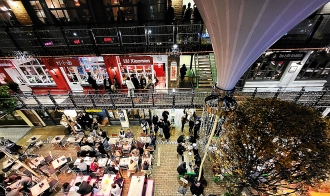
Kingly Court is a three-storey building surrounding a large rectangular courtyard filled with tables and chairs. The courtyard is surrounded by galleries, each of which is flanked by several eateries. There are also restaurants and bars on the ground floor. The place was literally buzzing when we arrived there at about 7.30 pm.
Kingly Court is bounded by Kingly Street, Ganton Street, and Carnaby Street. I can not determine when the place was built for its present purpose as a mecca for hungry people. In the 1890s, the block in which Kingly Court now stands was occupied by buildings of various sizes that surrounded an open space. The redevelopment of Kingly Court was carried out by Rolfe Judd Architects. The initial aim was:
“… the refurbishment and extension of four buildings, with the aim of creating unified, high-quality office spaces on the upper floors while retaining the bar and restaurant uses of the ground floor and basement.” (www.rolfe-judd.co.uk/planning/projects/kingly-street-2/)
However, since that project was undertaken, the Court’s main purpose has become a centre for restaurants and bars.
There is a wide range of food choice available at Kingly Court. There, you can feast on dishes from a multitude of different cuisines from around the world. And it seems to be very popular despite the financial problems afflicting the UK at present.
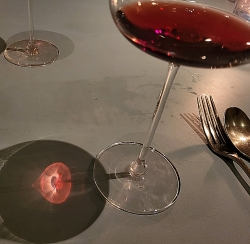
When out dining
Some like red, others prefer white
For quaffing with food
IN RECENT YEARS, the seaside town of Margate in Kent has become much more of a “trendy” destination than it used to be. From being yet another coastal resort, it has become a magnet for those interested in contemporary art. This is because of the presence of the Turner Contemporary Gallery, Tracey Emins’s gallery, and the Carl Freedman gallery … to mention but a few places. With the influx of tourists with sophisticated tastes, the town has become home to a range of restaurants, which is more varied than in many other seaside towns in north and east Kent.
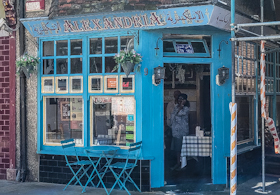
About 6 years ago, a husband and wife from Cairo (Egypt) set up a tiny restaurant on a corner plot in the old centre of Margate. It is called Alexandria Café. The owners chose the name not because they come from Alexandria, but because like the Egyptian city, Margate is by the sea.
Only open on Fridays, Saturdays, and Sundays at present, this restaurant serves beautifully prepared, tasty Egyptian dishes at very reasonable prices. We tried koshari, falafel, baba ganush, pickled tomato salad, and mint tea. Although these are all without meat, non-veg dishes are also available.
The tiny, comfortable eatery is decorated with photographs of Egyptian film stars. A small television screen was showing old Egyptian films.
A few doors away from the lovely Egyptian cafe, there is an ice cream parlour. What makes it special is that in 1866, Karl Marx stayed in the building.
We did not try the ice cream, but I can safely say that of all the places I have eaten in Margate, having visited the place many times, Alexandria is the best.
WE ENJOY ROAMING around rural England. However, eating in country pubs and restaurants can often be a bit ‘hit and miss’. In June (2025), we visited Flatford Mill in Essex, which has important connections with the artist John Constable and his family. We stopped to buy a drink at a refreshment stall, and asked the young man serving if he could recommend a pub where we could get a good lunch. He told us that The Marlborough in nearby Dedham was good; it is his ‘local’. He said that we should try their shepherd’s pie.
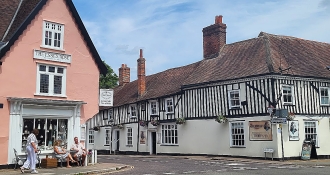
A short drive brought us to Dedham, and The Marlborough was easy to find. Situated on a corner plot almost opposite the parish church, the pub is a half-timbered edifice built mainly in the sixteenth century. Originally, it was built as a clearing house for local wool merchants. Inside the ground floor of the pub, there are many old timber beams to be seen.
Despite it being a hot day, I ordered the shepherd’s pie, which was truly excellent. It was accompanied by beautifully cooked carrots, parsnips, and cabbage. My wife ordered chicken parfait, and that tasted superb. The staf were friendly and the service was impeccable.
I am grateful for the recommendation we were given. Later, when mentioning how good it is to various people we met in Suffolk and Essex, they all knew of the pub and held it in high regard.
GENERALLY, I AM NOT A FAN of food courts. Many of them in England are merely a collection of branches of well-known fast-food chains (such as KFC, McDonalds, Pizza Hut, Subway, and Burger King). A notable exception to this is a food court in Trinity Market in Hull, which visited in April 2025. On 9 May 2025, we visited Peckham in south London, having just viewed an exhibition in nearby Camberwell.

While strolling along Peckham’s busy Rye Lane, we came across the entrance to Rye Lane Market. After entering it and walking along an arcade lined with shops, we arrived in a large, covered area filled with food stalls: a food court. Unlike many other food courts, the food outlets were not branches of well-known chains. Instead, there were stalls catering to the multi-ethnic local population. We sat down at a table that was surrounded by stalls serving Mexican, Carribean, Colombian, and other many cuisines. We ordered the set lunch offered by a small Peruvian kitchen. As first courses, we ate cold boiled potatoes dressed in a red pepper flavoured mayonnaise and a delicately flavoured beef soup. These were followed by a fried rice dish containing chicken, pork, and smoked sausages, and another consisting of a whole fish beautifully fried, served with lentils, rice, and a salad containing onions, lime juice, coriander, and tomatoes. Freshly prepared and reasonably priced, everything was delicious.
There were more stalls serving food from other countries, mostly Latin American and African. One stall offered a range of vegetarian Indian dishes, including a snack, dabeli, that is popular in Kachchh (once an independent state, and now part of Gujarat). The lady working there told us that she is from Rajkot in Gujarat. When we mentioned to her that we have always thought that dabeli is a dish from Kachchh, she said it was Gujarati, but added that:
“It does not matter because the people of Kachchh are our brothers”.
Our first visit to Rye Lane Market’s food court has whet our appetites for further visits. There are so many enticing dishes on offer that I feel sure that we will venture across the Thames more often to sample the fare offered in that food court.
OPPOSITE THE APOLLO Hospital in the Thousand Lights district of Chennai, my eyes alighted on a sign I was least expecting to see in southern India. The sign adorned the panel beneath the eaves of what resembles a Swiss chalet. It read “Swiss Hütte”. It is a restaurant. It was closed when I first spotted it, but we returned the same evening when it was open. We decided that it was such an unusual find that we had to eat something there.

The restaurant was founded about 19 years ago by a chef Joe Lobo. He lived in Switzerland for 25 years, working as a prize-winning chef. On returning to India, he established the Swiss Hütte restaurant. It is located in the verdant grounds of his family’s home.
The restaurant has an extensive menu with dishes inspired by various national cuisines, both European and Asian. We ate at the Hütte several times, and everything we ate was delicious and perfectly prepared.
We asked Joe if he ever served Swiss food. Occasionally, if given sufficient notice, he will make fondue. However, in his opinion, Swiss food is bland and tasteless. These adjectives can not be used to describe what Joe cooks in the kitchen for his guests. Eating Joe’s food, it is easy to see why he has won prizes for his cooking.

HYDERABAD IS FAMOUS for its biryanis. One restaurant that is well-known and highly rated is Shadab, which is not far from the Char Minar in the centre of the old city. We have visited it on previous visits to Hyderabad and thought highly of its biryanis. Today, in late January 2025, we ate a mutton biryani. It was certainly very good, but not nearly as excellent as one we ate in Surat last year and another we ate at Berhampore (West Bengal) a few days ago. However, the best biryani I have eaten to date was a Moplah style biryani served at Paragon in Calicut (Kerala). Blending Arabic and Keralan flavours, this biryani, which we ate more than 20 years ago, was memorably fragrant and tasty: a symphony of flavours.
THE MEHRANGARH FORTRESS rests on massive rock overlooking the city of Jodhpur in Rajasthan. At night the walls of the fort are brightly illuminated and can be seen from many places in the city. The older districts of Jodhpur cling to the lower slopes of the rock upon which the fort rests. To take advantage of the splendid views of the fort, many restaurants in the old parts of the city are located high above street level on rooftops. Some of these eateries are as much as five storeys above street level, and none of them have lifts to reach them.

One rooftop restaurant, which we have visited twice, is on the second floor of an old building. Called Indigo, we have eaten excellent Rajasthani meat dishes there, and were looking forward to visiting it a third time today (the 3rd of December 2024).
At about 4 am. on the 3rd of December, I awoke briefly and noticed that there was no electricity in the hotel and the alley next to it. By 7 a.m., the electrical supply had been restored. At breakfast, which is always served on the fourth floor rooftop of our guest house, Mr Manu, the owner of the place, told us that there had been a fire in the kitchen of the Indigo restaurant, which we had begun to enjoy. Burn marks were clearly visible from our guest house’s rooftop.
The reason the power had failed early in the morning was that the Indigo restaurant is located close to an electricity transformer, and the authorities were concerned that the fire might spread ⁷to it. Luckily, it did not.
After breakfast, we decided to walk to Indigo to offer our sympathy to its charming owner. When we arrived, we found his wife and a few other women seated in the restaurant’s ground floor courtyard. Each of them had very sad expressions on their faces. I felt that it was like visiting the bereaved soon after a loved one had passed away. They asked us to sit with them, and soon after that, the owner arrived. We told him how sorry we were about the disaster which had befallen him and his family. I believe that he appreciated our brief visit.
Had the fire not happened, we would have eaten all the rest of our evening meals at Indigo during the remaining few days of our stay in Jodhpur. I hope that Indigo will recover soon and that anyone who happens to read this and is visiting Jodhpur will eat at this excellent restaurant.
BITTER TASTING, WATERCRESS is a member of the cabbage family (Brassicaceae). It is rich in health-giving nutrients. In Britain, it is grown in fast flowing chalk streams. It used to be grown in streams on Hampstead Heath, and there is a row of cottages that formerly housed watercress workers on Hampstead’s Willow Road. Another place where it was once grown is the Oxfordshire village of Ewelme.
A trout stream runs past Ewelme. It was here in the late 19th century that the Smith family from the village of South Weston, not far from Ewelme and the larger town of Watlington, began cultivating watercress in the stream. The watercress beds stretch for about ¾ mile along the stream, and have now been preserved as a nature reserve. By the beginning of the 20th century, the watercress beds at Ewelme were flourishing, producing large crops. Hampers containing 56 lb of watercress were carried by wagon to Watlington railway station, and from there they were transported by train to the Midlands and Manchester. The cress from Ewelme was highly regarded all over the country.

The Smith family kept the watercress beds going until the mid-1960s, when they were sold to new owners. The beds were kept going but became increasingly less viable economically. They were closed in 1988. However, visitors to Ewelme can see the two rows of rectangular beds, each enclosed by low partitions. A boardwalk runs along the length of the beds, separating the two rows. The stream flows through the beds. What can be seen now was the result of much restoration work carried out by local volunteers. A small visitors’ centre stands next to the beds. Near the beds, there is a house called Watercress Cottages, where a member of the Smith family used to live.
Ewelme is an attractive village with many historic buildings. A visit to the watercress beds, now the home of waterfowl, is an unusual experience and well worth making.
 yamey
yamey 