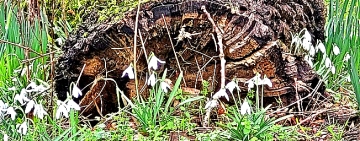
Skies may be grey
The white snowdrops are in full bloom
Spring is in the air

Skies may be grey
The white snowdrops are in full bloom
Spring is in the air
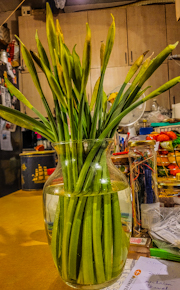
When British supermarkets begin selling bunches of daffodils at remarkably low prices, this is a good sign. It means that we are heading into springtime, and, I hope, longer days and better weather.
THE CITY OF Indore has a population of about 3.1 to 3.5 million. Of these, about 17750 are Roman Catholics. Indore is a diocese in the Ecclesiastical province of Bhopal. The diocese was established in 1952, having formerly been Mission Sui Iuris of Indore established in 1931. There are well over 12 Catholic churches in Indore.
It so happens that the hotel where we are staying in Indore (in December 2025) is a few hundred yards away from the Kanchanbagh Roman Catholic cemetery, which we took a look at today.
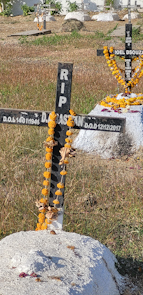
The older graves are raised mounds not too dissimilar from Sephardic gravestones. However, each grave is surmounted by a cross. What interested me was that on many graves there were fresh flowers. There is nothing surprising about this except that many of the flowers are ‘malas’ (garlands) such as are commonly found draped around Hindu effigies and shrines.
At the far end of the cemetery there is a large hall in which funeral masses are held. There is a bas-relief depicting the Last Supper at the altar within the hall.
On one side of the hall, there are the newer graves. These consist of flat rectangular slabs on which names are listed. These are the names and dates of the people buried beneath a slab. The idea is that several people will be interred beneath each slab, and their names recorded on it. No doubt, the new system is designed to make efficient use of the burial ground. I wondered about this because there seemed to be plenty of unused land in the graveyard.
I am pleased that we entered the cemetery because seeing it made me become aware of the surprisingly large number of Roman Catholics in Indore.
HAPPY NEW YEAR TO ALL OF MY READERS
I HOPE THAT 2026 WILL BRING YOU CONTENTMENT, GOOD HEALTH AND PROSPERITY

WORDS ARE INADEQUATE to describe the magnificent display of colours that can be seen in the Isabella Plantation at Richmond Park at the end of April and the start of May. I have written about this lovely garden many times before (e.g. https://adam-yamey-writes.com/2021/05/21/a-floral-fireworks-display/) and outlined its history, Do not take it from me that this display of flowering plants (including azaleas, rhododendrons, camelias, bluebells, and much more) is unbelievably beautiful, but hurry there and see it for yourself!
AT THIS TIME OF the year (April), many walls in London are partly hidden behind the exuberant bunches of flowers sprouting from the twisted trunks of Wisteria plants.

The Wisteria was originally grown in China, Japan, Korea, Vietnam, southern Canada, the north of Iran, and in the east of the USA. The first Wisteria plant to be grown in Britain was imported from Canton in China in 1816, This was a Wisteria sinensis plant. In 1830, another variety was introduced from Japan. Both varieties have both mauve flowers and white flowers.
In and around London’s Kensington, where I live, although both colours of flower can be seen, the mauve outnumbers the white.

Shining sun
Magnolias are blooming again
Welcome back springtime
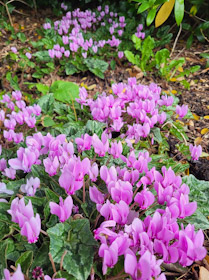
Even though it is October and the leaves are changing colour on the trees before being shed by them, cyclamens are blooming as if spring has just arrived. Nature never ceases to amaze.

Autumn blooming
In an English country churchyard
Roses I believe
THE GARDEN MUSEUM is next door to London’s Tudor Lambeth Palace and close to Lambeth Bridge. The museum has its own gardens – one within an enclosed courtyard, and the other, containing several glasshouses, outside the museum. Next to the latter, there is yet another garden, the St Mary’s Gardens. This slender garden, filled with a wonderful range of flowering plants, was created in 1932, and improved considerably in 2008.

In the centre of this almost rectangular garden there is a circular water feature, decorated with mosaics. This is surrounded by several smaller mosaics, each one depicting fruits and animals. From the northern end of the garden, you can catch glimpses of the Houses of Parliament and the towers associated with them.
Flanked by the busy Lambeth Road that leads to Lambeth Bridge, this garden is a pleasant oasis in one of the most traffic-infested parts of London.
LOCATED IN THE SOUTHWEST part of Richmond Park is one of London’s floral miracles: This year (2024), The Isabella Plantation is almost at its colourful best now (we visited it on the 12th of April) – a little earlier than usual. The camellia, azalea, and rhododendron bushes have exploded into flower alongside many other flowering plants. As you walk through the plantation, clouds of different coloured flowers seem to burst into view. Often two bushes of the same kind, but with different coloured flowers, have been planted together so that their blooms mix together to form an exciting ‘tapestry’ of flowers and contrasting hues.
During our latest visit, we were fortunate to have arrived at the right time to see some bluebells, but they were not close enough to each to seem like a carpet. However, they pale into insignificance in comparison with the flowering bushes, which have been skilfully planted so as to provide the viewer with three-dimensional, multi-coloured, natural works of art. On our recent walk around the Plantation, the morning sun (between 745 and 900 am) was shining brightly, enhancing the vividness of the flowers’ colours. Filtering through the trees, the sunlight created splashes of light on the flowers, producing an interestingly dappled effect. And some petals had sunlight shining through them, creating a lovely sight.

There are three ponds in the Plantation. The largest is Peg’s Pond. Next largest and at a higher altitude is Thomsons Pond, which is surrounded by a few flowering bushes. The most magnificent pond is the smallest of the three. It is the Still Pond. It is almost surrounded by azalea and rhododendron bushes. When they are in flower, their incredibly exuberant blooms are reflected in the mirror-like water of the Still Pond. This amazing effect must be seen to be believed. We saw a few mandarin ducks in the pond. As they swam, they created ripples on the surface of the pond. The gentle undulations of the water surface create interesting shimmering reflections of the firework-like flowers on the bushes next to the pond.
As on previous occasions, we parked in the free Broomfield car park, which is a short, pleasant walk away from the Plantation. Next to this carpark there is a café, which sells snacks at rather outrageously high prices. Optimistically, I hope that some of the profit goes to maintaining the Plantation.
Seeing the resplendent display of colour in the Plantation provides a pleasant distraction from the many disturbing things that are happening in many places in the world beyond the boundaries of Richmond Park.
 yamey
yamey 