Taramosalata and going Greek in London’s Charlotte Street

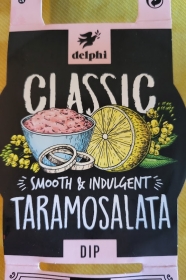
WE OFTEN BUY taramosalata (taramasalata) from the Athenian Grocery in London’s Bayswater district. They sell a brand called Delphi. It comes in a small plastic tub surrounded by a cardboard sleeve. Within the sleeve, there is a brief history of the company. The story begins as follows:

“It all started when our dad Tony started working in his family fruit and veg store on Goodge Street, London…”

Reading this brought back memories of shopping with my mother in the early 1960s. Being keen on Mediterranean dishes, we used to visit the shop in Goodge Street, mentioned above. Round the corner from this store, there was another Greek food shop, Hellenic Stores, in Charlotte Street. My mother preferred this shop, and only went to the one in Goodge Street if what she wanted was unavailable in Charlotte Street. It was close to the now long-since closed Schmidt’s German restaurant. Neither of these shops exists anymore.

Back in the 1960s and while I was at University College (until 1982), there were several Greek restaurants in Charlotte Street. These included Anemos, which was famous for its lively party atmosphere; Andreas, which I never visited, and is now called Ousia; the White Tower, which opened in 1938, and was highly regarded for its food, but is now closed; and Venus. My uncle, who worked in Bloomsbury, was fond of lunching there, and invited me to join him ther occasionally. It was less frenetic than Anemos, but pleasanter.
The reason that there were, and still are, many Greek or Greek Cypriot restaurants in and around Charlotte Street is more likely related to the huge demand for eateries in the busy area than to where Greek communities live in London. In London, the highest concentrations of Greeks (not Cypriots) is in Hyde Park, Regent’s Park, Chelsea and Kensington census districts. As for Greek Cypriots in London, some of whom run Greek restaurants, they are mostly living in Enfield, Haringey, Barnet and Hackney. In particular, they often live in Southgate, Palmers Green, Upper Edmonton, Cockfosters, Lower Edmonton, Tottenham North and Tottenham South. The Greek restaurants in the Charlotte Street area cater for the large numbers of students and office workers in the districr.

Returning to the story of the Taramosalata maker, Delphi, Tony decided to manufacture Greek food products. So, in 1984, he founded Delphi, which (according to the cardboard sleeve):

“Delphi is proud to be among the first UK producers of authentic houmous, taramosalata and many flavourful dips and salads …”

And the taramosalata they make is truly delicious.

Women with many heads on canvases at an art gallery in central London

TODAY, WE VIEWED an exhibition of paintings by an artist born in India, who spent most of her life in the British Isles. The artist is Gurminder Sikand (1960-2021), who was born in Jamshedpur, but moved to the Rhondda Valley in South Wales with her parents in 1970. Her artistic training was first at the Cardiff College of Art and Design (in 1979-80) and then at the City of Birmingham Polytechnic (now Birmingham City University), where she was awarded a fine art degree. In 1983, she and her husband moved to Nottingham. Her work began to attract wide attention after one of her pieces was selected as the winner of the East Midlands Art Prize by the South African artist Gavin Jantjes.

In an obituary written by her husband, published in thegauardian.com on the 14th of February 2022, it was noted that her work:

“… was characterised by images of strong women. This was true of her many self-portraits, her paintings influenced by Indian folk art, her watercolours of women hugging trees (inspired by the Chipko anti-deforestation movement), and latterly her drawings of muscular female figures whose physiques reflected Gurminder’s workouts at her city-centre gym in Nottingham.”

The paintings we saw today (22nd of May 2024) at the Maximillian William gallery in London’s Fitzrovia were some of Gurminder’s earlier works, created between 1986 and 1992. Most of the 19 works include depictions of women. All of them are slightly mysterious, but also eye-catching. Many of them include women with several heads. I wondered whether in creating these she was thinking about Hindu deities that are often shown as having many arms. As far as I am aware few, if any, Hindu deities are shown in images as having more than one head, but seeing Gurminder’s women with many heads made me think about the multi-limbed deities in Hindu imagery.

Trees also figure prominently in many of the paintings we saw. Regarding this and her painting style, the gallery’s press release has this to say:

“Images of women drawn from Indian mythology recur throughout Sikand’s work. Her interest in the figure of the goddess – particularly the Hindu goddess Kali, who both destroys and creates the world anew, and is often pictured with a garland of human heads – is evident in her depictions of women metamorphosing into nature. In Sikand’s paintings, women are seeds buried in soil, hang on tree branches to provide shelter, or are even the earth and sky themselves. These amorphous relationships between the figure and nature were further inspired by the Chipko environmental movement, which began in north India during the 1970s, when villagers – mostly women – embraced trees at risk of deforestation, a protest that also highlighted their primary role as caregivers. Sikand’s female figures are often portrayed as strong: appearing resolute with multiple heads or acting as protectors over her landscapes.”

Although Gurminder left India when she was only 10 years old, and was then immersed in British life, culture, and education, her Indian heritage never deserted her, and is expressed in her wonderful paintings. I enjoyed viewing this well-displayed exhibition, and I recommend seeing it before it ends on the 29th of June 2024.

A charming chapel preserved

WHEN RUDYARD KIPLING (1865-1936) died in London’s Middlesex Hospital, his body was placed in the hospital’s chapel before being taken to be cremated at the Golders Green Crematorium, Charles Carrington wrote in his biography of Kipling that just as his coffin, draped with the Union Jack flag, arrived at the crematorium:

“… the followers of Saklatvala, the Indian Communist who had been cremated just before Rudyard Kipling, were singing the Red Flag.”

Kipling was not a sympathiser of Communist ideas and ideals.

Middlesex Hospital in the Fitzrovia area of London, where Kipling breathed his last, no longer exists. Founded in 1746, it provided medical care on a square plot of land bounded one one side by Mortimer Street between 1757 and 2005. In 2008, almost all of the hospital was demolished. The only part of the complex, which was preserved, is the Fitzrovia Chapel, in which Kipling’s body reposed briefly. Between 2012 and 2016, a new development, Fitzroy Place, consisting of flats and offices, was constructed on the hospital’s site.

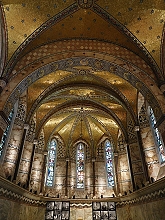
The small Fizrovia Chapel, beautifully restored, stands in a small garden in the middle of the new development, dwarfed by the buildings around it. This gem of a Victorian ecclesiastical construction was designed by the Gothic Revival architect John Loughborough Pearson (1817-1897) and was ready for use by 1892 (although the interior decoration was not fully completed until 1929). The chapel’s spectacular colourful interior must be seen to be believed. Its magnificent appearance is the result of skilful use of mosaic, marbles of different types and colours, and amazing decorative motifs inspired by early Italian, Byzantine, and Moorish architecture. Some of the metal lampshades that hang from the decorative ceiling seemed to have been influenced by the types of lamps typical of Turkish tradition.

The chapel is maintained by The Fitzrovia Chapel Foundation. It is open on most Wednesdays for public viewing as well as during the occasional exhibitions and concerts that are held within it. This charming place is also available for hire for weddings, fashion shoots, book launches, and other events.

Until we attended an exhibition in the Fitzrovia Chapel in late May 2022, we had no idea that this small architectural gem existed. Along with nearby All Saints in nearby Margaret Street, the Fitrovia, a treasure chest with its sparkling golden ceiling, should not be missed by lovers of Victorian architecture and/or fine mosaic work  (as well as masterful use of inlaid stonework).

Wandering along Warren Street

W1

Warren Street is a station on the Northern and Victoria Lines of London’s Underground network. Situated at the intersection of Tottenham Court Road and Euston Road, both important arteries, Warren Street itself is comparatively small and of minor significance in the greater scheme of things. Be that as it may, this short street, which runs south of and parallel to Euston Road, has had some importance in my life.


When the Underground Station was opened in 1907, it was named ‘Euston Road’. In 1908, it acquired the present name.  By the time that I began using the station regularly (in 1970), the Victoria Line had been serving the station for two years. Warren Street itself was built in the late 18th century as part of the Fitzroy Estate. It was named after Anne Warren (1737–1807), who married Charles Fitzroy (1737-1797), First Baron Southampton.

W6

In the early 1970s, when I was studying at University College London (‘UCL’), one of my fellow students on my BSc course in physiology was a young Indian girl, Lopa, who is now my wife. She spent a couple of years living at the International Students House (‘ISH’) which faces Great Portland Street Underground Station. She and other Indian students introduced me to really good Indian food. This was served at the now no longer existent Diwan-i-am restaurant on Warren Street. It was here and at other nearby restaurants, such as Diwan-i-khas, Lal Qila, and Agra, that food was cooked by Indians and Pakistanis rather than by Bangladeshis, who operated the majority of so-called Indian restaurants in the UK. While Bangladeshi cuisine might be excellent, much of the ‘Indian’ food cooked by Bangladeshis is less satisfactory.

W3

When the Diwan-i-am was in business, so were many car dealers who had their premises on Warren Street. These have long since disappeared. One business that still exists and predates the Diwan-i-am is Tiranti, an important supplier of, to quote their website: “…materials, equipment and tools to sculptors, modelmakers, mouldmakers, designers, prototypers, woodcarvers, stonecarvers, specialist plasterers, building picture and furniture restorers, potters and ceramicists.” Giovanni Tiranti started this enterprise in High Holborn in 1895. The company first began using premises near Warren Street in 1945. I am not sure when the Warren Street shop opened, but it was about 20 years ago at least. I never purchased anything there but my late uncle S, an engineer by profession and a keen sculptor in his spare time, was a regular customer.


I studied at UCL for twelve years. During the last five of these, I was studying dental surgery at the now, sadly, no longer existing Dental Hospital. Warren Street Station was the most convenient place from which to reach the Dental School from my home in Golders Green. It was a few yards from the station to the passage that led from Tottenham Court Road into Mortimer Market, where one part of the Dental Hospital was housed. In those days, the passageway was flanked by an official Iraqi Tourist Office. I used to visit this occasionally to look at the fine exhibitions of photographs shown there. The staff, no doubt agents of the late Saddam Hussein, were friendly. Once, they gave me a gift of four LPs of Iraqi folk music. Many of the ancient sights in the photographs might well now have suffered damage during the troubles that afflicted Iraq long after I had become qualified as a dentist.

W2

There were several photography suppliers’ shops on the stretch of Tottenham Court Road near Warren Street. Their windows displayed a huge range of camera bodies and lenses. I bought my first SLR camera at one of these shops. They have mostly gone now. So also has Sterns. This electrical shop was well-known for its superb stock of African music LPs. Some years after I had left UCL finally (in 1982), Sterns, which opened in the early 1950s, moved from its somewhat aged premises on Tottenham Court Road to a newer shop around the corner on Euston Road. This has also disappeared, but Sterns still goes on in the form of an on-line firm.


One rainy early Monday morning, I emerged from Warren Street Station, and walked to the Dental School. The streets seemed emptier than usual. When I arrived at the school, the doors were locked closed. I was puzzled. Then, I bumped into another student, also soaking because of the weather. Shamefacedly, we realised that we had turned up on a bank holiday.

W4

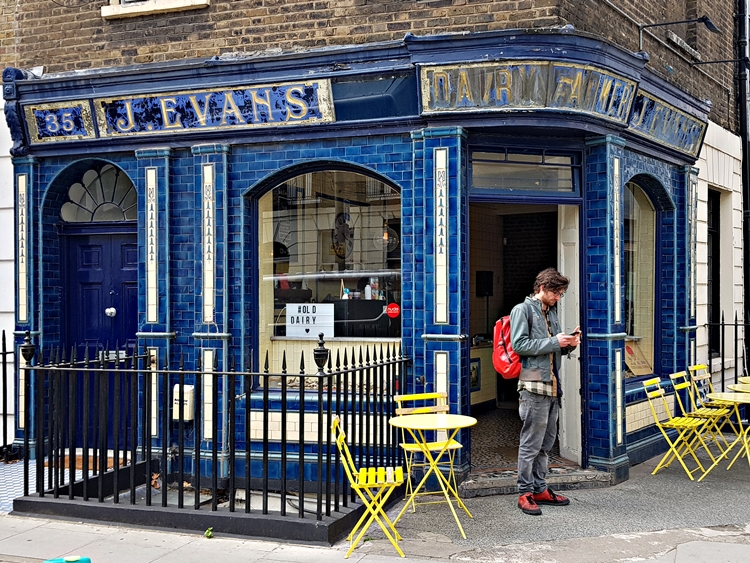
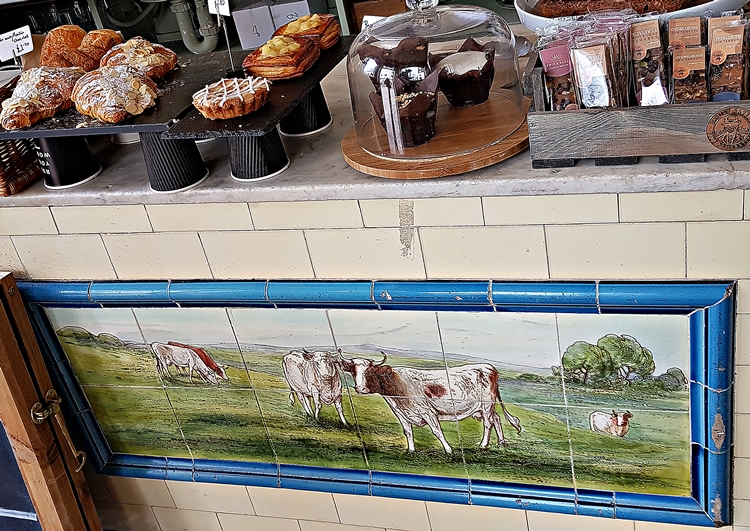
Some time during the mid to late 1970s, a branch of McDonalds opened on the corner of Warren Street and Tottenham Court Road. Occasionally, I used to pop in there for a snack on my way home. Now, some decades later, Warren street is lined with ‘trendy’ eateries, one of which is housed in an old dairy on the corner of Conway Street. Much of the original tilework of the former dairy of J Evans has been preserved. Although there are many newer buildings on Warren Street, a few of the original late 18th century structures have survived.

W5

While Warren Street is not worthy of a long detour, it provides much more than a name for an Underground Station.