ON CHRISTMAS MORNING (2024), we walked leisurely beside the Hooghly River (a stretch of the Ganges) between Prinsep Ghat and Eden Gardens, a distance of about 1.3 miles. With a good paved footpath, this is a pleasant, picturesque, tree lined place to stroll.
Near Eden Park railway station, there is a popular bathing ghat (a flight of steps leading into the water). From a bridge that overlooks this, we watched people bathing in the river. Many of them immersed themselves fully several times. Others washed themselves. We saw people applying shampoo to wash their hair. I noticed a few men wading out into the water, carrying small trays containing flowers for puja. They threw these floral offerings into the fast flowing stream.
The Ganges, of which the Hooghly is a part, is considered to be a place of great holiness by Hindus. They believe that bathing in this river conveys several benefits including: cleansing the soul; connecting with divine cosmic forces; washing away bad karma from the present or previous births; health giving and healing; and removing negativity. So, if you are a believer, bathing in the Hooghly/Ganges must be a good thing. But, must it?
Signs along the path on which we strolled exhort people not to dump rubbish in the river. But it is clearly obvious that these signs are not obeyed. It is not only strollers’ rubbish that enters the sacred river. The river is being continuously polluted by sewage, industrial effluent, and decomposing corpses. This has resulted in high levels of toxic chemicals including heavy metals, and frighteningly large amounts of bacterial and other microbial pathogens.
According to several official bodies, the Hooghly has been deemed totally unsuitable for bathing. Yet despite this, there is no shortage of people entering the river to bathe, putting their entire heads underwater, and washing themselves with this water that carries a real risk of causing ill-health. Such is the power of faith that the well-publicized risks of bathing in the river are outweighed by the belief that the water can only benefit the bather.
ACROSS THE MAIN ROAD from the 16th century Hazira Maqbara – a mausoleum – there is a small stepwell – the Hazira Vav. We have visited it before but never saw it in use.
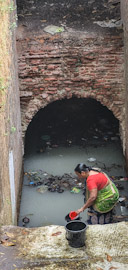
A flight of tiled steps leads down to the water in the stepwell. To put it mildly, the water looks filthy and completely uninviting.
At the top of the stairs, there is a small Hindu shrine. The small courtyard surrounding the top of the staircase is decorated with coloured images depicting various Hindu deities. A few coconuts hang between them. These nuts are considered auspicious by Hindus. At our Hindu wedding in 1994, coconuts were included on the complex ceremony, which lasted several hours.
While we were looking at the well, a lady in a sari and her husband arrived. The woman descended the steps to the waters edge. Her husband explained to us that she was suffering from itchiness and that the curative waters of the well might help cure her condition.
The lady picked up one of the bucket on the step beside the water, and filled it from the well. Then, she began dowsing herself with the water. Fully dressed, she poured several buckets of the unwholesome looking water over her whole body.
Having watched this, we felt that it was unlikely that the water itself would heal her, but more likely, it was her faith in its curative properties that might have helped. Having seen the water, my thought was that if one bathed in the well, it is likely that you would end up less healthy than before you entered it.
I HAVE PASSED IT often, and have long been curious about it, but until today I have not bothered to find out about it. I am referring to a small chapel on the corner of Kensington Place and Newcombe Street, which leads to the south side of a space where a weekly farmers’ market is held (on Saturday mornings). Called the Bethesda Baptist Church, its congregation was established in 1866. The building resembles a style commonly used in the late 18th century. According to a history of Kensington Place (www.hillgatevillage.com/the-facts), the chapel was constructed in about 1824. Over the years, it has been used by various Baptist sects. Currently, it is the home to a congregation, who believe in Restricted Communion and Particular Redemption. This sect was founded in 1866.
Bethesda Chapel, Kensington
Currently, I am reading about a clergyman, Conrad Noel (1869-1942), who believed fervently that the church should be both democratic and all-embracing. So, it was with some interest that I stumbled across a chapel in which people believing in ‘Restricted Communion’ gather to worship. The sect is a branch of the Strict and Particular Baptists, who follow the decrees of High-Calvinism. If you are finding this a bit difficult to follow, then you are not alone. Let me take a stab at giving a simple explanation of what the congregation in the Bethesda Chapel believe: a set of beliefs that are new to me. One website that seemed to clarify them well is www.sbhs.org.uk/membership/strictbapt/, from which I have attempted to extract the following information.
‘Strict’ refers to ‘restricted communion’. Unlike many branches of the Christian Church, which permit anyone who believes and loves Jesus Christ to partake in Holy Communion, the Strict and Particular Baptists believe that Communion should only be offered to those “who have been baptised by immersion as believers”. The above-mentioned website explained:
“Strict Baptists see baptism as a rite by which believers testify to their faith in Christ, and associate it with church membership. The Lord’s Supper is for those who have joined the church in this way.”
As for ‘particular’, this lives up to the common meaning of the word. The Strict and Particular Baptists believe that:
“…Christ died to make certain the salvation of a definite number of people whom he has purposed to save, rather than to make possible the salvation of an indefinite number of people who might choose to believe.”
That is, only the ‘select’ few, known as the ‘Elect’, will be saved. The sect does not accept infant baptism, even by immersion, as being sufficient to become part of the Elect. Another website (www.baptists.net/history/2022/07/the-articles-of-faith-of-the-gospel-standard-churches/) explained what is required to become a member of a Strict and Particular Baptist sect such as that which uses the Bethesda Chapel:
“At a regularly constituted church meeting … the candidate (whether already a member of another church or not) shall make a verbal confession of faith, and declare what he or she believes God has done for his or her soul. If accepted by a vote of the majority of members present and voting, signature in the church book to the Articles of Faith and Rules will be required. Thereafter, at the earliest convenient opportunity, the person shall, unless previously baptised by immersion, be so baptised in the Name of the Father, and of the Son, and of the Holy Ghost; and be formally received into church fellowship at the next observance of the Lord’s Supper.”
The Articles of Faith, and there are many of them, are strict. Thus, despite my oversimplification, it would seem that the Strict and Particular sects are, unlike the open-door church espoused by Conrad Noel, extremely exclusive and restrictive.
PS: A little way west of the Bethesda Chapel, there is an institution that is, unlike the chapel, far from exclusive: it is open to all children regardless of faith, providing they live in its catchment area: Fox Primary School. This state school, which was founded in 1842, is housed in modern buildings. I mention it as a postscript because its walls are decorated with several attractive, colourful mosaics.




 yamey
yamey 