
Some eagles in Old Goa

THE MUSEUM OF Christian Art has been recently been upgraded and is now a truly excellent display of Christian religious artefacts. It is housed in part of the convent of Santa Monica on Holy Hill in Old Goa. The convent Church was built in the early 17th century.

On arrival at the outside (south side) of the church, I spotted a bas-relief carved in stone above the main entrance to the church. It depicts an example of a heraldic creature that has long fascinated me: a double-headed eagle.
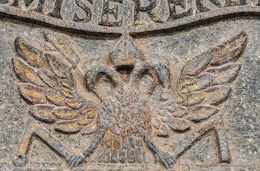
Inside the church, we met Natasha, who is the curator of the museum. I asked her if she knew about the reason for the double-headed eagle on the church. She informed us that the convent had been an Augustinian establishment, and that the double-headed eagle is a symbol used by that Order. That was news to me. She also directed me to another depiction of this creature on a carved tablet set into the church’s north wall.

When I returned to our lodging in Panjim, I consulted the internet, and learned about the connection between the Augustinian Order and the bird with two heads. It appears that although the main emblem of the Augustinians was a heart pierced with two arrow, the Hapsburgs allowed this Order to use their emblem, the double-headed eagle.

It will be recalled that there was a significant linkage of the Habsburgs and Spain. And Spain ruled Portugal between about 1580 and 1640. The Convent of Santa Monica was constructed between 1606 and 1627, and that was during the time that Portugal, which colonised Goa, was united with Spain. During that period, the united countries were ruled by Habsburg kings.

Although the museum, which I will describe later, was well worth the visit, discovering yet another example of the use of the double-headed eagle was a great thrill for me.

One body with two heads

HAPPY NEW YEAR

THE DOUBLE-HEADED EAGLE (‘DHE’) is a creature with a single body, two wings, and two heads each with its own neck. Of course it does not exist in nature but it is used quite widely as a symbol or emblem. I first became interested in the DHE after I became fascinated by Albania. The DHE has appeared as its national symbol for several centuries. It is also an emblem of Russia, Montenegro, Serbia, and the Indian state of Karnataka. In times past, the DHE was associated with the Hittites, several families in Cornwall, and the Byzantine Empire. It has also been used by some people in pre-Columbian America.

The DHE is an unusual symbol because it required considerable imagination to create it. Symbols like the cross, the crescent, the star, the swastika, and the circle are simple geometric emblems that could have easily arisen from thoughtless doodling. Likewise with emblematic animals like the lion, the eagle (with one head), and other creatures are based on observation of nature. The DHE, on the other hand, is neither an accident of geometry nor based on real life. It is, like the multi-limbed Hindu gods and the Egyptian sphinx, the result of human imagination.

The earliest archaeological evidence of the DHE is on rings used by the ancient Babylonians to mark ownership of containers of oils and other liquid goods. These seals have been dated as having been in existence between two and three millennia before the birth of Christ.

It is interesting to note that the DHE was not the only two headed creature conceive by the ancient Babylonians. There is plenty of archaeological evidence that shows that they created emblems depicting other creatures with a single body, two necks, each supporting a head.

In the future, I hope to explore the origins and the distribution of the DHE in far greater detail, maybe I will make this the subject of a book.