
Letters written from a princely state in India during the colonial era

SOON AFTER READING “A Passage to India” by EM Forster (1879-1970), published in 1924, I read this author’s “The Hill of Devi”, first published in 1953. Forster made two visits to the Princely State of Dewas Senior, which ins in what is now Madhya Pradesh, not far from Indore and Ujjain. His first visit was in 1912, and the second in 1921. During the second visit, he spent several months as private secretary to the Maharajah of Dewas Senior.
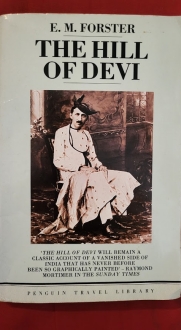
“The Hill of Devi” consists mostly of letters that Forster wrote from India to his mother and other people. In them, he described the typical often extraordinary events he experienced in Dewas Senior. He also describes the people whom he met and with whom he worked including the friendly but indecisive Maharajah. The letters, interspersed with commentary, provide a view of what life was like in a relatively unimportant kingdom within British India.

The letters were all written before Forster published his “A passage to India”. In his book “The Hill of Devi”, Forster noted that he had begun “A Passage…” before staying in India in 1921, and tried to finish it while staying in Dewas Senior, but was unable to do so. He completed it after his return to England. The letters published in his “The Hill of Devi” contain much material that he later incorporated into hs “A Passage …”.

I enjoyed reading the collection of letters. Because they were letters often written in haste and, originally not for a public audience, they have an immediacy even though they are not the finest works of the author. Nevertheless, they were most interesting because recently I have visited the region in which Dewas Senior is located, and stayed in places that must have formerly been similar to that about which Forster wrote.
A little England high up in the hills of southern India

WRITING IN 1931, the Spanish missionary Father Emilio noted:

“The Protestants in Munnar … appear arrogant and presumptuous and form a stark contrast to the humble pagans and submissive Catholics …”

The writer was referring to the British tea plantation owners and officials and their attitude to their Indian workers, both Hindus and those who had converted to Roman Catholicism.


31 years later, and after India had become independent,  another Spanish missionary, P Fermin, observed that Munnar (in Kerala) was conceived as:

“… as a meeting centre, with pretentions of an English town,  to break the routine of their [The British] plantation life on weekends. Munnar has its European club, …”


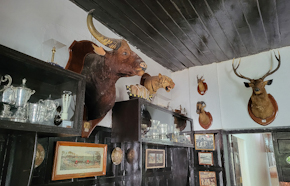
Now in 2026, the above-mentioned club, the High Range Club, still thrives, although now it is no longer exclusively for Europeans. We visited it several times in January 2026. Entering it is like stepping into the past.


The Club was established in 1909 on a large plot of land (6 acres) next to and high above a river. It was built as a residential  club, and has 17 rooms. Membership is restricted to corporate planters (senior officials of the tea plantations) of the Munnar area. As the club has many affiliations with other ‘elite’ clubs in India, many of the people who make use of its facilities are members of affiliated clubs.


Not only does the club’s architecture and interior design look like a leftover of bygone Britain,  but it preserves the old British club traditions and dress code rules. The Club has a wonderful old fashioned bar. Stepping into this is like going back to England of the 1930s or even earlier. Sadly, the High Range Club does not have a liquor licence.


On one of our visits to the Club, I looked at the board that listed the Club’s chairmen. From 1909 until 1973, all the chairmen had British surnames. It was only in 1974 that a chairman, Mr Murthy, had an Indian surname. And until 1966, none of the Honorary Secretaries had Indian surnames. Given this information,  I  wondered how many years elapsed before non-Europeans were admitted to the Club  after 1947 when India became independent.


Prior to the admission of Indians, the Club, like almost all of the British colonial clubs, were places where Europeans could isolate themselves from the Indian population. Today, these clubs provide a refuge for better-off Indians, who wish to socialise amongst themselves away from the ‘madding  crowds’.


The room used as the dining hall at the High Range intrigued me. At one end of it, there is a proper stage with curtains that could be used for performing plays and other entertainments. Seeing it reminded me of “A Passage to India” by EM Forster.  In it he described a British colonial club and how its members performed amateur theatricals. Here at the High Range is an example of exactly what Forster described.


Visiting the High Range is not only a pleasant way to pass a few leisurely hours, but it is also a chance to glimpse into the strange world that was once a feature of British India, albeit one that enforced a racial colour bar.

EM Forster and some caves in Mandu (Central India)

I AM OVER HALFWAY through reading “A Passage to India” by EM Forster (1879-1970). In this exciting novel, which contains the author’s acute observations about the minutiae of India as it was before Independence and to a large degree after,  Dr Aziz, an Indian, ill-advised (in my opinion) accompanies two English ladies to the Marabar Caves (a fictional name). Trouble ensues, and Dr Aziz is arrested.  I will not give away the rest of what I have read so far, but will mention some caves in Mandu (Madhya Pradesh), which we visited on Christmas Day 2025.


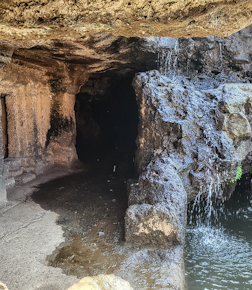
The caves are close to the scant remains of Mandu’s Lohani Gate. Easy to enter, they were excavated and converted into chambers or cells where Hindu priests or yogi might once have resided. Archaeological evidence suggests that the caves were excavated and modified in the eleventh or twelfth century. They predate all of the other archaeological sites in Mandu.


Fortunately,  our visit to these caves was less eventful and sinister as is described in Forster’s excellent story. In fact, the Lohani Caves are delightful, and considering how close they are to Mandu’s most visited places, they are  ignored by most tourists.


Now, I must leave you and get back to my tattered copy of “A Passage to India”.

PS: by “minutiae” I include Forster’s detailed description of the behaviour of Indian squirrels and the Echo Point at Mandu, which we saw recently, as well as the curious echo effects at the Gol Gumbaz in Bijapur, which I have experienced.