The writer Edward Lear (1812-1888), best known for his nonsensical poetry, was an accomplished painter and a great traveller. During his travels, which took him as far afield as India, Lear took the opportunity to record what he saw in the form of sketches and paintings. In 1848, he visited the Balkans, which at that time was ruled by the Ottoman Turks. On this trip, he spent many days in what is now Albania, but was then governed by the Ottomans. He recorded his experiences not only in visual representations but also in writing, which he published – in 1851 – as “Journals of a Landscape Painter in Albania etc.”
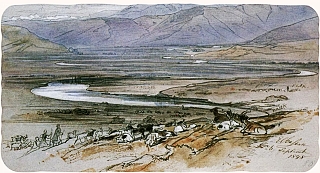
By 26 September 1848, Lear had reached the city of Elbasan, which today is surrounded by the rusting remains of huge industrial plants erected during the regime led by the country’s dictator Enver Hoxha. When Lear was there, it was quite different, as he wrote:
“I set off early, to make the most of a whole day at Elbassan — a town singularly picturesque …”
The views from the city walls were such that Lear felt the urge to sketch. However, as the following excerpt from his book shows, things were to turn out difficult for him.
“No sooner had I settled to draw — forgetful of Bekir[1] the guard — than forth came the populace of Elbassan, one by one, and two by two, to a mighty host they grew, and there were soon from eighty to a hundred spectators collected, with earnest curiosity in every look; and when I had sketched such of the principal buildings as they could recognise, a universal shout of ” Shaitan[2] !” burst from the crowd; and strange to relate, the greater part of the mob put their fingers into their mouths and whistled furiously, after the manner of butcher-boys in England. Whether this was a sort of spell against my magic I do not know; but the absurdity of sitting still on a rampart to make a drawing, while a great crowd of people whistled at me with all their might, struck me so forcibly, that come what might of it, I could not resist going off into convulsions of laughter, an impulse the Gheghes[3] seemed to sympathise with, as one and all shrieked with delight, and the ramparts resounded with hilarious merriment. Alas! this was of no Ions: duration, for one of those tiresome Dervishes — in whom, with their green turbans, Elbassan is rich — soon came up, and yelled, ‘Shaitan scroo ! — Shaitan!’[4] in my ears with all his force; seizing my book also, with an awful frown, shutting it, and pointing to the sky, as intimating that heaven would not allow such impiety. It was in vain after this to attempt more; the ‘Shaitan’ cry was raised in one wild chorus — and I took the consequences of having laid by my fez for comfort’s sake — in the shape of a horrible shower of stones, which pursued me to the covered streets, where, finding Bekir with his whip, I went to work again more successfully about the walls of the old city.
Knots of the Elbassaniotes nevertheless gathered about Bekir, and pointed with angry gestures to me and my ‘ scroo.’ ” We will not be written down,” said they. ” The Frank[5] is a Russian, and he is sent by the Sultan to write us all down before he sells us to the Russian Emperor.” This they told also to Giorgio[6], and murmured bitterly at their fate, though the inexorable Bekir told them they should not only be scroo’d, but bastinadoed, if they were not silent and obedient. Alas! it is not a wonder that Elbassan is no cheerful spot, nor that the inhabitants are gloomy. Within the last two years one of the most serious rebellions has broken out in Albania, and has been sternly put down by the Porte[7] …”
Lear outlines the rebellions as follows:
“Under an adventurer named Zuliki, these restless people rose in great numbers throughout the northwestern districts; but they were defeated in an engagement with the late Seraskier Pasha. Their Beys, innocent or accomplices, were exiled to Koniah or Monastir[8], the population was either drafted off into the Sultan’s armies, slain, or condemned to the gallies[9] at Constantinople, while the remaining miserables were and are more heavily taxed than before.”
Zuliki, whom Lear mentioned, was the English form of Zenel Gjoleka (1805–1852), who led the 1847 Albanian Revolt[10] and some earlier uprisings. Regarding the 1847 revolt, it is interesting to note that:
“… it was explicitly cross-confessional: the Mesaplik[11] assembly brought Muslim and Christian Albanians together on shared grievances, a principle that would become central to the national movement a generation later. [12]”
Today, more than 114 years later, Albanians – although they differ from each other in religious beliefs – show a tolerance of religions other than their own, which is unrivalled in most other countries. This is something that was often emphasised to us by Albanians we met during a fortnight spent touring in Albania in 2016.
Edward Lear’s travel writing rivalled his superb talent as an artist. His book about Albania is both enjoyable and highly informative to read, and what is more, it is beautifully illustrated.
[1] Bekir was Lear’s Albanian guard
[2] Devil
[3] Ghegs – Albanians living north of the Shkumbin River; the Tosks live south of it.
[4] The Devil draws ! — the devil.
[5] Foreigner
[6] Giorgio was Lear’s manservant, with whom he travelled everywhere.
[7] Porte: government of the Ottoman Empire
[8] Bitola
[9] galleys
[10] https://en.wikipedia.org/wiki/Zenel_Gjoleka
[11] Meeting held on 21 June 1847 in the village of Mesaplik, southern Albania, to organize an armed uprising against the Ottoman Empire.
[12] https://albanianregistry.org/blog/albanian-revolts-against-ottoman-rule

