
Fading lettering and an Edwardian building on London’s Harrow Road

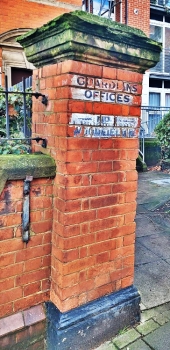
A LARGE BRICK edifice with white stone trimmings stands on the corner of Woodfield Road and the larger Harrow Road. Built in 1902, it now houses Westminster Register Office, but this has not always been the case. A clue to its former purpose can be seen on a brick pillar on one side of a now disused entrance to the building on Woodfield Road. In fading painted lettering, one can see the words “Guardians Offices”.
A somewhat difficult to read metal plaque on the staircase leading up to the building’s main entrance on Harrow Road gives a history of this elegant house. It was opened in 1902 as the then new offices of the Paddington Guardians, who supervised the running of the local workhouse. The Paddington Workhouse was built on a bank of the Grand Union Canal in 1846, and extended in 1868. According to an informative website (www.workhouses.org.uk/Paddington/):

One of the labour tasks for able-bodied inmates at Paddington was stone breaking.

In 1914, all the inmates of the workhouse were taken to the Marylebone Workhouse, and the Paddington establishment was turned into a military hospital that specialised in the care of men without limbs. In 1930, the place became Paddington General Hospital, and after 1986 it was demolished.

Returning to the building on Harrow Road, its new purpose came into being in 1965 after the original town hall on Paddington Green had been demolished to make place for the then new Westway. The council offices were moved into the former Guardians’ office building. In 1999, the building was demolished leaving intact only the grand façade we can see today. The 1902 façade is attached to newer buildings that contain the Register Offices in addition to residential flats managed by Paddington Churches Housing Association.

Despite its many reincarnations, the gatepost with its fading painted lettering is a reminder of the building’s original role.

From bank to beauty parlour

AL SAQI BOOKSHOP in London’s busy Westbourne Grove occupies a shop with a façade that would not look out of place on a palazzo on the Grand Canal in Venice. I have already described the interesting history of this building elsewhere (https://adam-yamey-writes.com/2020/10/18/the-story-of-a-bookshop/).

62-64 Westbourne Grove, London

Further west along the Grove, well past the Planet Organic ‘wholefood’ store and Alounak, one of the Grove’s several Persian restaurants, we reach number 62-64, whose façade is almost as grand as that of Al Saqi. Unlike the latter, this building’s history is harder to ascertain. Currently, it is the premises of Aveda, a beauty salon also called Gina Conway Salon Spa.  The ground floor façade of this edifice includes neoclassical columns with Doric capitals, and decorative mouldings, which include the letters ‘C’, ‘L’, and ‘M’. These are intertwined to form a logo. The first floor is fronted by three large arches separated by decorative mouldings and the top storey has three sets of windows set back behind lintels supported by short columns with Doric capitals. The salon, although modernised to suit its current purpose, has its original elaborately decorated moulded plaster ceiling and wall mouldings, some of which depict the heads of angels or putti.  Nobody in the salon had any ideas about the history of this attractive building.

A photograph in the London Metropolitan Archives describes number 62 as having an Edwardian façade. When this image was created in 1974, the building was a branch of the Midland Bank, which occupied its western two thirds. The eastern third of the place was the premises of The French Kitchen and Tableware Supply Company. The bank was already in existence at this address in 1940.  What was there before the bank occupied the edifice and when exactly it was built, I have not yet discovered. The building is marked as a bank on a detailed map surveyed in 1914, but not on one surveyed in 1893. However, Allan & Mortons Street Directory of 1867 revealed that number 62 was then the address of Dr Barry, who practised homeopathic medicine.  Both the 1893 and the 1914 maps mark the building west of number 62-64 on the corner of the Grove and the western arm of Newton Road as being a bank at those times. This building currently houses Farmacy, a vegan eatery.

The logo ‘LCM’ on the old bank stands for ‘London, City, and Midland’, a bank founded in 1898, which was renamed the London Joint City and Midland Bank in 1918 and then the Midland Bank in 1923 (www.gracesguide.co.uk/London_City_and_Midland_Bank). In the absence of any more information and in view of the fact that the architectural historian Pevsner regarded it as “Edwardian”, it might be safe to conclude that the present building at 62-64 Westbourne Grove was originally constructed to house a bank sometime during the reign of Edward VII, i.e., between 1901 and 1910, and certainly before 1918.