
When the letters V and R did not refer to England’s Queen Victoria

THE SETUPARVARTIPURAM DAM, also known as the Kundala Dam, is a popular spot for tourists. This curved dam, built with masonry blocks, lies near the beautiful road that runs between Munnar and Top Station, a high mountain view point.
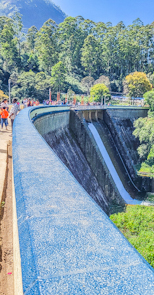
Kundala Dam

At the entrance to the narrow roadway that runs along the top of the dam, there are two commemorative plaques. Both of them bear the coat of arms if the former Kingdom of Travancore and the letters V and R intertwined.

One of the plaques informs the viewer that the dam was opened during the twenty-fifth year of the reign of “His Highness Sri Chitra Thirumal Sir Balaramvarma … Maharajah of Travancore”. Born in 1912, he died in 1991. He came to the throne in 1924. Therefore, the twenty-fifth year of his reign was 1948/49.

It was in 1949, that the Maharajah agreed to unite Travancore with Cochin (and the rest of India). Between Indian independence in August 1947 and 1949, Travancore resisted unification with the new republic of India. Between 1949 and 1956 Sri Chitra Thirumal served as the first and only Governor of the newly formed Travancore-Cochin Union. In 1956, this territory was incorporated into the state of Kerala.

As for the intertwined R and V, this has nothing to do with Queen Victoria (VR). Instead, it refers to Rama Varma, a set of rulers of Travancore, Cochin, and other parts of Southern India.

Having established the significance of the letters R and V, I must add that a visit to the dam is a delightful experience.
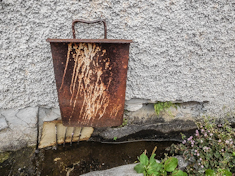
Diverting water in Madeira

A damming plate hanging on a wall beside a stream in Funchal

WHEN WE WERE IN the Western Cape of South Africa,  I  noticed streams running alongside roads in rural farming areas. Occasional small channels led off from them and into the fields of farms. At each junction of the main stream and a side channel, there were small plates that could be used  to temporarily dam the main stream to divert water into the channel leading to the fields.  

We are staying in Funchal, Madeira. Our guesthouse is high above the city centre and the seafront on a road that leads down an extremely steep hill.  On one side of the road there is a fast flowing stream. Every now and then, there are metal plates that can be inserted into slots on both sides of this stream to divert water into the property beside the water. This is just like what I saw in rural South Africa. Perhaps I should not be surprised by the similarity of the damming system, but I cannot recall having noticed it anywhere else I have visited.

Draining a canal

EVERY NOW AND THEN, a canal needs repairing. For example, it might have sprung a leak either in its retaining walls or in its clay bottom. In such circumstances and no doubt others, the repair work can only be carried out if the canal is emptied of water, a tall order in a canal that might be many miles in length. Recently, we were walking along the towpath of the Macclesfield Canal, which links Marples Lock on the Peak Forest Canal with Hardings Wood Junction on the Trent and Mersey Canal, when we spotted something that we had never noticed before whilst walking along a canal towpath.

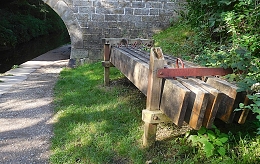
What we saw was a pile of sturdy wooden planks, each with two metal handles attached to their narrowest edges. They looked quite modern. We asked a man, who was walking his dog, about the planks. He explained that they were used to block both ends of a section of canal between two consecutive bridges. When these barricades are lined with plastic sheeting, the water between the two barricades can be drained from the part of the canal between the two waterproofed wooden barriers, Then, work can be carried out on the drained stretch of the canal. The planks are known as ‘stop planks’

Our informant pointed out notches carved in the stonework near to a bridge. The notch is opposite another identical one across the canal. It is into these pairs of notches that the planks we had noticed ate inserted to create a dam, I regard myself as being quite observant, but I have never seen or noticed either this kind of notch or the wooden planks for inserting in them during many long walks along canals in other parts of England. Maybe, they are common, but until we walked beside the Macclesfield Canal, I had never seen them before, Maybe, this is because other methods of damming (see: https://www.rchs.org.uk/wp-content/uploads/2017/01/OP-128.pdf) are also employed in addition to that which we spotted on the Macclesfield Canal at Bollington in Cheshire.