
Almost every old parish church in England contains at the very least one object of great interest. Usually, the older the church, the more remarkable are the discoveries within them. Recently, I visited a church in a small village in Cambridgeshire, and saw something that made me think.
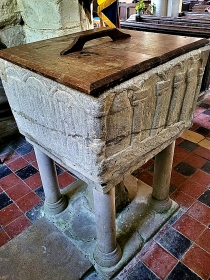
The object I saw in the Church of St Peter in the village of Coton has been in use for at least 800 years because it was constructed in the twelfth century – some time between 1100 and 1200 AD. It stands on four modern stone supports at the west end of the nave of the gothic church, whose construction commenced in the twelfth century.
The Domesday Book of 1086 lists the existence of Coton. Before 1563, there were no records of the village’s population. In that year, 21 families lived in the place. Between 1800 and 1900, Coton’s population increased from 126 to 390 (https://en.wikipedia.org/wiki/Coton%2C_Cambridgeshire). So, when the church was built and for a few centuries after its first stone was laid, Coton’s population must have been small, but not so tiny to have prevented the church from having been enlarged in stages between the fourteenth and sixteenth centuries.
As the population increased, the twelfth century object, which attracted my attention in the church, was used each time a child was born. The item that interested me is the stone font. It is a square tank with each of its four stone sides carved with geometric patterns. No two sides have the same design.
What makes the font interesting is not merely its age and carvings, but the fact that is still in use. I wonder how many children have been baptised with water from this font during the last more than 800 years, and how many more will be blessed at this ancient water receptacle in the years to come.
In a world where so many things keep changing, often at an alarming rate, it is wonderful to find something that has remained unaltered for so long, and is still in use.

