So long Soho

SOHO BAR ITALIA

IN MANY MINDS ‘SOHO’ conjures up sleazy night spots, strip joints, sex shops, and risqué nightlife. For me, Soho contains many memories of my childhood. And before you wonder about what kind of upbringing I had, let me emphasise that these recollections have nothing to do with the seamier side of this colourful district in London’s West End. If you are hoping for something more ‘exciting’, stop reading now to avoid disappointment.

My mother was an artist. Her preferred metier was sculpture. In the 1960s, she used to work in the sculpture workshops at the St Martin’s School of Art on Charing Cross Road. She welded pieces of metal to create artworks. Her companions in the studio included now famous artists such as Philip King and Anthony Caro.

In addition to being a sculptor my mother was acknowledged by friends and family as being a good cook. She was a disciple of the food writer Elizabeth David, who helped introduce French and Italian cuisines into British kitchens. Ms David’s recipes required ingredients and cuts of meat not readily available to British shoppers in the 1960s. However, St Martin’s was close to Soho, in particular Old Compton Street and Brewer Street, where the ‘exotic’ ingredients needed for Ms David’s recipes were easily accessible. These streets contained a variety of shops that catered to French southern European culinary needs.

We lived in Hampstead Garden Suburb, an attractive but, in my opinion, rather dull place. As a youngster, I loved being taken into central London. My mother often took me to the West End. We used to take the ‘tube’ to Oxford Circus Station. Near there, we always entered Dickins and Jones department store. Why, I cannot say, because my mother rarely bought anything there. The ground floor of the shop was dedicated to perfume and other cosmetic sales. Once, one of the salespeople, called to me. Without prompting, she advised me never to use after shave lotions. I was far too young to have begun shaving, but I have followed her unsolicited advice ever since then. I have not yet been brave enough to experiment with these lotions and to discover why she advised against them.

After leaving the department store, we used to visit the Danish Centre in Conduit Street, where I would be treated to an open sandwich and a kransekage, a Danish confection containing marzipan. From there, we used to head for Soho.

Meat was always bought at Benoit Bulcke, a Belgian butcher shop on the corner of Old Compton Street and a smaller side street. According to my mother, only this place knew how to cut meat properly, and she was not someone to argue with. Their motto was “Meat to Please You, Pleased to Meet You”. They moved from Soho to northwest London some years ago. 

Coffee was always purchased at the still extant Algerian Coffee Stores. The shop’s appearance remains unchanged since I was a child. My mother used to choose Mocha Mysore, a name which meant nothing to me as a child. Decades later, when I began visiting India, I got to visit Mysore and also Indian coffee plantations. One innovation at the Algerian Coffee Stores instituted long after my childhood, and well before the Covid-19 crisis, was the inclusion of a small counter where exquisitely made espresso coffee is served.

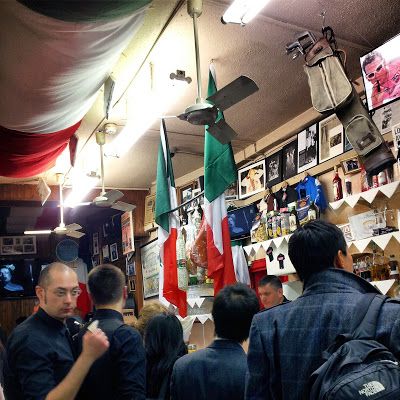
Other groceries were bought at Lina Stores, still in existence, and Camisa, another Italian grocery nearby. Almost every visit to Soho included a stop at Bar Italia. Founded in 1949, this coffee bar still exists. Entering it is like stepping straight from Soho into a typical bar in Italy. Much of its décor remains as I first remember it, but now the far wall of the café is lined with an enormous TV screen on which Italian football matches can be watched. Whenever we visited Bar Italia, my mother would point at a doorway close to it and tell me that it led to Jimmy’s restaurant. Founded in 1948, it was the first Greek restaurant to be opened in Soho.  Although she always mentioned the place, we never ate there. However, close by in a parallel street there was an Italian restaurant, Otello, which my parents visited often, sometimes taking my sister and me.

One shop that no longer exists was on the short stretch of Old Compton Street between Moor Street and Charing Cross Road. It had trays of vegetables and salad greens on stalls on the pavement outside the front of the store. It was a French run greengrocer, whose name I cannot recall. One of the things my mother bought there was something that sounded to my young ears like ‘mush’ (rhyming with ‘slush’). I had no idea what it was or what it was used for, but I know that my mother prized it greatly. Many, many years later, I realised what she was buying was in fact ‘mache’, also known as ‘lambs lettuce’ or ‘corn salad’, and to botanists as Valerianella locusta. In the 1960s when my mother was buying mache in Soho, hardly anyone in the UK would have heard of it, let alone eaten it. Today, it is a common ingredient of packaged salads found in supermarkets. I had no idea that back in the 1960s, my mother had become a foodie trend-setter by serving us mache in our salads.

My mother died forty years ago, and Soho has changed since then, but much remains that she would have recognised. Whenever I sip coffee at Bar Italia, I raise my tiny cup of strong black coffee to her memory. Mache more than that, I cannot do!
Rice and meat

Hyderabad is justifiably renowned for tasty biryani although the very best version of this rice based dish that I have ever eaten was at Paragon in Calicut. There, they serve Moplah biryanis, which are both Arabic and Indian in taste.

The biryani we ate at the Café Bahar in Hyderabad was delicious. It was delicately flavoured and cooked with a light touch. To enter Bahar at lunchtime it is necessary to join a long queue that extends from the top of tje stairs at the doorway to the first floor dining room down on to the busy street outside. It is worth the wait.

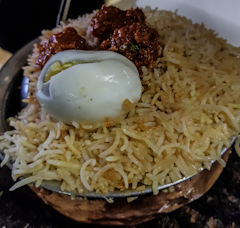
The restaurant itself is very noisy and as busy as London’s Oxford Circus at rush hour. We shared a table with a charming couple, who let us try their ‘double masala’ chicken biryani which is richly laden with extra spices. I preferred the less spicy ‘special lamb biryani’. It is made special by adding hard boiled egg and meatballs made with minced chicken.

One should not visit Hyderabad without eating at least one biryani, but avoid the much advertised Paradise restaurant chain, which is ok but nothing like as good as Bahar or Shadab (near the Charminar)

Weightless

HBY Kitchen 1960s

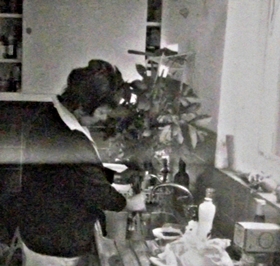
My late mother (see picture above, taken in the 1960s) was averse to weighing machines.

When she visited the doctor and had to be weighed, she did not want to be told or in any other way infrormed of her weight.

Her dislike of weighing machines extended into the kitchen. There were no kitchen scales in our home. A good cook, she managed without them. However, she did use a conical measuring device made by the Tala company. This contains printed markings that allow the user to dispence known amounts of powdered ingredients such as, for example, flour, rice, and sugar.

Years after my mother died, I married a lady from India. She told me that in the olden days, professional cooks of Indian origin often measured out cooking ingredients by feel rather than using a weighing device. For example if a cake required an equal weight of egg and flour, the cook would hold the egg in one hand and estimate its weight by feel and then measure the required amount of flour, also assessing its weight be feel alone. I do not know whether my mother possessed this skill, but regardless of that she was widely recognised to have been a competent cook.

If you are there, you must try…

TAHARI blogg

I had always wanted to visit Gulbarga (now ‘Kalaburgi’) in northern Karnataka (India), not far from Hyderabad, because of the richness of its medieval Islamic architectural heritage.

When my friend in Bangalore, Mansour, a great gastronome and connoisseur of fine foods, knew we were in Gulbarga, he said:

If you’re there, you must try tahari

Well, we had no idea what this dish comprised, but if Mansour reccomended it, it must be worth trying. A search on Google revealed that the Limra Tahari was highly rated. We rang to make a reservation and were told that was unnecessary. Also, we learnt that the place only took cash payments.

One evening, we hired an autorickshaw to take us to Limra. However, the driver had no idea how to find it, and eventually dropped us near a different restaurant, saying;

This is a restaurant. You can eat here.

It was a totally unsatisfactory eatery.

Next evening, we were fortunate. A rickshaw driver knew where to find the Limra. When we arrived, he told us that he would wait for us as we would not be long and, also, it was difficult to find autorickshaws in the area in the evening. We wondered why, but soon found out.

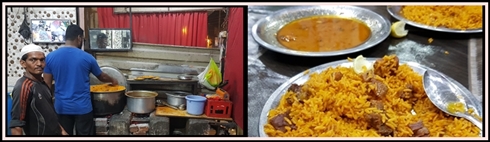
The front of the restaurant was unprepossessing, to put it mildly. The place was separated from the street by a pair of ageing red curtains, rather like that found at a theatre stage. The steps leading up to it from the street were littered with old newspaper and other rubbish. I looked at my wife questioningly. She seemed happy to enter, so we parted the curtains and stepped inside. The interior was spotlessly clean.

To the left of the entrance, an old man sat behind a small cash desk. To the right, there were a couple of men preparing food in huge metal post heated by smouldering charcoals. Limra’s dining area was simple. There were several long narrow rectangular metal tables, which were probably screwed to the floor. All of the diners were men, except my wife.

Before we had time to ask for a menu or what was on offer, a boy slid two metal plates across our table towards us. Each plate was laden with tahari. He added a third plate that contained an unappetising looking greasy sauce. We ordered a couple of bottles of mineral water and began our exploration of tahari.

The tahari consisted of spicy yellow rice which contained a few lumps of well-cooked tender meat. The sauce turned out to be delicious and not at all greasy. The tahari was very tasty and delicately spiced – a real treat. Tahari is, I later discovered, an Awadhi dish from the region of India where Lucknow is located. It is typical of a certain style of Mughal cooking. It is, as we saw when we entered Limra, slow-cooked.

When we finished our tahari, we noticed the menu on the wall behind us. It consisted of two items: tahari: full plate, and tahari: half plate. No wonder, we were served our food immediately. There was nothing to choose from here! Our bill for two full plates and two bottles of water came to only 80 Indian Rupees (about £0.90 sterling). It took us no more than 10 minutes to finish our scrumptious meal. We understood why our driver decided to wait for us, and we understood why the restaurant did not accept anything but cash as payment. So, if you are ever in Gulbarga, you must try tahari!

Burgers

Everyone, who eats them, can reccommend a place that serves the very best beef burgers. Naturally, most people have their own favourites. So, it would seem that there are many places that serve the ‘very best burgers’.  I havetried a few of these highly reccommended places and have with one exception (Gourmet Burger Kitchen – a chain that originated in New Zealand) been disappointed. Most ‘very best burgers’ turn out to be ok (usually) but an anti-climax (mostly).

Now, I am going to seem very conceited. That is because I believe that I make the ‘very best burgers’ myself in our home, and so should you. My recipe is dead simple. I take minced beef with a lowish fat content (10% or less), add a pinch of salt and a small spoon of oil (sunflower or olive) and, after washing my hands, mush the three ingredients together before hand shaping patties of the  sizes preferred by those who will eat them. Then, I cook them on a griddle. That’s all. No egg or breadcrumbs are added.  Try this for yourself and you will no longer be wasting your money on overpriced, mediochre burgers.


ham burger with vegetables


A patty of minced beef 

Mould-ed by hand

Enjoy burger perfection


Photo by Valeria Boltneva on Pexels.com

Getting to grips in the kitchen


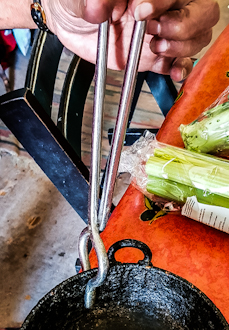
Just in case you have not got one in your kitchen, here is an implement that is extensively used in Indian kitchens and tea stalls.

The sandasi (pronounced roughly like ‘sun-er-see’ said fast), which is is also known as a pakad (from the verb ‘to hold’ in Hindustani) or a chimta (from the verb ‘to pinch’ in Hindustani), is essentially a pair of sturdy hinged metal (stainless steel) tongs. The handles of the implement are several times as long as the gripping elements. This means that quite heavy things may be lifted with the beaks of the tongs without any risk of them slipping out of their grip.

The sandasi’s long handles also mean that the user’s hands can be kept at a safe distance from the hot cooking vessels that are lifted with this pair of tongs. For example, the tea maker can lift and manipulate with ease the huge pots containing several litres of a bubbling, boiling mixture of milk, tea, and spices. 

I find the sandasi very useful for gripping the edges of large casseroles when I am stirring hot food like stews or curries.

Cooking tongs are, of course, available in countries other than India, but the sturdy construction and long handles of the sandasis have much to reccommend them.

Tastes differ


food toast meal morning


When I was a child, I spent a great deal of time with my aunt and her children. They lived a few minute’s walk from our family home and I enjoyed spending time with them. Often, my sister and I used to spend a whole day at my aunt’s house, sometimes over night especially when my parents were away on a trip.

My aunt fed us. Sometimes she made us fried eggs. Then, I was a very fussy eater. In those far-off days, I only liked the white part of the fried egg, not the central yellow bit. One of my cousins only liked the central yellow part, but disliked the white surrounding it.  My aunt was an extremely down-to-earth individual, laden with more than a fair share of common sense. Her solution to the fried egg situation was that after making the fried egg, she used to carefully dissect the yoke portion of the finished product and serve it to my cousin. I was given the white portion of the egg with a neat hole in it where the yellow had been.

Today, many decades later, I am not keen on any part of a fried egg and do not eat eggs prepared in this way. I much prefer omelettes and hard-boiled eggs. However, I do enjoy making them for other people, The challenge is to avoid breaking the yoke. 


Photo by Pixabay on Pexels.com

Fryers delight

FISH


Sometime during the summer in the early to mid-1980s, when I was living in Kent, two young people came to stay with me from land-locked Hungary. Because travelling opportunities were limited and money was short in the Communist country, people did not travel abroad as much as people in Western Europe. My two guests had never seen the sea, except in photos and on the TV or cinema screen.

One evening, I drove my guests to the Kent coast to see the sea. We parked by a beach. As soon as we had stopped, the two lads leapt out of my car and ran into the sea fully clothed. That is how excited they were to see real waves and the sea.

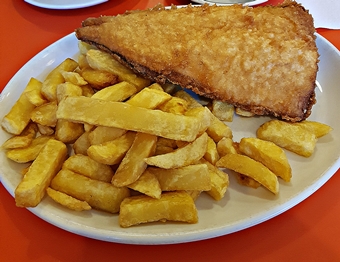
After experiencing the sea, they asked me about ‘fish and chips’, which their English teacher in Budapest had mentioned. We walked to a nearby fish and chips shop and placed an order. When the fillets of fish arrived wrapped in crisp golden batter, my friends looked at them, wondering whether or not they had been served pieces of fish. They had never seen fish prepared like this before.

Fish prepared, fried and covered with batter, as it is served in British fish and chip shops is actually not a dish of British origin. According to that mine of knowledge Wikipedia, it was the Sephardic Jews, who settled in the UK from the 16th century onwards, who introduced fish prepared this way. Alexis Soyer (1810-58), the famous 19th century chef wrote in his A shilling cookery for the people, published in 1854:

There is another excellent way of frying fish, which is constantly in use by the children of  Israel … In some families … they dip the fish, first in flour, then in egg, and fry in oil“, which is more or less what happens in a fish and chips shop. 

This leads me to the real subject of the article: a reccommendation. There are many highly-rated fish and chips shops (‘chippies’) in the British Isles. The ‘Fryers Delight’ is one of them. This unpretensious shop, whose decor seems unaltered since the day it opened back in in 1958, serves excellent fish with superb chips cut in the shop’s kitchen, all fried in beef dripping. I have eaten there twice, and look forward to my next visit. The staff are friendly, and the prices are very reasonable and the food is good value for money. 

The FRYERS DELIGHT, which is open from noon to 10pm every day except Sunday is located at:

 19 Theobalds Rd, Holborn, London WC1X 8SL

Let loose in the kitchen

There is no love sincerer than than the love of food

George Bernard Shaw

Most people think highly of their mother’s cooking. Many people thought highly of my mother’s cooking. She was an early disciple of Elizabeth David, the cookery book writer who introduced Mediterranean cuisine to British kitchens.

My mother regarded our kitchen as her territory. Being highly protective of my sister and me, she would not let us near the cooker nor sharp knives. However, she was quite happy to have us accompany her in the kitchen for two main reasons. One was to give her company while she cooked. Another was to do the washing up of crockery and cutlery. I did not much mind keeping her company, but washing up was not much fun.

Eventually, in the 1960s we acquired a dishwashing machine. This did not prove to be much of a labour saving device because my mother insisted on us, often me, washing every item before putting them in the machine. And, unloading the dishwasher and stacking everything away was as time consuming as washing up manually.

Sadly, my mother died young in 1980. By then, my sister had left home. As my father had no interest in cooking, the kitchen became my own territory. At last, I could begin to use the cooker and all of the kitchen utensils that my poor mother had guarded so jealously. This did not compensate for losing a beloved parent, but it did open a new door in my life experience: the art of food preparation.

My love of cooking commenced. At first, I followed recipes from an excellent series of cookbooks published by the Sainsbury’s supermarket company. Then, I experimented with Indian food guided by a cookbook written by Madhur Jeffrey. Later, I made use of a very practical Chinese recipe book written by Ken Hom and published by the BBC. For middle eastern dishes, I was guided by the well-known Claudia Rosen, who has also written a very good book of Italian recipes, and a superb one by the lesser known Arto Haroutian. For Hungarian food, the book by George Lang is hard to beat. Since marriage, I have been guided in the art of cooking by my wife, who is a superb cook.

I suppose that over the years I have become a ‘foodie’. ‘Foodie-ism’ seems to run in my family. My sister, a very competent cook, ran a restaurant in Italy for about 15 years; she was the chef. My mother’s sister was an excellent chef and her two children, my cousins, have inherited her culinary skills. Our daughter has also inherited the foodie gene, both from me and my wife, both of whose parents had discerning palates.

There are those who consider food simply as fuel. They are missing out on one of the pleasures in life, which I value greatly: the preparation and enjoyment of cooking and eating.

Let me end by wishing you all A DELICIOUSLY HAPPY NEW YEAR!