Comparing the art of Constable and Turner

DURING A VISIT to London’s National Gallery, I entered a room in which paintings by JMW Turner (1775-1851) and J Constable (1776-1837) were being displayed.

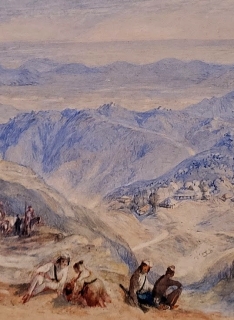
By Turner in the National Gallery

Seeing these artists’ works together reminded me of a visit to the Lady Lever Gallery in Port Sunlight (Cheshire). I wrote about this place in my book “An Alphabetical Tour of England”, and compared the two artists. Here is what I wrote in my book:

In one small gallery, … two paintings hang close to each other but are separated by a neo-classical fireplace (an exhibit). One of them is by JMW Turner (1775-1851) and the other by his contemporary and rival J Constable (1776-1837). It is interesting to see them almost side-by-side because it allows the viewer to compare their styles and what they tried to convey in their paintings. The Turner painting depicts “The Falls of the Clyde”, and the Constable depicts “Cottage at Bergholt”. Neither of the paintings, both created in the age before photography, achieves the accuracy of, say, a photograph. Both seem impressionistic, but the effects that the artists were attempting to have on the viewer are entirely different. Turner’s paintings are often far more impressionistic than Constable’s. Although his subject matter is always at least almost discernible, I feel that Turner’s works were created to evoke both the artist’s and the viewer’s psychological and/or emotional reaction(s) to what was being depicted. In contrast, Constable’s painting techniques seem to have been designed to emphasise aspects of the scene he was painting to give the viewer the impression that he or she is looking at the very same view as that which attracted the artist. Constable regarded painting as being a branch of science. In a lecture he gave in 1836, he said:

Painting is a science and should be pursued as an inquiry into the laws of nature. Why, may not landscape painting be considered a branch of natural philosophy, of which pictures are but the experiments?’

Turner, in his almost abstract paintings such as the one at the Lady Lever, appeared to be wanting to stimulate the viewer’s deepest emotions. In contrast, Constable tried to convey to the viewer what he saw or felt was important in his subject matter. Without resorting to the almost photographic accuracy of, for example, both Canaletto and Vermeer, the two artists, whose paintings hang almost next to each other in the Lady Lever, successfully achieve their aims. For me, the avoidance of detailed accuracy of representation in both Turner’s and Constable’s paintings, enhances the impression of reality in my mind, something that photography cannot do to the same extent.

Even if you do not wish to compare Turner and Constable, I can strongly recommend a visit to the soap maker’s gallery in Port Sunlight …

Seeing the paintings at the National Gallery reinforced my feelings as expressed above in the excerpt from my book.

If you wish to read my book, it is available from Amazon’s websites, e.g.:https://www.amazon.co.uk/ALPHABETICAL-TOUR-ENGLAND-Adam-Yamey/dp/B0FVV6JLZ7/

A pub with great food in Dedham (Essex)

WE ENJOY ROAMING around rural England. However, eating in country pubs and restaurants can often be a bit ‘hit and miss’. In June (2025), we visited Flatford Mill in Essex, which has important connections with the artist John Constable and his family. We stopped to buy a drink at a refreshment stall, and asked the young man serving if he could recommend a pub where we could get a good lunch. He told us that The Marlborough in nearby Dedham was good; it is his ‘local’. He said that we should try their shepherd’s pie.

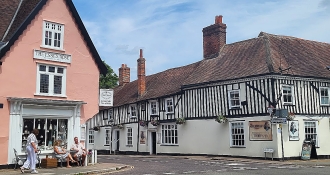
A short drive brought us to Dedham, and The Marlborough was easy to find. Situated on a corner plot almost opposite the parish church, the pub is a half-timbered edifice built mainly in the sixteenth century. Originally, it was built as a clearing house for local wool merchants. Inside the ground floor of the pub, there are many old timber beams to be seen.

Despite it being a hot day, I ordered the shepherd’s pie, which was truly excellent. It was accompanied by beautifully cooked carrots, parsnips, and cabbage. My wife ordered chicken parfait, and that tasted superb. The staf were friendly and the service was impeccable.

I am grateful for the recommendation we were given. Later, when mentioning how good it is to various people we met in Suffolk and Essex, they all knew of the pub and held it in high regard.

Constable, Turner, and a soap maker

MY GREAT GRANDFATHER Franz Ginsberg (1862-1936) was an industrialist and a politician in South Africa. One of his main industries was soapmaking. Many of his workers would have been black Africans, mostly living in poor conditions around his factory in King Williams Town (‘KWT’). While serving on the town council of KWT, he played an active role in establishing what he hoped would be a township with improved living conditions for some of the town’s black people (including his workers). Named after him, Ginsberg township, founded at the beginning of the 20th century, still exists.

A few years before my great grandfather established the township named after him, another soap maker, William Hesketh Lever (1851-1925) who was based in England, created what he hoped would be better living conditions for his workers. Far more grandiose and much more attractive than Ginsberg Township, Lever began building Port Sunlight (south of Birkenhead) in about 1887 (a year or two after Ginsberg began making soap). Lever’s model town provided his employees with salubrious dwellings in a well landscaped environment. However, they were subject to strict rules; Lever, who believed that discouraging immorality (e.g., gambling) led to a good workforce, was a benevolent paternalist.

Turner on the left, and Constable on the right

Lever and his wife were avid collectors of artworks. These are housed in the purpose-built Lady Lever Art Gallery in the centre of Port Sunlight. This gallery, contained within an impressive French neo-classical style edifice, was designed by the Warrington based architects William Owen (1846-1910) and his son Seager Owen, and opened in 1922. It contains a fine range of artworks dating from early times (pre-Christian) to the early 20th century. It contains one of the largest and most important collections of Pre-Raphaelite artists’ works. With its spacious, airy galleries and well displayed exhibits, it is amongst my top ten British galleries and museums.

In one small gallery, which contains a sculpture of a reclining nude, two paintings hang close to each other but are separated by a neo-classical fireplace (an exhibit). One of them is by JMW Turner (1775-1851) and the other by his contemporary rival J Constable (1776-1837). It is interesting to see them almost side-by-side because it allows the viewer to compare their styles and what they try to convey  in their paintings. The Turner painting depicts “The Falls of the Clyde”, and the Constable depicts “Cottage at Bergholt”. Neither of the paintings, both created in the age before photography, achieves the accuracy of, say, a photograph; both seem impressionistic, but the effects that the artists were attempting to have on the viewer are entirely different.

Turner’s paintings are often far more impressionistic than Constable’s. Although his subject matter is always at least almost discernible, I feel that Turner’s works are created to evoke both the artist’s and the viewer’s psychological and/or emotional reaction(s) to what was being depicted. In contrast, Constable’s painting techniques seem to have been designed to emphasise aspects of the scene he was painting to give the viewer the impression that he or she is looking at the very same view as that which attracted the artist. Constable regarded painting as being a branch of science. In a lecture he gave in 1836, he said:

“Painting is a science and should be pursued as an inquiry into the laws of nature. Why, may not landscape painting be considered a branch of natural philosophy, of which pictures are but the experiments?”

Turner, in his almost abstract paintings such as the one at the Lady Lever, appeared to be wanting to stimulate the viewer’s emotions. In contrast, Constable tried to convey what he saw or felt was important in his subject matter. Without resorting to the almost photographic accuracy of, for example, both Canaletto and Vermeer, the two artist whose paintings hang almost next to each other in the Lady Lever successfully achieve their aims. For me, the avoidance of detailed accuracy of representation in both Turner’s and Constable’s paintings, enhances the impression of reality in my mind, something that photography cannot do to the same extent.

Even if you do not wish to compare Turner and Constable, I can strongly recommend a visit to the soap maker’s gallery in Port Sunlight. Finally, it is a pity that my great grandfather did not invest in great works of art!

Constable and the clouds

THE ARTIST JOHN Constable (1776-1837) loved Hampstead and eventually lived there. It was in that part of London, then a large village, that he became fascinated by the depiction of clouds. Here is an extract relating to this from a book about Hampstead, which I am in the process of writing:

In the last of a series lectures he gave to the Royal Institution in Albermarle Street in 1836, Constable emphasised his systematic approach to depicting nature, by saying:

“Painting is a science and should be pursued as an inquiry into the laws of nature. Why, may not landscape painting be considered a branch of natural philosophy, of which pictures are but the experiments?”

Clouds over Hampstead Heath by John Constable

One of Hampstead’s attractions for Constable was its wide expanse of sky, which, as the historian Thomas Barratt wrote, the artist:

“… regarded as the keynote of landscape art, and so assiduously did he study cloud, sky, and atmosphere in the Hampstead days that Leslie, his biographer, was able to become possessed of twenty of these special studies, each dated and described. Constable was a man of Wordsworthian simplicity of character, fond of all things rural, and devotedly attached to birds and animals.”

The website of Cambridge’s Fitzwilliam Museum reinforces what Barratt wrote:

“While living at Hampstead, Constable made a series of oil sketches of the sky alone, each one marked with the date, time and a short description of the conditions. His interest in clouds was influenced partly by the work of the scientist Luke Howard, who had in 1803 written a pioneering study, classifying different types of cloud …”

In “The Invention of Clouds” by Richard Hamblyn, a biography of the chemist and amateur meteorologist, who devised the modern classification of clouds (cumulus, nimbus, etc.), Luke Howard (1772-1864), it is noted that Constable, who was familiar with Howard’s work, focussed his concentration:

“… on the extension of his observational range and clouds were the means that he had chosen for the task. After years of searching for an isolated image, seeking a motif upon which to weigh his technical advancement as a painter, he had found it at last in the unending sequences of clouds that emerged and dissolved before his eyes like images on a photographic plate.”

During the summers of 1821 and 1822, Constable made over one hundred cloud studies on the higher ground of Hampstead and its heath.  Writing in 1964 in his “The Philosophy of Modern Art”, the art critic/historian Herbert Read (1893-1968), who lived in Hampstead, commented that Constable was:

“… rather a modest craftsman, interested in the efficiency of his tools, the chemistry of his materials, the technique of his craft. His preparatory ‘sketches’ are no more romantic than a weather report. But they are accurate, they are vividly expressed, they are truthful.”

Read next contrasted Constable with Turner, pointing out that the former was far more attentive to depicting nature accurately than the latter, who became increasingly extravagant in his portrayal of it, always moving towards what is now called ‘expressionist’. Barratt wrote that although Constable admired Turner, he had no desire to imitate him and:

“He knew his limits, and recognised that within those limits were to be found subjects worthy of the highest aspirations. “I was born to paint a happier land,” he wrote, “ my own dear England ; and when I cease to love her may I, as Wordsworth says, — ‘never more hear her green leaves rustle or her torrents roar..’”