
An architect from Korea making something out of nothing in a London park

ALMOST ALWAYS I ENJOY the annual temporary pavilions erected beside the Serpentine South Gallery in Kensington Gardens. This year’s offering was designed by the South Korean architect Minsuk Cho (born 1966 in Seoul). The Serpentine website (www.serpentinegalleries.org/) explained:

“Tracing the history of past Serpentine Pavilions, Minsuk Cho observed that they often emerge as a singular structure situated at the centre of the Serpentine South lawn. To explore new possibilities and previously untold spatial narratives, Cho approaches the centre as an open space. The 23rd Serpentine Pavilion envisions a unique void surrounded by a constellation of smaller, adaptable structures strategically positioned at the periphery of the lawn.”

The five structures surrounding the void (or open space) in the middle of the pavilion compound vary in shape and purpose. One serves as a library, another as a café serving area with minimum seating, another as a children’s play area, another is a kind of hallway, and the fifth is supposed to represent a tea house.  

Apart from two of the small buildings (the play area and the library), I did not find the others visually satisfying. Also, I did not feel that the five structures surrounding the central space were in harmony with each other. All in all, I was unimpressed by this year’s so-called pavilion.

I realise from reading the information on the Serpentine’s website that Minsuk Cho was trying to express a set of concepts by designing the small complex of buildings that together form the pavilion. However, without knowing that, the result looks unsubstantial compared with almost all the pavilions that have preceded it over the years. The architect’s ideas have not translated well into concrete forms. Apart from this, the current pavilion, unlike its predecessors, has few places for people to sit and enjoy the space. In all the pavilions that have been constructed before this year, there has been ample place to sit and rest. And providing such a place within uniquely designed architectural spaces has, until this year, been one of the things that makes the pavilions accessible for people of all ages to enjoy – whether or not they have an interest in the architecture or its designer.
Ideas and appearance

EVERY YEAR SINCE 2000 (except 2020), the Serpentine Gallery in London’s Kensington Gardens has commissioned a temporary pavilion to be constructed next to it. A website (www.inexhibit.com/case-studies/serpentine-galleries-pavilions-history/) explains:

“The pavilions, which last for three months and should be realized with a limited budget, are located in the heart of the Kensington Gardens and are intended to provide a multi-purpose social space where people gather and interact with contemporary art, music, dance and film events.”

The architects chosen to design these temporary structures have not had any of their buildings erected in London prior to their pavilions. Some of the architects involved over the years included Zaha Hadid, Smiljan Radić, Sou Fujimoto, Herzog & de Meuron and Ai Weiwei, Kazuyo Sejima and Ryue Nishizawa, Frank Gehry, Olafur Eliasson & Kjetil Thorsen, Álvaro Siza, and Eduardo Souto de Moura with Cecil Balmond, and Oscar Niemeyer.

With a very few exceptions, I have liked the pavilions and admired their often visually intriguing, original designs. My favourites were the 2007 pavilion by Olafur Eliasson & Kjetil Thorsen; 2009 by Kazuyo Sejima and Ryue Nishizawa; 2013 by Sou Fujimoto; and 2016 by Bjarke Ingels.

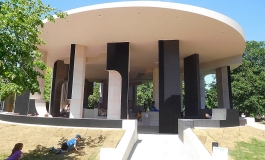
This year, the pavilion was designed by an architectural practice, Counterspace, based in Johannesburg (South Africa) and led by Sumayya Vally, who is the youngest architect to have become involved in the Serpentine pavilion project. According to the Serpentine’s website (www.serpentinegalleries.org/whats-on/serpentine-pavilion-2021-designed-by-counterspace/) the 2021 pavilion is:

“… based on past and present places of meeting, organising and belonging across several London neighbourhoods significant to diasporic and cross-cultural communities, including Brixton, Hoxton, Tower Hamlets, Edgware Road, Barking and Dagenham and Peckham, among others. Responding to the historical erasure and scarcity of informal community spaces across the city, the Pavilion references and pays homage to existing and erased places that have held communities over time and continue to do so today.”

Well, maybe this was the designers’ aim, but it does not convey that concept to me. This circular, building coloured black and white, immediately conjured up in my mind images of often disused municipal structures such as bandstands and public conveniences that might have been constructed on provincial British or even South African seafronts in the 1930s to 1950s. It might have been conceived with high-minded ideas in the architects’ heads, but I felt that the structure is lacking in visual interest both in detail and in its entirety. Compared with many of the previous pavilions erected on its site, this is one of the dullest I have seen. It is a shame that the pavilion’s creators did not put more effort into its appearance than into the message(s) it is supposed to convey.   To my taste, it is a disappointment but do not let me put you off: go and see it for yourself.