LIBERTÉ ÉGALITÉ (MAYBE) FRATERNITÉ IN A FORMER FRENCH COLONY

PONDICHERRY IN SOUTHERN India was a French colony between about 1674 and 1954. This picturesque city is still divided into White Town, where the French lived, and Black Town, where the Tamils and other Indians resided.  The segregation of Europeans and non-Europeans persisted after the French Revolution  of 1789. It was during (or soon after) this historic uprising that  the motto ‘Liberté, Egalité, Fraternité’ came into existence. However, it was during a visit to the lovely church of Notre Dame des Anges in White Town that we discovered that the motto might not have applied to the Non-European inhabitants of the Pondicherry colony.


Within the neoclassical church, there is an informative panel outlining the church’s history.  The present edifice was constructed in 1855, but the parish is older. It was established by Capuchin monks in the seventeenth century. In 1699, the Capuchins established a Tamil Christian community. Soon, the Jesuits took over the Tamil community, and the Capuchins began a parish for Europeans and “Eurasians” (people with both Indian and European heritage). The Capuchin church of Notre Dame des Anges served Europeans and Eurasians, but not Tamils, who attended another church.


In 1887, almost 100 years after the French Revolution,  Archbishop Lauennen decreed that Notre Dame des Anges was for the exclusive use of Europeans and Eurasians. So much for the ‘égalité’ and ‘fraternité’, which was so dear the the French.


In 1984 Fr. Dusseigne, of the Société des Missions Étrangères de Paris (M.E.P) was the last M.E.P. Parish Priest, to serve the parish. He served until 2007, and was the last of a long line of Capuchin priests to lead the parish.


Dusseigne was succeeded by Fr. Michael John Antonsamy, who was the first Indian priest to lead the parish. Although he was the first Indian parish priest, I  have not yet discovered when non-Europeans began to be allowed to worship in this church in White Town.


Near the church, there is small walled cemetery where Capuchin monks have been buried. The earliest person to have his tomb there died in 1703. Sadly, the graveyard was closed, but we managed to see the well maintained funerary monuments through gaps in the locked gate.

  Colour bars were common in European colonies in Asia and elsewhere. Some of the clubs and schools founded by the British in India forbade entry of Indians even until several years after independence. So, one should not be surprised that colour bars existed in churches such as St Marie des Anges.  But what amazed me somewhat is that even after the French Revolution,  racial inequalities were not frowned upon in a French colony such as Pondicherry.
CREATIONS IN GLASS FROM INDUSTRY AND ARTISTS AND A PUNJABI PUB

TWO TEMPLE PLACE was built for the American businessman William Waldorf Astor (1848-1919) in 1895. Located close to Temple Underground Station and Middle Temple, this distinctive edifice is said to be designed in the ‘neo-Gothic’ style, although I would prefer to describe it, and especially its interior, as ‘Tudor Revival’. Every year, between late January and late April, the building, which is now owned and maintained by the Bulldog Trust charity, houses an exhibition, which is always worth viewing. This year’s exhibition, which continues until the 21st of April 2024, is called “The Glass Heart”.

The exhibition is described on the Two Temple Place website (https://twotempleplace.org/) as follows:

“It will explore the narratives central to glass art and manufacturing, and celebrate the timeless skills, artistry and innovation required to work with this challenging material.”

And it does that very successfully by exhibiting a superb collection of glass creations ranging from industrial products, such as Pyrex, through stained glass, to intriguing artistic creations that defy the imagination. I will not attempt to describe all of these exhibits – each one of them both fascinating and beautiful – but I will concentrate on one small collection of items relating to the Red Lion – a pub in West Bromwich (West Midlands).

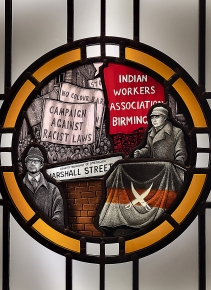
The Red Lion is a ‘desi’ pub owned by Indians, whose families originated in the Punjab, and came to work in the factories of Britain’s Black Country. Although all are welcome, the pub is mainly a socialising place for local people whose families came from the Subcontinent. It is one of several desi pubs in the former industrial heartland. In 2016, Steven Cartwright, who runs a studio that produces creative and decorative glassworks, was commissioned to create some stained-glass windows to decorate the Red Bull. His mission was to create traditional pub style stained-glass, but with an interesting slant – it was to celebrate the rich culture of the desi pub in the West Midlands. To do this, as Steven explained on his website (www.cartwrightglassdesigns.co.uk/projects/red-lion):

“I designed the window to give the appearance of a traditional pub but with a twist. The window utilises some of the colours and elements of the sub continent and tells the story of the punjabi community who migrated to the area in the 50’s. It also celebrates the establishment of the Indian workers association by Avtar Singh Jouhl and the visit of Malcolm X at their invitation.”

At the exhibition in Two Temple Place, there is a small piece of this pub’s stained-glass and some photographs of the rest of it.

What particularly intrigued me was the mention of The Indian Workers Association (‘IWA’) of Birmingham. The IWA was founded in the 1930s by Indian workers from Coventry to combat racist objections to them both by the British trade unions and the British people in general. The quote mentioned Avtar Singh Jouhl. He was born in the Punjab (British India) in 1937, and after the 1947 Partition, he came to London to study at the London School of Economics, arriving in 1958. Three years later, he moved to Smethwick in the Midlands, where he became an industrial worker. There, he saw and experienced racist anti-Indian conditions that prevailed at the time, He joined the IWA, and soon, along with others, he founded its Birmingham branch.

In February 1965, Jouhi invited the civil rights campaigner Malcolm X to visit Smethwick. A few days before his assassination, Malcolm X said of Smethwick:

“This is worse than America. This is worse than Harlem.”

In Jouhi’s obituary (The Guardian, 4th of November 2022), the following was written:

“The anti-racism campaign that attracted Malcolm X to Smethwick was spearheaded by Avtar Singh Jouhl, who has died aged 84 … Jouhl, as general secretary (1961-64; 1979-2015) and national organiser (1964-79) of the Indian Workers’ Association (IWA), challenged trade union members, factory owners and publicans to end this racism … When it came to breaking the colour bar in the town’s pubs, the IWA’s tactics were similar to those used by the Freedom Riders in the US in the previous decade. White university students were enlisted to order drinks, then hand them to British Indians, such as Jouhl. The landlord would invariably eject them, while the students challenged the eviction. The IWA then used evidence of these actions to successfully oppose the publican’s licence when it came up for renewal … This targeted campaign led to discrimination in pubs being outlawed in the Race Relations Act (1965) and paved the way for Britons of Indian heritage to become publicans themselves and set up what are commonly now known as “desi pubs”.

It was his actions described above and many others that helped to suppress racism in the Midlands and elsewhere in Britain. And it is very pleasing to see that what he achieved is being celebrated in glass in a pub owned and frequented by the people whom he helped. I visited the exhibition at Two Temple Place because I enjoy viewing glass artefacts. Little did I know that I would leave the exhibition having been introduced to an important political movement, about which I had known nothing.

Exclusion of Indians even after India became independent

WE HAVE STAYED in the guest accommodation at Calcutta’s Tollygunge Club several times. On our most recent visit, I spent a few minutes looking at the boards on which the names of the Club’s past Presidents are listed.

Between the year in which the Club was founded – 1895 – and 1968 – twenty-one years after Indian Independence- all of the Presidents had British surnames.
In 1969, the post was held by Brigadier RB Chopra. His surname is Indian. He was succeeded in 1970 by HA Whittle – someone with a British surname. Mr SP Achary, who was the next President (in 1971) had an Indian surname.

Mr Achary was followed by CJN Will CBE in 1973. Thereafter, most, but not all, of the Presidents had Indian sounding surnames. An exception was the President in 1979, who was AWG Macintyre, CBE. He was a senior executive in the Dunlop tyre company.

Seeing all of these Presidents with British surnames holding their positions so long after India became independent got me wondering. Already I knew that even after independence, some private clubs and other institutions in India restricted admission to Europeans and refused entry to all but a very few Indians. I became curious to know when the Tollygunge Club began welcoming Indians as members. The answer is that the colour bar was lifted in 1961. Indians were then admitted as “Associate Members”. They had no voting rights. The first non-white Associate Member was the then Japanese consul. In 1967, the first batch of 30 Associate Members (I.e., Indians) were made Permanent Members. The first Indian President, Brig. Chopra was amongst this batch.

Various factors must have swayed the Club towards admitting Indians. One of these might have been the slowly declining British presence in Calcutta. Another was more serious. Cutting a long story short, in the late 1950s, the West Bengal government, acting to some extent on guidelines from Central government, began to question the future of the elite clubs of India.

The government of West Bengal drew up a plan to construct a housing estate on the extensive grounds of the Tollygunge Club golf course. The clubhouse would have then been converted to some kind of communal amenity. These plans caused great concern to Calcutta’s British community. This plan was aborted. I have heard one explanation of why this happened, but it would be best if I do not reveal it.

Declining Club revenues and increased taxation must have also led to the Club enlarging its membership by accepting Indians as full members. During the very early 1970s, my father-in-law, a senior executive in a large company, was offered membership by the Tollygunge Club. He turned down the offer because he was reluctant to join a club that had refused membership to Indians for so many years after India became independent.

It is fortunate that the Tollygunge Club with its lovely grounds has survived because, although still quite exclusive, it is a wonderful place to relax and make new friends.

Colour bar at prestigious clubs

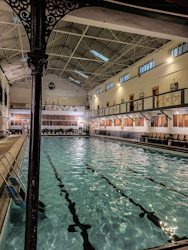
LAST NIGHT, THE 18th of January 2023, a relative by marriage hosted us for dinner at a historic swimming club in Kolkata. It was established in 1887. However, it was not until the 1960s that Indians were able to become members.

Despite India becoming independent of British rule in 1947, many of the prestigious clubs established in India prior to that date did not admit Indians as members until several years later.

In the 1960s, when eventually the Tollygunge Club in South Kolkata began admitting Indians as members, my father-in-law was offered membership to this exclusive previously ‘whites only’ club. He turned down the offer because he was a nationalist at heart and was upset that the Club had remained racist so long after 1947. In contrast, he happily became a member of the Bangalore Club, which welcomed Indian members almost immediately after Independence.

It is a mark of the tolerance of Indians that elite clubs (and some schools) were allowed to exclude non-Europeans so long after 1947, and, incidentally, that statues of Queen Victoria (and other British ‘worthies’) can still be found intact in many Indian cities.