
A deserted abbey in ruins close to the River Dee in North Wales

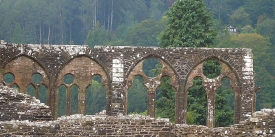
WE USED TO make long trips by car in France. Amongst the many sights we visited were various Cistercian abbeys, such as those at Citeaux and Clairvaux. Later, during trips to Wales, we often visited the ruins of the Cistercian Abbeys at Strata Florida and at Tintern on the River Wye. I do not know what drew us to these Cistercian places, but we went out of our way to see them. So, when we were staying near Warrington in Lancashire and I noticed that we were not far from yet another Cistercian site, we made a bee line for it.  Overlooking the River Dee, the ruins of Basingwerk Abbey are located near the town of Flint in the county of Flint.

Though not as extensive as the ruins at Tintern, there is plenty to see at Basingwerk. Dedicated to the Virgin Mary, the abbey was founded in 1132 by Ranulf de Gernon, 4th Earl of Chester. Being on the border between England and Wales:

“Basingwerk was patronised by both the Welsh and Anglo-Norman nobility. Royal benefactors included Henry II, Prince Llywelyn ab Iorwerth (d. 1240), Prince Dafydd ap Llywelyn (d. 1246) and Edward I.” (https://www.monasticwales.org/browsedb.php?func=showsite&siteID=24).

Originally founded as part of the Order of Savigny, it joined the Cistercian Order in 1147. In about 1355, it was reported that the abbey was in a devastated condition. During the early 15th century, Basingwerk tried to encourage pilgrims to visit its shrine, hoping that this would raise funds to repair the place. Between 1481 and 1522, Abbot Thomas Pennant restored the abbey and improved its fortunes. Sadly, by 1537, the institution had been suppressed by order of King Henry VIII. In 1540, the site of the former monastery was sold. After changing hands a couple of times, it became the property of the Mostyns of Talacre.

In 1923, the ruins of the abbey were taken over by the government, and now they are well-maintained by CADW – the historic environment service of the Welsh Government. Despite the appallingly bad weather prevailing when we visited the remains of the Cistercian abbey, we were able to enjoy wandering around the ruins. To recover from the inclement conditions, we took refreshments in the nearby café/restaurant in Basingwerk House.
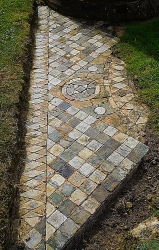
Out on the tiles in North Yorkshire

YORKSHIRE IS RICH in the ruins of abbeys and other religious institutions, which were all dissolved (closed down) by Henry VIII in the 16th century and left to decay. The better known of Yorkshire’s ruined abbeys include those at Fountains, Rievaulx, and Whitby. In the North Yorkshire district of Ryedale, there are the extensive ruins of a former Cistercian abbey, founded in 1137 and called Byland Abbey. Having visited ancient but still intact and well-preserved Cistercian monasteries in various places in France, I have a reasonable idea of what these places look like. What I particularly liked about the ruins at Byland was that although much of the old stonework has been taken away and incorporated in other buildings, sufficient remains not only of the abbey church but also of the many buildings (e.g., the refectory, the cloisters, the chapter house, and the abbot’s house) that made up the monastic settlement. Having seen the monasteries in France I was able in my mind’s eye to create an image of how Byland might have looked in its heyday.

Apart from its great beauty as a ruined church, the abbey’s vast former church has something that I cannot recall ever having seen at other ruined abbeys I have visited. Exposed to the open air and risking being trod upon by visitors are many quite large expanses of mediaeval floor tiling. Many of the fired clay tiles still bear their coloured glazes. There are patches of tiling where they are laid out in circular geometric patterns. It was surprising to see such a great number of these tiles because even in many of the still intact British churches and cathedrals, such ancient flooring is quite rarely preserved to such an extent as in the ruined Byland Abbey.

I was told that when the abbeys were dissolved by Henry VIII, their roofs were removed, and this ensured that the buildings became unusable and fell into decay. The west end of Byland’s huge church contains the remains of a masonry circle that was once the frame for an enormous rose window, believed to be a prototype for the rose window that still can be seen at York Minster. While the Minster is a sight not to be missed, so is Byland Abbey. The latter might not have such a spectacular location as the ruins at Whitby and Rievaulx, it is, in my opinion, a far more interesting place to explore.

Travelling abroad at last

WE ARRIVED IN ENGLAND from India on the 27th of February 2020. Because of the covid outbreak, we had not left England until today, the 13th of September 2021. Some, especially those who live there, regard Cornwall as being another country, rather than part of England. We have visited that southwest county of what most people regard as England, since we arrived back from England. So, it would be pushing things if we said that we went abroad to Cornwall,

Today, we travelled abroad, leaving England for a few hours. To reach our destination we did not have to take covid tests or show evidence of double doses of vaccine or, even, show our passports. However, leave England we did. We crossed the River Severn to leave England and enter Wales. Crossing the Severn Bridge on the M48 did not require us to pay a toll as used to be the case, as the crossing is now free of charge. A few years ago, a toll was charged for crossing into Wales, but no longer; it has been abolished.

Tintern Abbey

Well, I hear you say, Wales is not exactly ‘abroad’, but when one has not left England for over 18 months, it will do as ‘abroad’. Wales has its own parliament and most signs, be they on the road or elsewhere, are bilingual (English and Welsh) and, if you are lucky, you will meet a speaker of the Welsh language. To us, crossing over into Wales, after so many moths without foreign travel, felt like going abroad.

We drove along the beautiful Wye Valley and stopped at the attractive ruins of the former Cistercian Tintern Abbey (Abaty Tyndyrn in Welsh), the first ever Cistercian foundation in Wales. At the ticket office, I expressed my joy at being abroad after so many months, and the cashier said to me in a gently Welsh accent:

“I like your style.”

We have visited Tintern Abbey (founded 1131) many times in the past and each time it has been a wonderful experience. Today was no exception. Set in a wooded valley, the ruins of the gothic buildings look great against the background of trees with dark green foliage. After spending about an hour in Tintern, we drove along roads which were mainly in Wales but occasionally crossed the border into England. When we reached Wrexham (Wrecsam in Welsh), we headed off north and east into England, our trip abroad having been completed.