Sunday morning stroll along the river from Hogarth’s grave to Hammersmith Bridge

EARLY ON SUNDAY mornings, we often drive to the riverside between Chiswick and Hammersmith. Usually, a parking place can be found on Chiswick’s picturesque Church Street close to the church of St Nicholas, in whose graveyard the artist William Hogarth is buried. This narrow lane leads from the Hogarth Roundabout to the riverside. Chiswick Mall follows the riverbank. On one side it is lined with elegant houses, some of which are several hundred years old. Between the Mall and the water’s edge, there is a chain of private gardens, across which you can catch glimpses of the river. All along this road, there are plenty of trees and flowers to be enjoyed.

Heading downstream, Chiswick Mall ends, and leads into the short Hammersmith Terrace, which is lined with houses where some famous printers and typographers once lived. Beyond Hammersmith Terrace, from which the river is hidden by houses, we regain views of the water as we walk along Upper Mall. This riverside promenade heads east and ends at a narrow passageway next to the Dove Pub, but before reaching it, we pass Kelmscott House, once a home of the artist and social reformer William Morris.

After passing the Dove pub, we enter Lower Mall. This riverside thoroughfare runs past Furnivall Gardens and then beneath Hammersmith Bridge, eventually reaching the Riverside Studious, where in addition to seeing one of the Daleks used in the “Dr Who” TV films, you can obtain refreshments in a pleasant café with a good view of the bridge. Sadly, this Victorian strucruer is in such a poor state of repair that only pedestrians and cyclists can cross it.

By walking between Hogarth’s grave and the Riverside Studios, you will have walked almost exactly one mile. We do this pleasant stroll quite often, and are never disappointed. Along the way, there are potential hazards including self-important joggers, who cannot understand that they are not the only people allowed to use the pathways, and cyclists, who seem to have the same arrogant approach as the joggers. That said, walking between St Nicholas and Hammersmith Bridge is a worthwhile and enjoyable experience, and along the way you will pass many places of historic interest, which are described in detail in my book “Beyond Marylebone and Mayfair: Exploring West London”.

A cafe of uncertainty

MANY READERS – ESPECIALLY those with some knowledge of physics – will have heard of the German Werner Heisenberg (1901-1976), who is well known for his famous Uncertainty Principle that relates to quantum physics. Because of my uncertainty about what exactly this principle expresses, I will let you look it up on Google or elsewhere.

One thing I was not uncertain about was seeing a café called Heisenberg in Chiswick’s Turnham Green area. As it was nearly 11 am, I was certain that I needed a cup of coffee, and what better place to have it than a place named after a person who ‘discovered’ uncertainty. The café is small but quirkily decorated and the coffee it served was very good. We drank from disposable cups, which bear the motto:

“Perfection cannot be measured as explained by the Heisenberg theory. However, this is the closest you’ll get to the perfect cup of coffee.”

Although I am uncertain whether the second part of this is true, I am certain that when I am next in the area, I will try another cup of Heisenberg’s coffee.

No, not the former Prime Minister

AT THE WESTERN END of Chiswick’s Turnham Green, there is a striking church, which was designed in the Arts and Crafts style by the architect Richard Norman Shaw (1831-1912) and consecrated in 1880. It served the community that was beginning to settle in the recently established Bedford Park, which I described as follows in my book “Beyond Marylebone and Mayfair: Exploring West London”:

“Bedford Park near Turnham Green is probably the first example of what has become known as a ‘Garden Suburb’ development, although originally it was not known as such. Pevsner noted:

‘Its reputation as the earliest garden suburb needs some qualification. Trees and green spaces … are found in many earlier suburbs; the novelty of Bedford Park is their combination with ‘artistically designed’ houses … inspired not by classical or Gothic pattern books but by the red brick and tiled idiom derived chiefly from the home counties vernacular of the c17 and c18…’

He added that the idea was to recreate the:

‘… relaxed informal mood of a market town or village…’, in ‘… a completely speculatively built suburb.’

And, in the case of Bedford Park this ideal has been almost but not quite fully achieved, because the suburb, attractive though it is, has a somewhat staid, bourgeois feel about it. Created by Jonathan Thomas Carr (1845-1915), its development began in 1875 …”

If you want to know more, you can find it in my book.

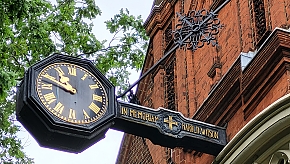
Returning to the church, which we re-visited today (20th of June 2023), I showed my wife the interesting clock on one of its exterior walls. It is held away from the building by a sturdy beam on which there are some words. On one side, you can read: “Spion Kop Africa 1900”, and on the other, you will see: “In memoriam Harold Wilson”.

In case you are wondering, the clock has nothing to do with the former Prime Minister Harold Wilson (1916-1995). Instead, it commemorates 2nd Lieutenant Harold AC Wilson, who fell at the battle of  Spion Kop in January 1900 during the 2nd Anglo-Boer War (1899-1902).

[My book is available from Amazon: https://www.amazon.co.uk/BEYOND-MARYLEBONE-MAYFAIR-EXPLORING-LONDON/dp/B0B7CR679W/ ]

An artist and a traffic roundabout

THE FOLLWING FIVE ROADS meet at West London’s busy Hogarth Roundabout: The Great West Road, Church Street, Burlington Lane, Hogarth Lane, and Dorchester Grove. Excepting Church Street, they are all major thoroughfares, which carry a great deal of traffic. The roundabout is named after the artist William Hogarth (1697-1764), whose former home, Hogarth’s House – now a museum, is close by.

The museum at Hogarth’s House contains a large collection of prints created by Hogarth. All of them illustrate 18th century life in Britain in exceptional detail. The artist did not portray scenes straightforwardly. He portrayed the people and what they were doing in a satirical – sometimes comical – way. So, that what we see today is not only how things looked in Hogarth’s time but also what he felt about them.

Amongst the prints on display, there is one created in 1997 by the cartoonist Martin Rowson (born 1959). It depicts the chaos, dirt, and traffic at Hogarth Roundabout as Hogarth might have done had he been alive to see it. This entertaining print, which was made to commemorate Hogarth’s 300th birth anniversary, includes details copied from Hogarth’s prints. It is a fascinating addition to the collection of the small museum.

It was the fashionable thing to do

I AM READING A most fascinating book at present (June 2023). Published in 1984, it is “Staying Power: The History of Black People in Britain” by Peter Fryer (1927-2006). In it, the author described how during the 18th century, it was fashionable for wealthy British people living in England to have at least one ‘black’ servant (or slave, in some cases) amongst their teams of domestic staff. Including a black servant in a portrait painting was believed to add to the perceived status of the subject being portrayed. Putting it crudely, just as sporting a Prada handbag or driving a Maserati is supposed to enhance the status of their owners today, exhibiting the ‘black’ servant did the same for the vanity of the wealthy in the 18th century. Sadly, many wealthy British people in the 18th century did not see the ‘black’ servants as human beings but as valued possessions or accessories.  

Today (3rd of June 2023), we paid a visit to Hogarth’s House in Chiswick. Located next to the busy A4 dual carriageway and the often-congested Hogarth Roundabout, it is now hard to believe that in 1749, the artist William Hogarth (1697-1764) bought this place to use as his country home. For, in those days this 17th century house was surrounded by countryside. The house and its garden are open to the public free of charge. The visitor gets to see a series of wood-panelled rooms, very much like those I have seen a friend’s 18th century house in the oldest street in Kensington. Unlike our friend’s house, the walls of the rooms of Hogarth’s former country place are lined with a large number the artist’s wonderful, printed works. Most of these depict scenes portrayed with many fine details. They express Hogarth’s satirical views of the life and behaviour of his contemporaries.

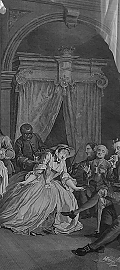
Some of the prints portray the lives of the poor and less well-off. A few depict life in ‘high society’. In several of the latter, there are a few black faces amongst the people in the pictures. All of them are obviously servants. In one of these prints, a black woman with her back facing the viewer can be seen attending to something at her white mistress’s foot. The lady is reclining, and she is looking up from a book propped in front of her. In another print, a black man is shown carrying a cup and saucer into the room filled with white people and there is also a black child playing with a small statue or toy. I examined all the prints on display and noticed that it was only those with scenes of the lives of rich people that included black people. The people in all the other prints were white only.

The depiction of black people with rich people in Hogarth’s satirical depictions of life in 18th century England helps to back up what I have read so far in Fryer’s book. That said, and I might not have noticed what I have described had I not been reading the book, Hogarth’s House is a delightful place to visit. It does not offer refreshments but the lovely café at Chiswick House is only a few minutes’ walk away.

An oddly named house overlooking the River Thames

WALKING BY THE THAMES along Chiswick Mall is always enjoyable whatever the weather. The landward side of the street is lined by houses, many of them well over 100 years old. One of them is called Said House. At first, I imagined that the ‘Said’ referred to someone or something in the Arab world, but it seems that this is not the case.

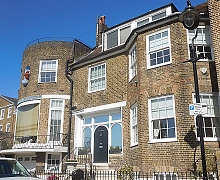
Said House on Chiswick Mall

The façade of Said House is dominated by an overly large bay window with a vast single pane of curved glass. The building’s earliest structures date back to the 18th century, but much has been done since to distort its appearance. Pevsner said that the building was Victorian, but “georgianised” in about 1935 by Darcy Braddell (or by Albert Randall Wells [1877–1942]). One of its early inhabitants was an artist, Katherine Parsons. The actor and theatre manager Sir Nigel Playfair (1874-1935) was also one of its inhabitants. It was for him that the modifications, including the western wing with its bay window, were made.

The origin of the house’s name is uncertain, but one source suggests that it is so-called because its title deeds refer to “the said house”. This is the only explanation of the name that I can find having searched the Internet thoroughly.

There is a terracotta urn in an alcove high above the bow window. A passer-by with a strong Irish accent despite having lived in Chiswick for 65 years told me that this was something to do with Josiah Wedgwood (1730-1795). This might possibly be the case, but I cannot be certain about it. Wedgwood’s associate Thomas Bentley (1731-1780) did live in Chiswick. According to Lloyd Sanders in his “Old Kew, Chiswick and Kensington” (published 1910):

Bentley was in failing health when, in 1777, he took up his residence at Chiswick, possibly to be near his friend, and three years afterwards he died. He was buried in Chiswick church, where Wedgwood raised a monument to his memory with a medallion portrait by Scheemakers.”

I have not yet discovered precise location of Bentley’s house. But that should not stop you from taking a stroll along Chiswick’s lovely Mall and enjoying the glorious display of flowers in bloom especially during spring and early summer.

From his garden to his grave

IT IS PLEASANT to stroll beside the Thames along Chiswick Mall. Occasionally, we take a look at the graveyard of Chiswick’s St Nicholas Church. On a recent visit to this place, we walked deeper into it than usual and spotted a grave marked by a remarkable sculpture.

The idyllic, romantic, leafy churchyard by the river is chock full of graves. Several of them caught my attention. One is that for the artist William Hogarth, who lived close-by. His monument is protected by a cast-iron fence. An urn on a plinth decorated with an artist’s palette and brushes. It was erected after the death of his sister in 1781 (who is also commemorated on this monument) and was restored by a William Hogarth of Aberdeen in 1856. Another painter, Philippe Jacques de Loutherbourg (1740-1812), who was born in Strasbourg, is buried with his wife Lucy de Loutherborg (née Paget). Like Hogarth’s, their decaying monument on the north side of the cemetery is surrounded by cast iron railings. In 1789, Philippe gave up painting temporarily to develop his interest in alchemy and the supernatural. Later, he and his wife took up faith-healing. The remains of yet another painter, James Abbott McNeill Whistler (1834-1903), lie in the cemetery.

Private Frederick Hitch (1856-1913) is less famous than these artists. He was awarded the Victoria Cross for his brave actions during the Battle of Rorke’s Drift (January 1879) in the Anglo-Zulu War fought in South Africa. He is also buried in this large cemetery.

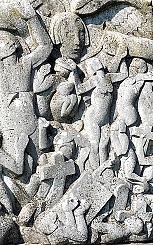
Amongst the more recent graves is the one with the unusual sculpture. It is that of Baronet Percy Harris (1876-1952), who was a Liberal politician. Son of a Polish immigrant, he was born in Kensington, and died there after a long career in parliamentary politics. According to a website listing British Jews in WW1, Percy was Jewish, yet his grave is distinctly Christian in sentiment. Aesthetically, his grave is the most remarkable one in the cemetery next to St Nicholas. It includes a semi-abstract, vorticist carving of The Resurrection of the Dead, created by the sculptor Edward Bainbridge Copnall (1903-1973) in the 1920s. Harris had acquired it for display in his garden long before it was moved to adorn his grave.

Although Percy Harris was born Jewish, he is buried in the graveyard of a Church of England parish church. Despite searching the Internet, including reading his extensive entry in the Dictionary of National Biography, I cannot determine whether or not he converted to Christianity sometime during his life.

The fantastic herons

ON SUNNY EASTER Sunday (2022), we took a morning walk along the Thames Path from the Black Lion pub (and the excellent Elderpress Café facing it) to Dukes Meadows, upstream from the pub. Dodging the endless stream of mostly courteous joggers and less polite cyclists, we enjoyed splendid views of the River Thames and the many old buildings lining Chiswick Mall. Several of the buildings were covered with flowering wisteria.

The Fantastic Herons

The river was well-populated with waterfowl including swans; geese of various kinds; ducks; a pair of cormorants resting on a buoy; and several herons. The latter were either standing on the sand and mud at the waterside or in the water close to the bank. Eventually, we reached Dukes Meadows, which consists of fields formerly part of the estate of nearby Chiswick House.

Near the Hammersmith end of the Meadows, we saw a metal sculpture, ‘The Fantastic Herons’, on top of a tall pole. Created by the artist Kevin Herlihy (born 1962) along with pupils from Cavendish Primary School and unveiled in 2004, it depicts three herons standing on a nest. Like most of Herlihy’s creations which often depict animal life, it is made from recycled waste materials. Funded by Singapore Airlines, who held a series of art workshops in the school, it is an appropriate sculpture for the area as herons can often be standing by, or in, the Thames flowing past the Meadows.

Letting off gas

THIS IS AN UNSAVOURY subject. So, you have been warned.

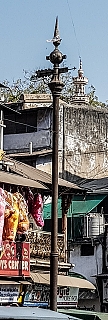
On our first visit to Baroda (Vadodara) in the western Indian state of Gujarat a few years ago, I noticed several tall cast-iron structures resembling lamp posts, except that they were topped with curious objects. Each of these tall streetside poles is topped with spheres, each with four cylindrical projections. Beneath each sphere, there is an arrow. I was puzzled by these objects. So, I posted pictures on Facebook and asked if any of my friends knew what purpose these things serve or used to serve. I received several ingenious suggestions, none of which turned out to be correct.

Baroda (Vadodara)

Having seen these items in Baroda (and also in Bombay and Ahmedabad), I began noticing similar structures in London. None of the examples in London are topped with the sphere and arrow, but in other respects they are not particularly different from those I saw in India. Eventually, I learned that they are all examples of ‘stink pipes’. There are many fine specimens, disused I believe, dotted around London. Recently, I was reminded of those I saw in India when I saw a couple near Chiswick Mall in west London.

It was not until after about 1858 that sewage began being channelled through enclosed sewers in London, an improvement instigated by London Metropolitan Board of Work’s Chief Engineer Joseph Bazalgette (1819-1891). Sewage is waste matter, which tends to decompose. The products of decomposition include noxious gases such as for example hydrogen sulphide, carbon monoxide, ammonia, and methane. Some of them are highly inflammable and all of them increase in pressure as the sewage flows through the sewers. The stink pipes serve(d) as vents through which the gasses building up could escape from the sewers. They tend to be tall so that the gases blow off high above ground level where there are more likely to be breezes that can disperse the gases. Without adequate venting, the gaseous vapours can become dangerously explosive. Returning to Baroda, where the stink pipes are topped with spheres. The gases escape through the conical projections and, I have learned, the arrows indicate the direction of the sewer running beneath them and which way the sewage is flowing.