Overcharging by Uber taxi cabs in Chennai

WHENEVER WE HAVE HIRED Uber cabs in Bangalore, Bombay, Calcutta, and Hyderabad, we have always paid the amount quoted on the Uber app when making the booking: no more and no less. During a recent visit to Chennai (Madras) in January 2025, we ordered several Uber cabs, and each time experienced the same thing.

The first Uber cab we ordered arrived, and the driver asked us how much we had been quoted. When we told him, he said he would take us only if we paid an amount he mentioned, which was greatly in excess of the fare quoted on the app. On subsequent occasions, we ordered Uber cabs using the app and each time the driver telephoned us before he arrived. Each driver wanted to know the price of the fare on the app. And each time we told the driver the amount, he replied that he would only pick us up if we agreed to pay the higher fare he quoted. We were most surprised by this, but a friend in Chennai seemed to think that there was nothing unusual about what we were experiencing.

I suppose the Uber drivers in Chennai are charging a surcharge to cover what the Uber company deducts from them as a commission.

A Swiss hut in the centre of Chennai

OPPOSITE THE APOLLO Hospital in the Thousand Lights district of Chennai, my eyes alighted on a sign I was least expecting to see in southern India.  The sign adorned the panel beneath the eaves of what resembles a Swiss chalet. It read “Swiss Hütte”. It is a restaurant. It was closed when I first spotted it, but we returned the same evening when it was open. We decided that it was such an unusual find that we had to eat something there.


The restaurant was founded about 19 years ago by a chef Joe Lobo. He lived in Switzerland for 25 years, working as a prize-winning chef. On returning to India, he established the Swiss Hütte restaurant. It is located in the verdant grounds of his family’s home.


The restaurant has an extensive menu with dishes inspired by various national cuisines, both European and Asian. We ate at the Hütte  several times, and everything we ate was delicious and perfectly prepared.


We asked Joe if he ever served Swiss food. Occasionally, if given sufficient notice, he will make fondue. However, in his opinion, Swiss food is bland and tasteless. These adjectives can not be used to describe what Joe cooks in the kitchen for his guests. Eating Joe’s food, it is easy to see why he has won prizes for his cooking.

A photographer and his works exposed at a garden in Chennai

SUNIL GUPTA IS a renowned photographer. He was born in 1953 in New Delhi, and migrated to Canada with his family in 1969. With a degree in accountancy and a diploma in photography, he moved to London (UK) in 1983. There, he married another photographer Charan Singh. Much of Sunil’s work relates to themes of sexual identity, migration, race, and family.

While we were in Chennai, the parents of another photographer, Varun Gupta, told us about the exhibition of Sunil Gupta’s works currently (January 2025) being held in the garden of the Government Museum in Chennai. The show is part of the Chennai Photographic Biennale, of which Varun is one of the founders.

The show is being held in the open air. We saw it when the air temperature was hovering around 29 degrees Celsius. In addition, crowds of schoolchildren were enjoying their packed lunches on the ground amongst the walls upon which the photographs were hanging. The show has been arranged to produce what could be termed an autobiography expressed by photographs.

There is no doubt that Sunil’s photographs are visually superb as well as being of great interest.

While I was looking at the images, many of which are artistic as well as informative, I began to wonder whether photography limits the expression of a photographer’s innermost feelings more than is the case for a creator who is painting or sculpting. The photographer, like other visual artists, can compose his/her pictures, regulate their appearance, and edit them. However, the light coming through the camera lens dictates the final product however many adjustments etc are made. In contrast, the light coming through the eyes of a sculptor or a painter (or a printmaker) impinges on the artist’s brain, and what eventually results reflects the effect that the image projected into the brain has on the creator’s innermost feelings about the subject matter.

Having said this, which I hope makes at least a little sense, I must admit that I do enjoy making photographic images and I hope that my photographic skills will be improved by viewing great works such as we saw at the exhibition of Sunil Gupta’s photographs in Chennai.

A peaceful garden close to the Adyar River in Chennai

THE MEANING AND PRACTICE of Theosophy remain a mystery to me. Suffice it to say that Theosophy was first established by Helena Petrovna Blavatsky and others in 1875. One of its co-founders was the American Colonel Henry Steel Olcott. With some others  they founded the Theosophical Society. In 1895, there was a split in the society. Blavatsky and Olcott both converted from Christianity to Buddhism and established the home of their branch of the Society in India, the birthplace of Buddha. By the way, the Theosophists welcome people of all faiths.


Blavatsky and Olcott established the headquarters of their branch of Theosophy on a plot of land close to the Adyar River in Chennai (Madras). The various buildings used by what became known as the  Adyar branch of the Society are set within a 260 acre garden known as the Huddlestone Garden. This peaceful area is rich in trees, other plants, wild birds, and other wildlife. During our visit there in January 2025, we spotted two mongooses as well as numerous squirrels and dogs.


Although I  can tell you almost nothing about the nature of Theosophy,  I  have two personal connections with it. First, my wife’s paternal grandfather,  Kisanlal Daru, was an influential member of the Bombay branch of the Adyar Theosophical Society. 


Secondly, one of our friends in England is the grandson of Peter Freeman (1888-1956). The managing director of the family’s tobacco business  in Cardiff (Wales), he was a Labour politician, and served several terms as a Member of Parliament.  In addition, he was the General Secretary of the Welsh Adyar Theosophical Society between 1922 and 1944. He was the author of a few publications about Theosophy.  According to our friend, Peter’s grandson, when Peter died, he left all of his considerable fortune to the Adyar Theosophical Society.  I would like to believe that some of this legacy has helped to make the Theosophical Society grounds at Adyar so beautiful.

It pays to be perceived as being senior citizens

Chennai Airport is very modern and user-friendly until you leave its terminal building. To get a taxi or a hired car, you need to join a queue to board an electric buggy that carries you to a distant car park where you then wait again for your vehicle. Oh, and while travelling on the crowded buggies, you need to hang on to your possibly heavy and/or bulky luggage.

Fortunately, in the eyes of the team handling the buggy loading, we were considered to be elderly people. Therefore, they took us and some other aged people out of the queue and summoned taxis to pick us up outside the terminal building instead of at the distant car park, reached in the buggy.

Industrial action and a library

The Madras Gymkhana Club library was not devoid of interest. To enter it, one has to climb over a tall step. This is designed to protect the library when rainfall causes flooding of the Club’s grounds which are on low lying land close to the Adyar River estuary.

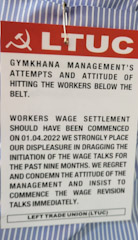
Another interesting feature was pinned to the shirt of one of the library staff. It was a rectangular plastic badge with a hammer and sickle on both of its sides. One side had words in Tamil, and the other in English. These words explain to the reader that there was a grievance between the staff and their employers, The Club. The problem about which the employees were protesting concerned pay. Seeing these badges of protest reminded me of a visit to Nizam’s restaurant in Kolkata a few years ago. There, the waiters were wearing similar badges, some in Bengali, some in Hindi, and others in English.

As for the library, it seemed well stocked with books and journals. Several old books were being sold, and there were three that I could not resist!

The bodies which came back to life

AT ABOUT FIVE in the morning, a taxi dropped us off at the Madras Gymkhana Club in Chennai. It was late February 1994, and we had just disembarked from an overnight train from Bangalore. We were going to rest at the Club before taking a flight to Colombo in Sri Lanka.

Today, the 8th of January 2023, we revisited the Gymkhana Club, and seeing the place reminded me of a strange experience we had there back in February 1994. The Club, which was founded in 1884, has as its main building an edifice gifted by the Rajah of Venkatanagiri in 1886. Compared with the Madras Club, south of it, its architecture is far less refined.

When we got out of our taxi before daybreak in February 1994, we entered the main building, which was unlit at such an early hour. The night watchman at the reception desk asked us to sit in some armchairs near the entrance until the morning receptionist arrived. After sitting for a while in the hot, humid reception area, the sun began to rise and the Club’s interior began to become visible slowly.

I noticed that we were sitting close to a very large room. As the light improved, I saw that the room was filled with tables. The tables were covered with napkins, cutlery, and plates of unfinished food. Alongside the tables, there were bodies lying on the floor. Soon after dawn, these bodies came to life. They belonged to the Club’s staff – waiters and so on. These people then proceeded to clear up the remains of the previous night’s banquet. Maybe, they had finished too late at night to make it worthwhile to return to their homes for a few hours.

Seeing these people lying in the gloomy light of daybreak and then coming back to life was a memorable experience. Visiting the Gymkhana Club today, 29 years later, evoked this memory powerfully.

Our brief visit to the Club today was quite different. The place seemed far from sleepy, and we received a warm welcome.

A short bus journey in Chennai

IT WAS VERY HOT when we decided to travel from Chennai Central Railway Station to the city’s Indo-Saracenic style High Court, which is about a mile away. A policewoman told us that it was too far to walk, so we must take a bus. Following her sensible advice, we boarded a local city bus.

As with all buses in India, there was a conductor on boarf who sold tickets. On enquiring the cost, we were told that the price was 5 rupees. We asked if that was per ticket or for the two of us. The conductor replied that my ticket was 5 rupees and that on his bus women travel free of charge. Then, he gave us two fragile paper tickets. One was marked with a large ‘5’ and the other was covered with Tamil script, but no ‘5’ (except a small one in the ticket’s six digit serial number). A friend, who reads Tamil, explained that the brown ticket without the large 5 reads ‘lady’s ticket’.

After travelling one stop, we disembarked in a busy street market, and walked about a quarter of a mile to the impressive, oriental-looking Court building’s, which were constructed between 1888 and 1892, to the designs of architects JW Brassington, Henry Irwin, and JH Stephens. As we had committed no misdemeanors and had no legal work to do, we could not enter the complex of buildings.

The saying goes ‘there’s no such thing as a free lunch’, but during our visit to central Chennai, we discovered that there is such a thing as a free bus ride!

A strange notice in a railway station

BE THEY LARGE OR SMALL, I always enjoy railway stations. Today, the 7th of January 2023, we visited the Central Station in Chennai (Madras). This huge edifice is also known as ‘Puratchi Thalaivar Dr. M.G. Ramachandran Central Railway Station’. It is the busiest station in southern India. When we visited it at about 11 am, it seemed rather sleepy even though there were many people waiting for their trains.

The station was designed by a British architect George Harding. Its distinctive exterior has neo-Romanesque decorative features. It was first opened in 1873, but was rebuilt twice: in 1959 and 1998.

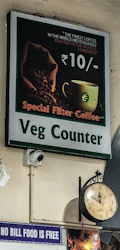
We bought coffees to drink in a canteen within the station. After paying at the cash desk we were given two small plastic discs, like counters used in board games. Each disc had the word “coffee” printed on one side of it. We handed these to a lady who prepared excellent South Indian filter coffee.

The walls of this small café-cum-restaurant are decorated with murals depicting Chennai and the Central Station. Numerous informative notices were also displayed in the walls. One informed customers that all of the water used had been filtered. Another forbids the eating of “outside food”, which means food not bought in the canteen. Yet another reassured customers that “medium refined” cooking oil was used in the kitchen. And another warned clients that they are under cctv surveillance.

One notice puzzled us. It reads: “NO BILL FOOD IS FREE”. Grammatically, it made no sense to us. We asked another customer, who was standing close to us, if she could explain. She smiled, revealing a set of teeth that would have benefitted from orthodontic treatment, and then, as quick as a flash, she explained that these words mean that without paying, no food will be served.

Armenian script in a church in Chennai

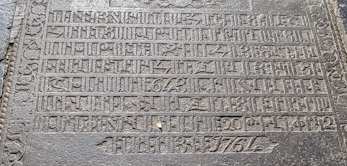
I HAVE VISITED ST THOMAS Mount in Chennai twice so far. The two visits were separated by at least a quarter of a century. Amongst the many interesting things to see and experience on this sacred hill are some examples of Armenian script. This characteristic lettering can be found both on several tombstones and on some framed paintings of saints. Also, there is some Armenian writing inscribed on an ornate pulpit.

The church on the Mount is dedicated to Our Lady of Expectation. There are several sculptures of the pregnant Mary in or near the church, which was constructed close to the spot where St Thomas (the doubter) is supposed to have died. The church was constructed by Portuguese Franciscan missionaries in the 1520s. None of this information provides any clues to the presence of the Armenian lettering.

Armenians began setting in Madras in significant numbers in the mid-17th century. There is an Armenian Street in Chennai, where one can find an Armenian church. This was built in 1712. The two funerary monuments I saw on the Mount are dated after 1712: 1739 and 1764. The paintings with Armenian script are far newer. I am no expert on Armenia, so can say little if anything about their religious practices. Many Armenians are Christians, and a few of them are of the Catholic variety. I can only assume that the graves on the Mount are those of Catholic Armenians, and that some Catholic Armenian donor provided the paintings.

If anyone can give me more information about the presence of Armenian script in this church on the Mount, please share it with me.