
Trains, buses, and Bar Linda in London’s Golders Green

MUCH HAS CHANGED IN Golders Green since I was a small child in the 1950s. However, a few things have remained more or less the same. My earliest memories of Golders Green Underground station and its neighbouring open-air bus terminus date back to about 1960, when I began travelling by bus to school in Swiss Cottage.
The Underground station used to have two entrances. One, which faces the bus yard, is still in use. The other, which was approached by a long, covered walkway from beneath the bridge crossing Finchley Road, was closed to the public many years ago, but the passageway still exists. It was this entrance that my family used when using the train to travel into central London. There was also a covered staircase situated between these two entrances – this, now disused, was opened during rush hours. It led to the small parking area where the H2 bus, which serves Hampstead Garden Suburb, begins its journey. During my childhood, there was no public transport in the Suburb. Every day, I used to make the 10-minute walk to Golders Green station, passing the crematorium and the Jewish cemetery on my way.

Overlooking the eastern edge of the bus yard, is what was once the Hippodrome Theatre. When I was a lad, this was a flourishing theatre showing plays and pantomimes. Later, it was taken over by the BBC. After they left it, various religious organisations have used it for their meetings. Built in 1913, six years after the Underground was extended from Hampstead to Golders Green, this building’s exterior looks much as it did when I first remember seeing it.

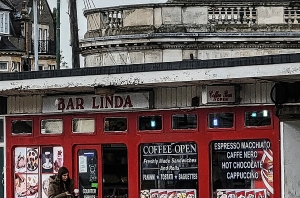
The western edge of the bus yard has always been lined with a row of single storey sheds. Most of these have been used as shops and offices for London Transport. One of them houses a small café called Bar Linda. This was not in existence when I first used to visit the station, but I believe that it opened in the 1960s. Although this friendly little place has been serving customers for many decades, the first time I ventured inside it was in about 2017 when I was about to walk around Golders Green to take photographs for a blog article I was planning to write. I have re-visited it several times since then.

Although Golders Green might not be as aesthetically pleasing as its neighbours, Hampstead and Hampstead Garden Suburb, it is an area full of interest. Much has happened there since 1907 when it began growing from a rural hamlet into a leafy suburb. You can discover much more about Golders Green – its past, my memories of it, and its vibrant present – by reading my book “GOLDERS GREEN & HAMPSTEAD GARDEN SUBURB: VISIONS OF ARCADIA”, which is available (paperback and/or Kindle, from Amazon websites, such as:

Pilots

I associate the word ‘pilot’ mainly with aeroplanes. Also, I think of small boats that help larger ones enter and leave ports. There is also, I believe, a creature called a ‘pilot fish’.

On arrival in Calcutta (now ‘Kolkata’) in West Bengal (India), I noticed that the local city buses have the word ‘pilot’ written on the doors that the bus drivers (i.e. pilots) use to enter their buses.

I am certain that I have never seen the word pilot used to describe a bus driver anywhere else I have visited.

Buggy battles

Buggy


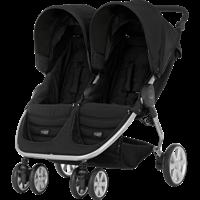
All public transport buses in London have dedicated areas for buggies (baby strollers, push-chairs etc.) Other passengers need to, or are made to feel that they need to, move out of the way so that a buggy can be parked in the designated area.  So far so good. Many child carers use their childrens. buggies as shopping trolleys, often overloaded with bags of merchandise. Often, the child or children being transported in the buggies are removed from them during the bus journey and then occupy a passener seat. The empty buggies then simply take up space that could be used by other passengers on a crowded vehicle.

Now, there are clear signs by the designated ‘buggy area’ that state quite clearly that the area is also for use by persons confined to wheelchairs. These signs also make it very clear that wheelchair users have priority over buggies in the special area on the bus.

Clashes, often quite uncivil, occur if too many carers pushing buggies are competing for the the limited space available for buggies and wheelchairs. Or, even worse, battles can break out between whelchair users who want to board a bus and buggy owners, who are already on board the bus. Both the child carers and the wheelchair-bound  people can often behave quite unpleasantly. Unlike the wheelchair occupant, almost all baby buggies can be folded up and placed in the luggage area that is available on every bus.

Yesterday, it was a sunny afternoon and I was travelling in a bus past Swiss Cottage in north west London. The buggy/wheelchair area was occupied by two baby buggies and a folded buggy was in the luggage area. We stopped at a bus stop where a man in a wheelchair was waiting. He wanted to board the bus, but the owners of the buggies occupying the designated area would neither fold their buggies nor leave the bus to make space for the priority user, the wheel chair user. The bus driver had to get out to sort out the stand-off. He wanted the buggy users to disembark, but they would not budge. In the end, the wheel chair bound fellow behaved decently, saying he would wait for the next bus.

In my opinion, both wheelchair passengers and buggy pushers can easily manage to wait  (especially when the weather is good) until a bus arrives with sufficient space. After all, the wheelchair user is sitting and waiting as is the buggy borne child, who is often far too big and independently mobile to be confined to a buggy. What do you think, dear reader?


Picture from: https://www.britax-roemer.co.uk/pushchairs/strollers