Three hares or rabbits sharing three ears between them in a church in Buckinghamshire

WE HAVE COME ACROSS this type of curious motif once before in the parish church at Long Melford (Suffolk), and recently (September 2024) in the parish church at Long Crendon (Buckinghamshire). The motif consists of three hares (or rabbits) in a circle and joined by their ears which form a triangle at the centre of the design. Each creature appears to have two ears, but between them, they share only three ears. At Long Melford, this image can be seen in a small piece of mediaeval stained glass in a window on the north side of the church. At Long Crendon, it can be seen on a small 14th century tile close to the high altar.

According to the guidebook we obtained in the church at Long Crendon, the three hare/rabbit motif is only seen in a few places in Britain (including 12 of the Stannary villages in Devon and Cornwall, Long Melford, Lavenham, and Chester Cathedral). Also, it stated that it can be seen:

“… in a few places stretching from China to Europe along the Silk Road.”

Well, this got me very interested, and I did a little research on the Internet. Soon, I came across a website, “Three Hares Project” (www.chrischapmanphotography.co.uk/hares/page7.htm).  This site contains a mine of information including a map showing where the motif has been found along the Silk Route and other places.

The earliest examples that have been found are on the ceilings of  Buddhist caves near Dunhuang in China. They been dated as having been placed there between 581 AD and 907 AD. The three hares have also been found on a late 12th or early 13th century Iranian tray made of brass inlaid with copper. Another example was found painted on the ceiling panel that once used to adorn an 18th century German synagogue. The authors of the website noted:

“The three hares are also found in glass and ceramic wares from the Islamic world.”

So, it appears that the motif that we have seen in churches was not confined to Christian usage.

As to the meaning of the three hares/rabbits motif, the website offered the following:

“… as yet, we have not come across a contemporary written record of its meaning … The hare is strongly represented in world mythology and from ancient times has had divine associations. Its elusiveness and unusual behaviour, particularly at night, have reinforced its reputation as a magical creature. The hare was believed to have mystical links to the female cycle and to the moon which governed it.”

What it meant to Christians, who placed the motif in their churches, was suggested on the website. It said that the ancients believed that the hare was hermaphroditic, and could give birth to its offspring without need for copulation. In relation to this, the learned Thomas Browne (1605-1682) wrote in 1646 in his “Pseudodoxia Epidemica”:

“THE double sex of single Hares, or that every Hare is both male and female, beside the vulgar opinion, was the affirmative of Archelaus, of Plutarch, Philostratus, and many more. Of the same belief have been the Jewish Rabbins: The same is likewise confirmed from the Hebrew word; which, as though there were no single males of that kind, hath only obtained a name of the feminine gender.” (https://penelope.uchicago.edu/pseudodoxia/pseudo317.html).

This belief might have led Christians of old to compare the hare to the Virgin Mary and the birth of her well-known son.

Another less likely possibility is that the three creatures have something to do with representing the Holy Trinity.

Whatever its meaning, I find the motif of three hares sharing three ears almost as fascinating as the eagle with one body and two heads (the double-headed eagle, such as seen, for example, on the flag of Albania and the crest of the Indian State of Karnataka).

Caught in time in west Buckinghamshire

DUE TO BE DEMOLISHED in 1900, the newly established National Trust (founded in 1895) saved it from this terrible fate that year. The building is a long, narrow half-timbered, brick and wattle structure in the attractive village of Long Crendon in the west of Buckinghamshire. Built sometime between the 14th and 15th century, it served as the manorial courthouse.

Meetings of the manorial court of Long Crendon are believed to have begun before the 13th century. Until 1233, they were held in the lord of the manor’s house, which was demolished that year. In 1275, the manor was divided equally among three female heirs, and courts were held in the farmhouses of their families. By 1558, the courts of the three lords of the manors combined, and it must have been around this time that the courthouse began being used for judicial procedures. The building was not only used by the court but also as a facility for the poor. By the 19th century, it was used by one family to store wool. Some historians question this. In Victorian times the courtroom was used as a Sunday school and a place where occasional public lectures were given.

In 1900, the National Trust purchased the venerable edifice and began repairing it to keep it standing.  The Arts and Crafts architect and designer Charles Robert Ashbee (1863-1942) and his wife lived in the courthouse. They used to invite groups of apprentices from London for arts-based holidays lasting a fortnight. In 1902, the Ashbees, whose bohemian activities disturbed the locals, left for Chipping Camden where they established the Guild of Handicrafts. In 1918, Ashbee was sent to Jerusalem as civic adviser to the British Administration for Palestine.  In 1937, the courthouse became used as a clinic by the area’s District Nurse. This continued after the NHS was established in 1948. The courtroom then served as a Welfare Clinic.

Between 1985 and 1987, the building was intensively restored. Now, the long room, which occupies most of the upper floor, and was once the court room, is now a village museum. It is reached by a steep flight of wooden stairs. The upper rooms are the only part of the building open to the public. The long courtroom has a timber floor made with irregularly shaped planks. The arched ceiling is supported by massive timber crossbeams. Each one differs in shape from the others. Various exhibits and boards with historic photographs line the walls of this otherwise empty room, in which long ago trials were held.

We visited Long Crendon to see the courthouse. However, many other buildings in this village are incredibly picturesque and well-worth exploring.

A concrete environment: a brave new world

ONE SUNDAY MORNING in October 2023, we arrived in central Milton Keynes (‘MK’). The reason for our visit was to see an exhibition at the MK Gallery. I will describe the exhibition in a future posting. Although it was just after 10 am, there were few people around in the city centre. The little that we saw of central MK reminded me of trips to modern parts of cities in Eastern Europe before the collapse of the so-called ‘Iron Curtain’. However, in comparison with those places, central MK seemed much less lively.

Like New Belgrade and the new parts of Bratislava and Budapest, MK was built after WW2. In the 1960s, the UK government decided that to relieve the housing congestion that had developed in Greater London, new towns should be developed. MK was one of these. It was founded in 1967, and named after one of the villages in the area which the new city covers, rather than, as I had believed, in honour of two economists (John Maynard Keynes & Milton Friedman). Laid out in a grid pattern, it is modernist in conception. Having learned the mistakes made when planning earlier new towns in the UK, MK was designed to have commercial buildings that did not exceed six storeys, and residential that did not exceed three. However, a few taller buildings were added in the 21st century to provide the city with a central landmark. The city was designed by Melvyn Webber (1920-2006), who, according to an article in Wikipedia, believed:

“… telecommunications meant that the old idea of a city as a concentric cluster was out of date and that cities which enabled people to travel around them readily would be the thing of the future, achieving ‘community without propinquity’ for residents.”

Thus, MK has an amazing grid of roads that mostly intersect each other at roundabouts. It also has a high proportion of its area covered with open spaces (greenery and water features). MK was granted formal city status in August 2022. The part of MK we saw – and it was only a small part, but centrally located – has roads separated by wide tree-lined walkways. As already mentioned, the place reminded me of post-war urban developments in the formerly Communist countries of Central and Eastern Europe. I wondered whether the city has been a success. I have read that it makes an important contribution to the economy of the UK, but what I would like to know is how its inhabitants feel about living in what resembles a totalitarian utopia.

Buckingham, but not the Palace

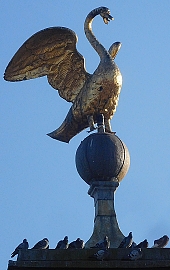
A LARGE GOLDEN SWAN with wings outstretched towers over the small town of Buckingham, once the county town of Buckinghamshire (until the 18th century, when Aylesbury took over this role) and now home to a respected private university, with whose founding my late father was to some extent involved. The gold-coloured copper swan surmounts a clock above the roof of an elegant late 18th century building on Market Square. Built in about 1783, this is The Old Town Hall, but not the oldest that the town has known.

The Old Town Hall was built to replace an even older one constructed in 1685 at the instigation of a local Member of Parliament, Sir Ralph Verney (1613-1696), during whose life the Civil War occurred. Initially on the side of the Parliamentarians, he fell out with them and fled abroad for a few years. After King Charles II gained the Throne, Verney returned to England where he served his people and the monarch.

In 1882, the clock was added above the Old Town Hall and upon this was placed the Swan of Buckingham, the borough’s crest. The wrought iron canopy over the main entrance was added early in the 20th century. The façade of the Old Town Hall faces another building, a well-known landmark and tourist attraction in the town, The Old Gaol, built in 1748 with its façade added in 1839.

The Old Town Hall was used for municipal administration until the 1960s when the local government headquarters were established elsewhere in the town. Now, the building is home to a firm of solicitors and the large metal swan high above their offices provides a nice perch for groups of the town’s pigeons.

Amazing Grace was written here in this small hut

MANY PEOPLE KNOW, but I did not, that the words of the hymn “”Faith’s Review and Expectation”, now better known as “Amazing Grace”, were written by John Newton (1725-1807), an Anglican clergyman. What fewer people know is that John Newton had once been the captain of ships that transported slaves across the Atlantic, but also a slave himself. In 1745, having fallen out with the crew on the ship he was sailing, he left his ship in what is now Sierra Leone. He was captured and enslaved and became the property of a princess of the Sherbro People, who lived in that part of Africa. He remained enslaved until 1748, when he was rescued by a sea captain, whom his father had sent to rescue him. On the voyage back to England, he received his spiritual calling.

Cutting a long story short, Newton was ordained as a priest in 1764. Soon after, he became the curate of a church in the small town of Olney in the north of Buckinghamshire. He remained in Olney until about 1779. While living in Olney, Newton struck up a friendship with the poet William Cowper (1731-1800; pronounced ‘koo-per’), who moved to the town in 1767. They collaborated on several literary projects.

From 1779 until his death, Newton was Rector of St Mary Woolnoth in the City of London. In 1788, Newton published his “Thoughts upon the Slave Trade”, a pamphlet that described to horrors on board the slave ships crossing the Atlantic. It was also a confession of his error of having been involved in such an inhumane business. He became an ally of William Wilberforce in the campaign to abolish the slave trade.

Olney is a charming little town, which we visited recently. Close to the market square, there is a large building in which William Cowper lived between 1768 and 1786. It now houses a museum dedicated to commemorating both Cowper and Newton. Behind the house, there is an attractive garden, which leads to another equally lovely garden. In the further garden, there is a small hut with white plastered walls and a tiled roof. It is just large enough for one person to sit inside it. It was here that Cowper’s friend John Newton used to sit and write. It is said that one of the hymns he wrote here in this tiny edifice was the hymn, now known by the words of its first line, “Amazing Grace”. This hymn was probably written in 1773.