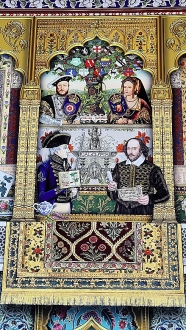
THE SINGH TWINS, Amrit Singh and her sister Rabindra Kaur Sing, were born in Richmond (Surrey), and brought up in Birkenhead (Cheshire). Between the mid-1980s and early ‘90s, they studied art at University College Chester, then at Manchester University. These highly creative women produce works that incorporate features of Indian traditional art, mediaeval illuminated manuscripts, contemporary western culture, and pop art, often all combined in one work.
The exhibition at Kew Gardens, “THE SINGH TWINS: Botanical Tales and Seeds of Empire”, which is showing until 12 April 2026, is filled with great examples of their artwork. Their highly decorative, colourful works are rich in interesting details, rather in the way that Italian renaissance paintings were enriched with symbols and features that would have meant a great deal to those viewing them when they were first paintings, and to art historians many centuries later. The many details in the pictures at Kew evoke many thoughts in the minds of people seeing them today, and remind the audience of events that happened not too long ago when Britain had a vast empire and Britannia ruled the waves, and much of the world’s commercial activity.
Each of the pictures on display at Kew contains plenty of witty and often chilling reminders of what the British (and other Europeans) did to the lands they colonised and exploited. Though filled with imagery relating to Britain’s imperial past and its consequences both abroad and in modern Britain, the pictures are glorious to see. A video, with a commentary written in verse and narrated by the twins, accompanies the exhibition. If the pictures alone do not convey the artists’ messages to all viewers, watching the film is very helpful. In keeping with where they are being exhibited, this collection of the twin’s work focusses not only on colonial histories but also on the plants that helped the colonisers enrich themselves.
The exhibition can only be visited if you have paid for entry to Kew Gardens or if you are a member. After seeing the exhibition you can wander around the gardens and spot some of the many plants that were originally brought from different parts of the empire to grow in the botanical gardens.
COMPTON CASTLE IN DEVON is deep in the countryside near to Torquay. It is a fortified manor house that dates back to 1520, and before the fortifications were added in that year, it was already a manor house by the mid fourteenth century.
For many centuries, Compton Castle was home to the Gilbert family. In 1785, the estate was sold. However, in 1931, and American descendant of the family purchased the estate and restored the castle. In 1951, the estate became part of the National Trust on condition that the family could continue to live in a part of it. Today, one wing of the castle is the private home of some members of the Gilbert family.
The most famous member of the family is Sir Humphrey Gilbert (c1539-1583). He is best known for establishing a British colony in Newfoundland – the first British colony in America. And it was the first ever British colony in the world. It can be said that by founding this colony, he was the founder of the British Empire.
Sir Humphrey died at sea while travelling on an English ship, the Squirrel. In many places within Compton Castle there are images and sculptures of squirrels in memory of this ship.
Compton Castle is well worth visiting. Not only is the castle magnificent, but also the rose garden next to it.
THE BRITISH MUSEUM contains many objects that were obtained when much of the world was part of the British Empire. Over the past couple of years, the artist Hew Locke (born 1959) has been selecting items in the museum’s collections and putting them together in a special exhibition called “What have we here?”. The exhibition will continue until the 9th of February 2025.
The items he has chosen are exhibited alongside sculptures and other artworks he has created in recent years. Each of the museum objects that Locke has chosen is accompanied by a short text that places the exhibit in the context of British imperialist exploits and exploitation. This has been done sensitively and gives the viewer an idea of what the objects meant to their original owners and why British collectors deemed them worthy of bringing home to England as ‘souvenirs’ of their activities in far off lands.
Interspersed amongst the exhibits chosen from the British Museum’s collection there are artworks by Hew Locke. Each of these beautiful things has been created to illustrate aspects of colonialism. For example, the model boats he has made symbolise exploration, trade, and the transport of goods and people (often against their will). There are also several historic companies share certificates on which Locke has added paintings. The shares were issued by companies that used slave labour. Perched above the display cabinets are a series of well-crafted but grotesque models of people, often dressed in clothes made from fragments of company documents. They represent the people who were downtrodden by their imperialist rulers.
In this exhibition, Locke neither seeks revenge nor condemns the activities of the colonialists. Instead, he tries to improve our understanding of what happened, hoping that history will not repeat itself. As with many other of Locke’s creations, this exhibition at the British Museum is both imaginative and eye-catching. It is well worth a visit.
THE ARTIST YINKA SHONIBARE was awarded the prestigious CBE in 2019. In case you do not know what these three letters stand for, it is ‘Commander of the British Empire’ – not that Britain has much of, if any, empire left to boast of. For much of its long existence, places in the British Empire witnessed many injustices and inhumanities. This was especially true before the abolition of the slave trade in the early 19th century. Yinka Shonibare, who was born in London in 1962 and brought up between that city and Lagos in Nigeria, uses his artistic skills to explore Britain’s lengthy history of imperialism imaginatively and creatively. Even without knowing that he does this, his art works are in themselves visually exciting and fascinating to the viewer. The pieces on display until the 1st of September 2024 at the Serpentine South gallery in Kensington Gardens are well worth seeing both for their inherent beauty and for the way that Shonibare expresses his interpretation of Britain’s colonial past and its legacy.
RECENTLY I PUBLISHED a book about the highly innovative Victorian photographer Julia Margaret Cameron (‘JMC’; 1815-1879). She married a British colonial administrator and lived during the heyday of the British Empire. In my book, I tried to portray her sympathetically, but I do hint briefly that she was a ‘child of her times’ as far as he attitudes towards the colonised was concerned. Today, the 11th of July 2023, I paid a visit to London’s National Portrait Gallery (‘NPG’) to see how JMC and her works are currently presented.
JMC was a friend of the painter George Frederic Watts. His portrait of her hangs in the NPG. Another portrait by Watts hanging in the gallery depicts the historian and social commentator Thomas Carlyle (1795-1881). Nearby in another room, you can see Carlyle as portrayed in a photograph taken by JMC. This photograph is close to JMC’s photograph (see photo above) of Edward John Eyre (1815-1901). As British Governor of Jamaica, this gentleman was responsible for the brutal suppression of a revolt against British rule on the island. Under his command, 1000 homes were burned and 439 people were killed. Although this outraged many in Britain, it was defended by people such as Carlyle. Eyre’s portrait, made whilst he was awaiting trial, was, according to the NPG’s label, crafted by JMC to make him seem as if he was vulnerable and not:
“… a ruthless murderer but a sensitive man of duty.”
Another caption, next to a photograph of JMC by an unknown photographer suggests that her:
“… photographs are admired for their beauty and artistry. They also reflect the values of the Victorian era. Her portrait of Governor Eyre indicates her support for him following his violent suppression of the Morant Bay uprising.”
From what I have just written, you might get the impression that someone who composes the labels in the NPG is disapproving of JMC. Much as I feel that JMC’s apparent support for Eyre (and Carlyle) is not to my 21st century taste, one must remember that Cameron was living in a time when any uprising in the colonies would have been regarded as a dangerous – even apocalyptic – threat to the privileged life that she and her contemporaries enjoyed.
In all fairness to the NPG, they also have on public display one of JMC’s photographs of a less controversial sitter – the scientist Sir John Herschel (1792-1871). JMC met him in South Africa whilst she was convalescing from an illness she caught in India where she was living in 1837. It was Herschel who sparked off JMC’s enduring fascination with photography, which really ‘took off’ when she received her first camera in late 1863. She was then living on the Isle of Wight next door to her friend the poet Alfred Lord Tennyson.
JMC did not confine herself to taking photographs of defenders of colonialism. She made wonderful photographs of anyone she could find – both famous and completely unknown. What distinguished her work from that of her contemporaries is that, by experimenting with techniques in the studio and also in the darkroom, she created photographs that were works of art rather than slavish attempts to record real life accurately. Like great portrait painters, her photographic portraits give the viewer a sense of the sitter’s inner personality as well as his or her physical appearance.
WHEN I FIRST VISITED Bangalore in 1994, there was a coffee house on MG Road close to the now derelict Srungar Shopping Complex. This venerable ‘hole in the wall’ was a branch of the Indian Coffee House (‘ICH’) chain. In both appearance and atmosphere it reminded me of some of the older coffee houses I had seen in Yugoslavia when it was still a country.
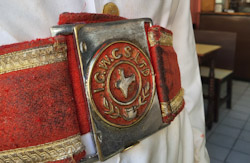
Customers sat at old wooden tables on wooden benches with upright hard backrests. Old Coffee Board posters hung on the walls. The waiters were dresses in grubby white jackets and trousers held up by an extremely wide red and gold belt with huge buckles that bore the logo of the ICB. These gentlemen wore white turbans with red and gold ribbons on their heads. On addition to rather average quality South Indian filter coffee, a variety of snacks and cold drinks were also available.
During the British occupation of India, admission to most coffee houses was restricted to European clients. In the late 1890s, the idea of establishing an ICH chain of coffee houses for Indian customers began to be considered. In 1936, the India Coffee Board opened the first ICH in Bombay’s Churchgate area By the 1940s, there were at least 50 branches all over what was then British India.
In the mid 1950s, the ICHs were closed by the Coffee Board. The Communist leader AK Gopalan (1904-1977) and the Coffee Board workers managed to get the Coffee Board to hand over the ICH outlets to them, and they formed a series of Indian Coffee Workers’ Co-operatives. The cooperative on Bangalore was formed in August 1957. There are now several branches in the city.
The MG Road branch, which opened in 1959, closed in 2009, at about the sane time as the nearby Srungar Complex began becoming closed for redevelopment, which has not yet happened.
The branch reopened in the Brigade Gardens complex on Church Street. Apart from being accommodated in a room which is rather nondescript compared to its former home, not much has changed as a result of the move to a new location. The furniture is that which was in the older site. Likewise, the old posters have been transferred. And the waiters are still attired in their stained white uniforms with belt, buckle, and turbans. The ‘atmosphere’ of the old ICH on MG Road has been recreated or maybe continued in the coffee house’s new premises. The quality of the coffee served has neither improved nor deteriorated. The ICH remains as popular as ever, and for me it is always a pleasure to enter this old-fashioned place in a city that is addicted to change.
A FRIEND IN BANGALORE, Mr Aggarwal, alerted me to the existence of an historic pillar box (letter box) in the city’s Bowring Institute. This private club has been located in its current position on St Marks Road since 1888, when it’s elegant clubhouse was constructed.
In front of the main entrance to the clubhouse, there is a hexagonal pillar box, which is still in use. This six-sided box is topped with six sloping triangular panels which meet at the highest point of the letter box.
The box bears a crest or emblem on the side where the slot for posting letters is located. This consists of a lion and a unicorn facing each other. Their forecast rest on a circle contains a cross. The circle is surmounted by a crown with two crosses. There is also a small crown with a cros on the lion’s head.
Below the crest, there is a diamond shaped lozenge containing the letters R, N, C, I (or possibly O). What these letters signified (or whether this was the manufacturer’s name) has not yet been revealed by an Internet search.
It had been suggested to me that the pillar box was a British East India Company (‘EIC’) letter box. This is unlikely to be the case because, from what I have managed to ascertain, the EIC crests included two lions facing each other, but no unicorns. Furthermore, by 1888 India was governed by the British Government rather than the EIC (which was in charge of governing India prior to 1857).
The letter box is believed to be contemporary with the construction of the Bowring clubhouse. In 1888, Queen Victoria was the Empress of India. The post box is therefore likely to have some connection with the British Indian postal service. I have yet to discover whether I am right about this. A quick search of the Internet did not reveal any examples of historic pillar boxes bearing the crest on the box at the Bowring Institute. If anyone knows more about this particular crest, please do inform me.
DURING THE FIRST ‘LOCKDOWN’, we spent a lot of time walking within two miles of our home. Despite having lived in Kensington for about 30 years, we wandered along many streets, which we had never visited until after March 2020. One of these many streets, which we ‘discovered’, is Aldridge Road Villas, a few yards south of Westbourne Park Underground station. On our first walk along this road, we met a man, who was repairing or restoring an old model of a Volkswagen parked near his home. Amongst his collection of old restored cars was an old Chevrolet truck, which we admired. We chatted with him and hoping to meet him again, we revisited Aldridge Road Villas several more times, sometimes meeting whilst he was working on one of his vehicles. Because we tended to walk along this road hoping to meet him, we managed to miss something else of great interest to us. It was only recently, that I spotted what we had been walking past without noticing it.
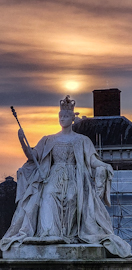
Statue of Sardar Vallabhbhai Patel in Gujarat, India
Aldridge Road Villas is probably named after the Aldridge family, who had owned land beside the Harrow Road at Westbourne Park since 1743 or before. The barrister, member of Lincoln’s Inn, John Clater Aldridge (c1737-1795), who became MP for Queensborough between 1780 and 1790 and then for Shoreham between 1790 and 1795, married Henrietta Tomlinson, widow of William Busby and a wealthy landowner, in 1765 (www.historyofparliamentonline.org/volume/1790-1820/member/aldridge-john-clater-1737-95). Through this marriage, John came into possession of more land around Westbourne as well as some near Bayswater. It is on this land that Aldridge Villas Road was built (www.theundergroundmap.com/article.html?id=10787). The oldest houses on the street date from the middle of Queen Victoria’s reign. A map surveyed in 1865 shows that the road was already lined with houses by that date.
One former resident of Aldridge Villas Road, at number 1, was the surgeon George Borlase Childs (1816-1888), who was born in Liskeard, Cornwall. A biography (https://livesonline.rcseng.ac.uk/) reveals that he was:
“…connected with the Metropolitan Free Hospital for many years, but is perhaps best remembered as Surgeon-in-Chief to the City of London Police, and to the Great Northern Railway. He took, indeed, a large share in organizing the medical departments of these institutions, displaying on a wider field the characteristic forethought and ingenuity of his work as an operator. The sanitary and physical well-being of the City policeman was one of his prime interests. He devoted much thought and care to the process of selection of members of the force, to their housing and their dress. The last-mentioned is, in fact, his creation, for he introduced the helmet as we now know it, the gaiters, and so forth. He also established the City Police Hospital…”
Celebrated as he should be, it is not Childs who was the best-known resident of the short road near Westbourne Park station. Although he did not live for a long time in the street, the most famous inhabitant of Aldridge Road Villas must be Sardar Vallabhbhai Patel (1875-1950). It was the plaque affixed to a five-storey terrace house, number 23, which had avoided our attention the first few times that we walked along the road.
Like many other Indians living under British rule in India, who became involved in political activity, including Mahatma Gandhi, Shyamji Krishnavarma, Bhimrao Ambedkar, Vinayak Damodar Savarkar, Jawaharlal Nehru, and Mohammed Ali Jinnah, Patel decided to sail to England to study. Vallabhbhai set sail from Bombay in July 1910. On arrival in London, he stayed briefly at the then luxurious Hotel Cecil in the Strand. After that, he stayed in a series of ‘digs’ in different parts of London while he completed his legal training. One of these was for several months at 23 Aldridge Road Villas, the address that appears in his records following his admission to The Middle Temple to become a barrister on the 14th of October 1910 (https://middletemplelibrary.wordpress.com/2020/04/08/famous-middle-templars-3/), the same year as that in which Jawaharlal Nehru joined Inner Temple. Patel was called to the Bar on the 27th of January 1913 (www.telegraphindia.com/india/alma-mater-honours-iron-man/cid/220801). Incidentally, many years later my wife was also called to the Bar at Middle Temple, as had also been the case, many years earlier, for my wife’s great grandfather and his father-in-law.
This shortage of money might well have been the reason that he walked between his digs and the library every day. His biographer, Rajmohan Gandhi, a grandson of Mahatma Gandhi, wrote in “Patel. A life”:
“His twice daily walk between Aldridge Villas Road, Bayswater and the Middle Temple – 4 ¾ miles each way – took him past parks and edifices of great charm or magnificence, including Kensington Gardens, Buckingham Palace, St James Park, Cleopatra’s Needle and Waterloo Bridge. When he moved digs his walks were as long or longer but not less scenic.”
Gandhi lists Patel’s other London digs as 62 Oxford Terrace, 2 South Hill Park Gardens, 57 Adelaide Road, and 5 Eton Road. With the exception of Oxford Terrace, the other did were near Belsize Park and Swiss Cottage.
Back in India, Patel became involved in the struggle for Indian Independence, joining Mahatma Gandhi and the Indian National Congress Party. Like many other freedom fighters Patel served several terms in prison. After WW2, he was significantly associated with negotiations with the British regarding transfer of power to the Indians. In 1947, when India became independent, the country consisted of areas that were directly under British rule and well over 800 Princely States that were allowed some independence providing that their rulers did not do anything to challenge the overriding authority of the British Empire. Sardar Patel oversaw and encouraged the rulers of these Princely States to give up their supposed sovereignty and to become part of a new unified India. This was no easy task because some of the larger states, notably Junagarh, Kashmir, and Hyderabad, wished to become part of the recently created Pakistan instead of India. Some considerable persuasion was required to get these places to merge with India. Patel’s achievement at unifying India must surely rival that of Otto Von Bismarck, who unified the myriad German states to become one country by 1871.
The plaque in Aldridge Road Villas is a modest and almost discreet memorial to the great Patel. If you wish to see a more spectacular monument to this remarkable man, you will need to travel to Gujarat in western India, where an enormous statue of him, almost 600 feet high, was completed in 2018. Called ‘The Statue of Unity’, its bronze plates and cladding were cast in the Peoples Republic of China.
Usually, we walk south along Aldridge Road Villas. Until we spotted the plaque commemorating Patel’s residence in the road, we had not realised that we were likely to have been following in the footsteps of one of India’s greatest politicians, which he made when he set out for Middle Temple every morning. And, the idea that one is often walking where famous figures of the past have trod is yet another thing that makes London so wonderful for both residents and visitors alike.
ON OUR THIRD VISIT to the delightful grounds of Compton Verney House in Warwickshire, we took a close look at the chapel that stands close to the main house. Constructed between 1776 and 1779 in Palladian style, it was designed by someone who was far better known for his skill in landscape planning than for his architectural ability, Lancelot (‘Capability’) Brown (c1715-1783).
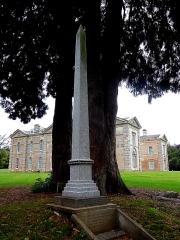
The chapel was constructed to replace another older mediaeval one that Brown demolished in order to improve the view of the garden’s lake from the main house. A slender obelisk stands close to the lake, marking the former position of the older chapel. A carved stone notice below it explains:
“This obelisk is an exact model of the Lateran obelisk at Rome. The marble was given by Joseph Thomas Jeffrey Esq of Place in Cornwall”
A man with the same name ordered the building of the Treffry Viaduct in Cornwall in 1839, using granite from his own quarries (https://explorecornwall.org/a-walk-around-luxulyan-valley/). Maybe this is the same person who supplied the granite on which the Compton Verney obelisk stands. Place in Cornwall is near to Fowey, where Jeffrey was based.
Close to this monument, there are a couple of gravestones lying in the grass. When the old chapel was demolished in 1772, most of its funerary monuments were saved and then transferred to Brown’s new chapel, where they can be seen today.
A fenced off area near the obelisk contains a brick structure from which spring water issues. This is fed to a rectangular stone bath next to the lakeside. This pool is currently being used to grow watercress.
On entering Capability Brown’s chapel, the visitor cannot help immediately noticing the splendid carved monument in the centre of the eastern half of the nave. Carved in 1631 by Nicholas Stone (c1586-1647), sculptor and architect as well as Master Mason to both James I and Charles I, its top bears the carved almost life-sized effigies of Richard (1563-1630) and Margaret Verney (née Margaret Greville, 6th Baroness Willoughby de Broke; c1561-1631) . Various large gravestones form the floor of the raised step where an altar should normally stand. Some of these have been placed so that the heads of the stone slabs face east rather than the usual west. The oldest memorial that we could find in the chapel is dated 1574. It is the gravestone of George Verney (c1543-1574), son of Sir Richard Verney (c1516-1549) and his wife Frances (née Raleigh; c1521-1544).
While I was looking at the stones set in the floor, our friend, who was accompanying us and knows of my interest in India and its history, pointed to a commemorative plaque on the north wall of the chapel. It informs:
“In memory of Henry Verney 2nd Lieutenant VII Hussars. Born June 19th 1870, drowned at Poonah with two of his brother officers June 25th 1893, and of Katharine Verney born July 3rd 1874, died July 28th 1897.”
Henry’s full name was ‘Henry Peyto Verney’. He was the son of Henry Verney, 18th Baron Willoughby de Broke (1844-1902) and Geraldine (née Smith-Barry). Katharine was Henry’s sister. ‘Poonah’ is an old name for the city of Pune (modern name) in the current State of Maharashtra in India.
The VII Hussars were originally ‘7th Queen’s Own Light Dragoons’. They took on their new name in 1807. This British army unit, which Henry Verney joined, was in existence from 1805 until 1958. The unit served all over the place: in the Peninsular Wars (1808-1809); in England to help quell the Corn Law Riots (1815); at the Battle of Waterloo (1815); in Canada, quelling riots (1838-1842); in India suppressing the Revolt that began in 1857 (1857-1859); South Africa (1881-1882) during the First Anglo-Boer conflict; the Sudan (1884-1885); and again in India (1886-1895)
“Preparations for embarkation to India began in September 1886 when the 7th left Hounslow to go to Shorncliffe. Horses were handed over to the Mounted Infantry and to the 14th Hussars who were returning from India. Extra men were drafted into the regiment from other hussar units so that the strength was now 21 officers, 587 NCOs and privates. They, with 50 women and 47 children proceeded by rail to Portsmouth where they sailed on the ‘Euphrates’ troopship on 26th Nov 1886. They arrived at Bombay on 23rd Dec, taking less than a month, so must have sailed through the Suez Canal. They were stationed at Secunderabad … In Oct 1891 they moved to Mhow…”
They arrived at Mhow (renamed ‘Dr. Ambedkar Nagar’ in Madhya Pradesh State) in the year following that in which Henry Verney joined them:
“He joined the 7th Hussars on 8th Oct 1890 and served with them in India but he was unfortunately drowned in a boating accident at Poona on 25th June 1893. He and two other young officers, Lt Sutton and Lt Crawley were on leave and hired a sailing boat to go on the river, but they lost control of it in the current and were swept over a waterfall. The three of them were seen clinging to the upturned boat in the swirling waters but they succumbed and went under, one of them was last seen swimming towards a bridge but he never made it. Verney’s body was found on 27th and the other two on the next day. They were buried on 28th June with military honours. A firing party was provided by 2nd Yorks LI and a gun carriage by L Battery RHA. The commanding officer Lt-Col J L Hunt attended with 9 officers and 3 warrant officers.”
This plaque in Capability Brown’s chapel is not the only one recalling the drowning of Henry Verney. Another one can be seen in the church at Lighthorne, a village close to Compton Verney. The trapezoid plaque, which I have yet to see, reads:
“TO THE GLORY OF GOD/ AND IN THE MEMORY OF HENRY PEYTO VERNEY/ LIEUT 7TH HUSSARS DROWNED AT POONAH/ IN INDIA 25 JUNE 1893 AGED 23 YEARS” (www.iwm.org.uk/memorials/item/memorial/83855).
Had Henry not been killed so young, he might have become involved in the Second Anglo-Boer War (1899-1902) or even WW1, by which time he would have been 44 years old. During that war, the VII Hussars lost 224 of their members in Mesopotamia during 1917. They had been sent to the Middle East from Bangalore (India), where they had been stationed since 1911.
Even if your interest in India is minimal or non-existent, it is well worth making a visit to Compton Verney to see its art collections, house, chapel, its lake with fine stone bridges, its wonderful trees, and its beautifully landscaped grounds.






 yamey
yamey 