Horses and a golf course in Calcutta

HAVE STAYED AT the Tollygunge Club several times, but it was not until yesterday (18th of January 2024) that my friend Prihvi Chaudhury made me aware of an interesting historical object. Near the club’s Shamiana refreshment area and partly hidden by the foliage of a tree, it is a circular metal plate mounted on a tall metal pole. Prithvi told me that it is all that remains of the former Tollygunge Club horse racing track. It was the finishing post.
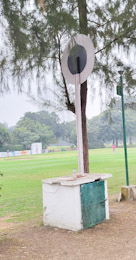
The Tollygunge Club was founded by a Calcutta banker, Sir William Cruikshank. He established the club on land bought from the descendants of Tipu Sultan. The Club was originally founded for British colonialists to enjoy equestrian activities within easy reach of the city. The racecourse was laid out in connection with this.

In addition to the racetrack, much of the extensive grounds of the Club were develope into an 18 hole golf course. This is beautifully landscaped and provides many challenges to the golfers who play there.

The race course was ‘dismantled’ many years ago. However, the Club’s association with horses continues today. On the Club grounds there is an airy, well-maintained stable block, which is currently home to at least 36 horses. We visited the stables today and fed some of the animals with carrots provided by members of the friendly stable staff.

The horses are exercised twice a day either in a special paddock or on some of the footpaths that thread their way through the club’s grounds. Club members can join horse-riding lessons and can hire steeds for taking rides (not gallops) around the Club’s terrain. When taking a ride, the horse and rider are accompanied by a stable hand.

Had Prithvi not pointed out the historic finishing post, I doubt that we would have become aware of the stables for a long time, if at all.

Golden dogs on a golf course in southern Calcutta

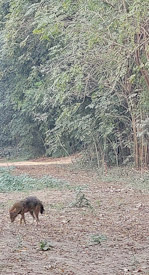
THE TOLLYGUNGE CLUB in southern Calcutta has a beautiful golf course. Between the greens, bunkers, and other golfing features, there is a large variety of trees, many water features, and a profusion of bushes and flowers. It is a joy to stroll through the grounds, taking care not to get in the way of the golfers and their caddies. As you wander through the terrain, you can spot a variety of birds, the occasional dog, and a few pussy cats. However, the greatest treat is to come across the Golden jackals (Canis aureus) that live on the golf course land.

These jackals, usually only seen in the wild, seem quite at home on the golf course. During the day, they lope around or squat, watching the golfers and walkers like myself. Although not tame, they allow humans to approach quite closely before they wander away, but not hurriedly. At night, their howling can be heard if the Club is not holding a noisy social function.

A study by AK Sanyal et Al. (Rec. Zool. Surv. India III, 2010) revealed that when it was published there were 40 to 45 jackals living on the Club grounds. They tend to live some distance away from the Club house and its neighbouring buildings. This is probably because of the tame dogs that hang around close to the Club’s semi-outdoor eating areas. The study discovered that the jackals feed on a wide variety of creatures including insects, birds eggs, rodents, larger animals, and fruits. They are also partial to food produced by humans.

The above-mentioned study revealed that there have been rare attacks on humans, but only by rabid jackals. These incidents have happened in the wild, rather than in the Club’s grounds. And the most common way that the jackals can catch rabies is by being bitten by dogs.

The Tollygunge Club land is about one square kilometre and is home to about 7 families of jackals. In the wild, this number of families would occupy an area of up to three square kilometres. This suggests that the living conditions for jackals in the Club grounds is far better than in the wild.

Every time I have walked on the golf course land, I have seen some of the jackals. When I first saw them, I was wary of them, but now I realise that they have no inclination to interact with me or fellow members of my species. Even though I have seen them plenty of times, I am thrilled whenever I spot one of the Club’s Golden jackals.

Hergé, Hitler, and a lifelong friend

A FEW DAYS AGO, I posted a photograph on Facebook. It shows some books displayed on a pavement bookstall in Calcutta’s Park Street. Two of Hergé’s Tintin books were placed next to a copy of Hitler’s “Mein Kampf” (translated into English). The book by Adolf H was placed next to another book – “The Intelligent Investor” by Benjamin Graham. Neither the title nor its author meant anything to me.

Seeing books by Hergé is not uncommon in India. Nor is it unusual to find copies of Hitler’s book on sale, as I have described in my book “The Hitler Lock and Other Tales of India”.

Soon after I posted the above-mentioned photograph on Facebook, my friend Andrew Sofer, whom I have known since he was born, commented on the photo as follows:
“Grandpa Ben would not be happy about his neighbor.”
I was staggered to read this. The author of “The Intelligent Investor” was Andrew’s grandfather. His book, which was displayed next to Hitler’s was first published in 1949, and still sells well.

Andrew’s father, Cyril, was born in South Africa and was one of my father’s best friends. Cyril was a Don at Queen’s College in Cambridge when he died at a young age. Our family used to visit Cyril and his family at their home in Cambridge regularly during my childhood and early teenage years. Benjamin Graham was the father of Andrew’s mother. I was unaware of Andrew’s connection with Benjamin Graham when I took the photograph of Hergé’s books juxtaposed with “Mein Kampf”.

What puzzles me is whether the close placement of the books by the three authors was random (ie accidental) ,or consciously arranged. Both Hitler and Hergé had fascist tendencies, but not Benjamin Graham. I wonder what was going through the bookseller’s mind when he arranged the books on that stall.

You will not find my book on that bookstall but you can purchase it here: https://www.amazon.co.uk/HITLER-LOCK-OTHER-TALES-INDIA/dp/B0CFM5JNX5/.

A young Parsi travelled the world and then fought in WW1

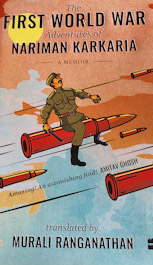
I HAVE JUST FINISHED reading a fascinating book gifted to me by my wife’s cousin. Most of the text is a Parsi’s experiences of fighting for the British during the First World War. Unlike other books about Indian soldiers who fought during that conflict, which deal with statistics and a general overview, this one contains the personal reminiscences of an individual who experienced the battlefronts first-hand.

The book is a translation from Gujarati of the memories of a Parsi (a Zoroastrian) from the town of Navsari in Gujarat – Nariman Karkaria (1895-1949). At the age of only 15, Nariman, wishing to see the world, ran away from home, and with hardly any money in his pocket, reached Hong Kong. From there, he slowly travelled through China to Siberia. His impressions of the places he visited are recorded in his often entertaining book.

When WW 1 broke out, Nariman travelled across Russia and through Scandinavia before embarking on a ship to Newcastle in the UK. From there, he reached London, where he enlisted in an English regiment. After detailing the training he received, he describes his journey to the Western Front in France.

In addition to describing the conditions on the battlefields of France, Egypt, Palestine, and Greece, vividly and often in great detail, Nariman portrays his fascination for seeing new places and people in a delightful way. Reading his memoir, I was infected with his enthusiasm for seeing the world.

Near the end of WW, Nariman spent time in Jerusalem, which he describes most interestingly. His accounts of Tbilisi, Istanbul, Baku, and post-WW1 London are fascinating. I was intrigued reading about daily life in Tbilisi and Baku as they were only a short time before the Russian Revolution.

Nariman’s writings portrayed him as a a genial person, whom it would have been fun to have met. His prose is easy to read and never dull. As the translator, Murali Ranganathan, explained in his introduction to the book, what Nariman wrote is a rare account of the travels and wartime experiences of an adventurous young Indian man from Gujarat.

This is a book well worth reading not only because of its unique perspective of WW1 but also its highly agreeable narrative style.

Enjoying forbidden food in Calcutta after waiting many years

JHAL MURI IS a Bengali ‘street food’. Mixture of puffed rice, mustard oil, and other things including: chilli, coconut, channa, peanuts, lemon juice, coriander, onion, tomato, sev, chutneys, … and more! You choose your mix.

Making jhal muri

Usually made in the street, it may pose a risk to weak stomachs. My wife’s mother, a medical doctor, forbade her daughter from eating this when it was sold by street vendors. It was sold just outside Loreto House School, where my wife was a pupil. She felt hard done by when she saw her schoolfriends eating this ‘forbidden’ snack.

Today, having yearned for it for many years, she sampled jhal muri at the Tollygunge Club. Sadly, it did not meet her great expectations.

Blooms beneath a bridge in the city of Calcutta

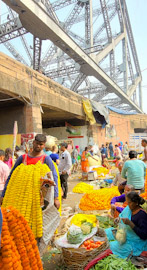
OVERLOOKED BY THE MIGHTY Howrah Bridge and straggling alongside the left bank of the Hooghly River – a stretch of the Ganges – you will find the colourful Mullick Ghat flower market. The best way to enter this busy marketplace is by descending a staircase at the southeast corner of the Howrah Bridge (completed 1943). As you go down the stairs, you will have to step aside to make way for men carrying enormous, heavy loads on their heads. Many of them make use of the stair rails to support themselves while they climb.

Part of the flower market (next to the railway track) is in the open air. The rest of it – the part nearest to the river – is under cover. Narrow, muddy passages run between the numerous stalls selling whole flowers, flower heads, individual flower parts, and petals. Also, flower garlands and other floral decorations are aplenty. A steady stream of people hurry in all directions along these paths. Many of them are carrying heavy head loads. Occasionally, they dump the head loads (containing floral items) at one stall or another. To an outsider, like me, the place seems like a chaotic but highly colourful environment. It is probably not as crazy as it seems, but highly organised.

The flower market was established along this part of the Hooghly during or before the 19th century (https://www.telegraphindia.com/my-kolkata/places/a-visit-to-mullick-ghat-flower-market-one-of-asias-largest-under-the-howrah-bridge-in-kolkata/cid/1892065). The ghat was built in 1855 by Rammohan Mullick in honour of his father Nimai Charan Mullick. It was constructed on the land where the old Noyaner Ghat had stood. The older landing stage had been made by Noyanchand Mullick in 1793.

The Mullick Ghat stands next to the Jagganath Ghat, which was constructed in 1760. Both ghats were important because they were used by pilgrims embarking on ships to transport them to the holy site at Puri in Orissa. Although it is not known for certain why the flower market was established beside these ghats, it is not unlikely that it was connected to the embarkation places for the pilgrims. And flowers play an important role in Hindu rituals.

Even though the market seemed extremely busy to me, it is apparently in decline. This was in no little way connected with the recent covid19 pandemic. If what I saw is a somewhat diminished version of the market, I can barely imagine what it must have been like a few years ago. Providing you are not allergic to pollen or crowds, a visit to the flower market is an exciting and beautiful experience.

From the Ganges to the shore and then back into the river

THE CERAMIC ARTIST, our friend Falguni Bhatt, works in Calcutta. While visiting her studio, she suggested that we visit Kumartuli in north Calcutta. Close to the Hooghly River – part of the Ganges – this district of the city is a warren of narrow lanes lined with the workshops of craftsmen who make Hindu idols out of the grey clay collected from the shores of the Ganges. We went there and were amazed by the huge amount of creative activity that confronted us.

Mounds of damp dark grey clay are carried on the heads of porters to the workshops. Others carry bundles of straw to the artisans. The straw is used to make armatures – these are shaped roughly like the finished idols. A completed armature, which can sometimes include supporting metal rods, looks sufficiently like the idol being created.

Clay is applied to the straw armatures. Gradually, the straw is hidden by the clay. The surface of the clay is either smoothed to resemble fine skin and/or inscribed to create bodily details – for example finger nails and the creases on the palms of hands or facial details or clothing and footwear. Creatures and objects associated with the depicted deity – for example, veenas and snakes – are created in the same way, starting with straw armatures.

The completed idols, which are frequently very detailed and of complex shapes, are left to dry and harden. The clay idols are not fired in a kiln.

Detailing on a clay idol

Later, the idols are painted according to tradition, and then decorated with elaborate costumes and jewellery. The jewellery is made from hand cut cardboard often with sequins and mirrors applied. A small section of Kumartuli is dedicated to workshops creating these intricate, attractive ornaments.

Each of the clay idols is an exquisite work of art. Each of them displays evidence of the highly skilled workmanship that created them. They rival the superb ancient Hindu stone carvings that can be found carefully displayed and conserved in museums. Yet, each of these clay masterpieces is destined to have but a very short life.

The idols are created in Kumartuli for use in important Hindu festivals such as Durga Puja, Kali Puja, and Saraswati Puja. We saw idols being prepared for the last mentioned. Most of the idols being created include the stringed musical instrument played by Saraswati – the veena. Her puja is to be held next in February 2024.

During these ceremonies, the carefully crafted idols – fully painted and decorated with elaborate hand made ornaments – are dropped into the Ganges. When I expressed my surprise at hearing about this, Falguni said something like:
“Life is transient.”

Rabindranath Tagore, blood, and coffee in Calcutta

THERE IS A BRANCH of the India Coffee House chain in College Street, Calcutta. Housed on the first and second floors of Albert Hall (built 1876 in memory of Victoria’s Prince Consort), it is located in the midst of a vast bazaar specialising in bookselling – mainly textbooks and technical manuals. Soon after it was opened, the coffee house within Albert Hall became a centre of anti-British agitation.

The first floor serving area – many chairs and tables – is overlooked by two huge portraits. One photograph depicts Rabindranath Tagore as a young man and next to this, there is another of the poet and writer Kazi Nazrul Islam. Other smaller painted portraits line the walls of the café. Waiters wearing pugrees busily wandered around taking orders and delivering food and drinks – mostly coffee.

This ninth of January (2024) was a special day when an annual blood donation camp was held in memory of the Bengali footballer Sailendra Nath Manna (1924-2012). It was, as we discovered today, being carried out on the second floor gallery overlooking the serving area of the College Street India Coffee House.

Loudspeakers within the coffee house and in the streets surrounding it were exhorting people to come and donate some blood. A steady stream of volunteers climbed the staircase to the second floor. One of the officials, who was having coffee at a table near us, suggested we took a look upstairs.

The gallery was full of people. Chairs lined the walls. Donors were sitting in these with catheters in their veins. Several medics were wandering about with stethoscopes around their necks. Those who had donated blood were given packages contains bottled water and snacks. There were a few folding beds ready for anyone who fainted or collapsed during or after they had given blood, but these were unoccupied. Despite the seriousness of the purpose of the occasion, the blood donation camp seemed more like a joyous fair or party than a clinical situation.

We had come to College Street to enjoy the historic ambience of the old coffee house. Little had we expected to come acros a blood donation festival within it.

A bowler with only one leg in a park in Calcutta

WHEN I TRAVEL, the things that fascinate me most are not listed in any travel guidebooks. It is chance glimpses of everyday life that interest and delight me most.

This morning (9th of January 2024), we took a morning walk on Calcutta’s Maidan – a vast green space running along the western edge of the heart of the city. After entering the area from Park Street, we walked past a tall statue of Jawaharlal Nehru and came across a large pond, where a few people were bathing.

We walked along the path near to the pool, and met a flock of goats being herded along it towards us. Nearby in a large field, groups of school children were doing drill, marching on the spot, shouting “left, right, left, …”. A boy nearby was beating time on a drum. Beyond the children, there was another flock of goats. Looking away from them, we could see tall buildings through the dusty, hazy sunlight.

We followed various paths in a northerly direction, and came across a fenced in compound where we saw military cadets being taught outdoors. One of their teachers stood at a portable lectern upon which he had his lecture notes. Next, we saw a cricket match. We watched for a few moments, but nothing exciting happened.

Heading further north, we passed a huge open space fringed with various kinds of trees, including palms. Near the northern edge of the field, we came across a cricket practicing net. What we saw there was quite unexpected.

The one-legged bowler in action

There was nothing unusual about the batsman in the net. Padded up, he faced the bowlers, and whacked the balls bowled at him. There were two bowlers, who took turns to pitch the ball at the batsman.

One of the bowlers was an invalid. One of his legs had been amputated at knee level, or maybe just above. He supported himself on his one intact leg and a stout pole that he used as a crutch. Each time he bowled, the ball flew fast and was aimed accurately. Despite his considerable impediment, he was a formidable bowler. We watched spellbound as he bowled over and over again. If one had been unable to see his legs and his support, one would never have guessed that he had a serious physical impairment. It was life enhancing seeing this man making the most of life.

After watching the one-legged bowler, we hailed a taxi to carry us up to College Street, where we experienced another event that you would not find in any guidebook, but more about this in a future essay.