
Modernism in Ghana and India in a museum in London’s South Kensington

UNTIL THE 22nd OF SEPTEMBER 2024, the Victoria and Albert Museum in London’s South Kensington is hosting an exhibition called “Tropical Modernism: Architecture and Independence”. It focuses on two countries: Ghana and India. It was the exhibits relating to India that interested me most, although those connected with Ghana were also intriguing.

The Royal Institute of British Architects describes Modernism as follows:

“Rejecting ornament and embracing minimalism, Modernism became the single most important new style or philosophy of architecture and design of the 20th century. It was associated with an analytical approach to the function of buildings, a strictly rational use of (often new) materials, structural innovation and the elimination of ornament.” (www.architecture.com/explore-architecture/modernism).

Modernism began both in the USA and Europe in the 1920s and 1930s. Its better-known pioneering exponents include Le Corbusier, Mies van der Rohe, Walter Gropius, Maxwell Fry, Louis Kahn, and Eero Saarinen. The Modernist architects, like the abstract painters of the early 20th century, broke with traditional approaches to form and style.

On the 15th of August 1947, India became independent. The country was no longer ruled by foreigners. Jawaharlal Nehru (1889-1964) became India’s first Prime Minister, a position he retained until his death. His vision for India was for it to shake off the shackles of the past (both colonial and traditional) to become a modern state. This extended to architecture in his new India. He invited Modernist architects including Le Corbusier and his cousin Perre Jeanneret to design a new city in the Punjab (following the loss of Lahore to Pakistan): Chandigarh. This is illustrated well in the V&A exhibition. Le Corbusier wanted to create his ideal of a city, which included forbidding street markets and cows to wandering in its streets. His pupil and collaborator, Balkrishna Vithaldas Doshi, who died in 2023, had a more human approach to architecture. Having seen some of his buildings, notably in Ahmedabad and Bangalore, I would say that Doshi developed an architectural opus, which might be loosely described as ‘user-friendly Corbusier’.  Incidentally, Doshi was also taught by Louis Kahn, who worked in India, notably in Ahmedabad.

A label in the exhibition noted that in 1959, at a conference about national identity in Indian architecture, Nehru urged Indian architects not to be “imprisoned by tradition”, but to experiment as had been done at Chandigarh (built between 1951 and 1956). Examples of this experimentation can be seen in the exhibition.

Naturally, since Nehru’s death, there have been many changes in India. I notice new changes every time we make our annual trips to the country. Nehru’s vision of a secular India has been replaced by a different vision in the minds of the leaders of the present Indian Government. Modernism’s internationalist aspects, which attracted Nehru and some of his successors, appear to have lost their appeal currently in India.

Immediately after gaining independence, both Ghana and India favoured Modernism in architecture. The exhibition at the V&A shows that even before independence, architects (almost all European) in Ghana had been building in the Modernist style, but specially adapted to cope with intense heat and high humidity. Ghana’s first leader, Kwame Nkrumah, encouraged the continuation of this architectural style. The exhibition includes a fascinating video about this. In India, Modernism seems to have been introduced post-independence. Both leaders wanted to project visions of a emerging modern countries, freed from the constraints of colonialism. Yet both promoted an architectural style developed largely by architects who came from countries that had had colonies in Asia and Africa.

Before ending this piece, I must not forget to mention two exhibits, which caricatured the great British colonial architect, Edwin Lutyens, who was certainly not a Modernist. One of them is a model of Lutyens’s head which has been combined with a model of one of his imperial buildings in New Delhi. The other, which is painted in the style of a Mughal miniature, shows Lutyens offering a model of the (British) Viceroy’s House (in New Delhi) to the Viceroy.

The exhibition was fascinating. Despite its rather obscure title, a good number of viewers were there during the Monday mid-afternoon when we visited it.
A MOSQUE IN ISTANBUL AND RECYCLING BY THE OTTOMANS

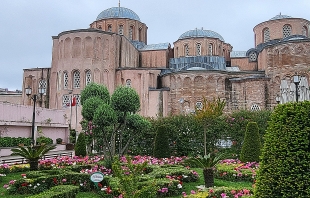
THE MOLLA ZEYREK mosque stands high on one of Istanbul’s seven hills. From its garden, which has a pleasant café, you can enjoy a wide panorama that includes views of the Bosphorus, the Golden Horn and bridges crossing it, the Galata Tower, the great Suleymaniya Mosque, and many other historic buildings around it. Turn your back on the view, and look across the well-kept flower garden, then you will see what looks like a large Byzantine church with three apses and several domes. However, as you stroll around this building, you will soon notice that it has its own minaret. This mosque was a church before 1453 when the Ottomans captured Constantinople/Istanbul.

As is the case with many other places of historic interest in Istanbul, there is an informative notice outside the mosque, written in three languages (Turkish, Arabic, and English). It outlines the history of the mosque. The building, designed by the architect Nikeforos, was built in the 12th century by Eirene (died 1134), the wife of Emperor Ioannis II Komnenos (ruled 1118-1143). Her father was King Laszlo I of Hungary. The edifice which is, in fact three churches joined in one building were the churches of the large Pantokrator Monastery. This institution included a 50-bed hospital, a library, an old-age home, a sanctuary for lepers, a medical school, a pharmacy, and a holy spring. The triple church was exceptional because:

“Except for the Church of the Holy Apostles, no other Byzantine building received as many imperial burials. John II (1118-43) and Eirene (Piroska of Hungary), their son Manuel I (1143–1180), and his wife Bertha of Sulzbach, were buried there, as were the Palaiologan emperors Manuel II and John VIII in the 15th century. In front of Manuel’s black marble sarcophagus was the Stone of Unction (a marble slab on which Christ’s body laid after his crucifixion), which Manuel brought from Ephesus around 1170. The large funerary chapel of the Archangel Michael is described by the typikon as a heroon – the shrine of a hero later used for the imperial mausoleum of Constantine and his imperial successors at the Church of the Holy Apostles.” (www.thebyzantinelegacy.com/pantokrator-monastery)

These monuments can no longer be found in the building.

Soon after Mehmet the Conqueror captured Istanbul, the monastery was converted into a madrassa. It became the first educational establishment created by the Ottomans in Istanbul. The monastery’s monk cells became cells for the madrassa and the triple church, suitably modified with a minaret, a mimbar, a mihrab, and other Islamic features, became a mosque with two classrooms for religious instruction. One of the new establishment’s professors was Molla Mehmed Efendi, nicknamed ‘Zeyrek’ – now, part of the mosque’s name. This learned man not only offered education to those who were already Muslim, but also to those who converted to Islam. In addition, he was instrumental in persuading many local people to convert to his religion.

Apart from the former church complex, now mosque, the other monastery/madrassa buildings have disappeared. This century, what had become an unusable, badly dilapidated structure was restored, and is now back in use as a mosque. The mosque occupies the southernmost of the three chapels. The other two chapels, although attractively painted, were empty spaces. One of these once served as the Byzantine Imperial mortuary chapel.

The Molla Zeyrek Mosque was formerly a Byzantine church. When the Ottomans took Istanbul, rather than destroying the places of worship of their Christian enemies, they recycled or repurposed them – they modified the churches and converted them to become mosques. Probably, the best-known example of this is Istanbul’s enormous Ayasofya-i Kebir Cami-i Şerifi (i.e., the ‘Hagia Sophia Grand Mosque’), constructed in the 6th century.  Apart from Ayasofya, which we walked past almost every day during our recent 16-day visit to Istanbul, The Molla Zeyrek mosque was one of the most impressive and largest former Byzantine churches that we saw in the city. However, my favourite of these recycled churches was near where we were staying: the Kucuk Ayasofya Mosque, in whose charming walled garden we enjoyed numerous glasses of tea, met many friendly Turks, and watched the antics of the garden’s large feline population.

I have visited many cities in America, Asian and Europe. Many of them are fascinating, but now I can safely say that amongst these wonderful places, Istanbul has become my favourite because here the past, present, and future blend together with an exciting vibrance.

It need not have happened

CONSTRUCTED IN 1974, it was 221 feet tall. It overshadowed the homes of many people including many of the wealthier inhabitants of West London’s Kensington. And I imagine that the wealthy inhabitants of the elegant crescents and other thoroughfares near it did not appreciate the views from their windows being spoiled by this Brutalist block of flats containing less well-off people, about whom they would rather not think. Between 2015 and 2016, the block was refurbished and made less of an eyesore by the addition of cladding – ostensibly to improve insulation – to its exterior.

On the afternoon of the 13th of June 2017, I was walking around North Kensington, taking photographs as usual. I stopped to take pictures of the recently built Kensington Leisure Centre and its near neighbour the Kensington Aldridge Academy – both are interesting examples of contemporary architecture. While I was taking these photos, I had my back to the tower block I have just described.  Had I looked at it then, I would have thought that it would have been of little interest to me. How wrong I was.

Just after midnight on the following day, a fire broke out in that tall block – Grenfell Tower – that edifice which overlooked the homes of the wealthy residents of Kensington. The fire spread rapidly because of the highly inflammable nature of the cladding used to make the tower more attractive to its neighbours. Seventy-two people died in the conflagration; many were injured; and all the surviving residents were not only badly scarred psychologically, but also lost their homes and possessions.

From wherever you looked in a large area around Grenfell, including from the homes of the prosperous residents of Holland Park and Notting Hill, one could see the horrifically charred tower block – a fear-inspiring eyesore – the result of local government officialdom ignoring repeated warnings about the already known potential fire hazards that the cladding presented and inadequate planning for escape during a fire. I felt – and I am not alone in thinking this – that the local council hardly cared for a few impecunious residents in a tower block. What was more important was to save money so as not to impose high local taxes on people who could have easily afforded to pay them.

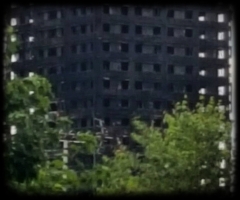
Soon after the fire, the charred tower was covered with protective wrapping to assist forensic investigations and to contain debris, which might otherwise have flown away and dropped in the neighbourhood. It also removed from sight the scarred, charred remains of the building – a 24 hour a day reminder of the avoidable, tragic loss of life, which was not altogether disconnected with civic and possibly criminal negligence. The remains of the tower are still covered up.  Before the heart-rending remains of the conflagration were covered up, filmmaker Steve McQueen (born 1969 not far from Grenfell Tower) made a short film about the tower. It is currently on show at the Serpentine South Gallery in Hyde Park until the 10th of May.

The film is without words in its soundtrack and without any captions. It looks as if it might have been filmed with a drone or a camera held within a helicopter. It begins with a flight over beautiful countryside far beyond the edge of London. The camera moves above the scenes of rural serenity and slowly the city of London comes into view. We pass over London’s sprawling suburbs, and then the charred Grenfell Tower begins to be seen in the centre of the screen. The camera moves closer and closer to the blackened building, and then slowly circles around it many times. Each time the tower is slowly encircled, and the camera moves closer to it, more and more details of the destruction entered my consciousness, and my understanding of the horror of what had befallen Grenfell and its inhabitants gradually increased. As the camera moved around the wreck, you could catch glimpses of the parts of London surrounding it – the houses and flats of those who must have witnessed the fire, but were not affected by it, at least not physically. As the camera moved, one could see trains moving on nearby tracks and vehicles travelling along roads. I felt that I was witnessing life going on as usual at the same time as witnessing the horrors of a disaster. The absence of commentary added to the powerful impact that seeing these images of a lethal incineration simultaneously with scenes of normality made on me. There was a soundtrack, which consisted of recordings of everyday sounds – both natural and man-made. However, while the camera encircled the tower of death, there was no sound at all. I wondered whether this signified the fact that the victims, who had died, will no longer be able to enjoy the sounds of everyday life.

McQueen’s film is a sophisticated and solemn memorial to an event that could easily have been avoided. Without a soundtrack or explanations, the viewer is left to ponder the tragedy in his or her own way.