The power of faith and a polluted river

HAPPY NEW YEAR!

ON CHRISTMAS MORNING (2024), we walked leisurely beside the Hooghly River (a stretch of the Ganges) between Prinsep Ghat and Eden Gardens, a distance of about 1.3 miles. With a good paved footpath,  this is a pleasant, picturesque, tree lined place to stroll.


Near Eden Park railway station,  there is a popular bathing ghat (a flight of steps leading into the water). From a  bridge that overlooks this, we watched people bathing in the river. Many of them immersed themselves fully several times. Others washed themselves. We saw people applying shampoo to wash their hair. I noticed a few men wading out into the water, carrying small trays containing flowers for puja. They threw these floral offerings into the fast flowing stream.

 The Ganges, of which the Hooghly is a part, is considered to be a place of great holiness by Hindus. They believe that bathing in this river conveys several benefits including: cleansing the soul; connecting with divine cosmic forces; washing away bad karma from the present or previous births; health giving and healing; and removing negativity. So, if you are a believer, bathing in the Hooghly/Ganges must be a good thing. But, must it?


Signs along the path on which we strolled exhort people not to dump rubbish in the river. But it is clearly obvious that these signs are not obeyed.  It is not only strollers’ rubbish that enters the sacred river. The river is being continuously polluted by sewage, industrial effluent, and decomposing corpses. This has resulted in high levels of toxic chemicals including heavy metals, and frighteningly large amounts  of bacterial and other microbial pathogens.


According to several official bodies, the Hooghly  has been deemed totally unsuitable for bathing. Yet despite this, there is no shortage of people entering the river to bathe, putting  their entire heads underwater, and washing themselves with this water that carries a real risk of causing ill-health. Such is the power of faith that the well-publicized risks of bathing in the river are outweighed by the belief that the water can only benefit the bather.
Oh no, the baby is missing!

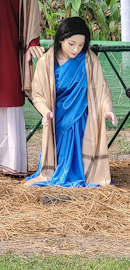
ON CHRISTMAS EVE (2024), we visited the Victorian gothic St Paul’s Cathedral in Kolkata (Calcutta). There was a creche (Nativity scene) in the garden. Unlike other such cribs we have spotted in the city, in which all the human characters look European,   all of the (lifesize) models in the St Paul’s creche depict Indians. The three kings look like Rajput maharajas,  a small boy near the crib is wearing kurta pyjamas, a shepherd carrying a lamb sports a turban, Joseph is wearing a dhoti, and Mary is dressed in a blue sari.

 This beautifully made ensemble illustrating happenings in Bethlehem, where there was no room at the inn, is lacking one person. There was no baby Jesus to be seen. The model of Mary seems to be looking adorably at an empty patch of ground. I wondered whether someone had stolen the model of Jesus. We asked a gardener what had happened to baby Jesus. He replied: “It’s Christmas Eve. Jesus has not been born yet. He’ll come tonight.

Epic narration and a great plot: it would make exciting cinema

THE GORDON RIOTS which occurred in London in 1780 were a reaction to a law passed in 1778. The law gave rights to Roman Catholics and aroused the hostility of no-papists (anti-Catholics). The disturbances,  which resulted in much destruction of property in London were instigated by the hateful propaganda of Lord George Gordon (1751-1793).


I first became interested in the Gordon Riots when I was writing my book about Hampstead and its surroundings. The rioters headed out of London towards Hampstead on their way to Lord Mansfield’s country house at Kenwood.  Mansfield’s house in London’s Bloomsbury district had just been razed to the ground by the riotous mob, and they had hoped to do the same thing at Kenwood.  Fortunately, they were stopped just before they reached Mansfield’s country mansion.

 Given my interest in the above-mentioned,  I  was excited to find that Charles Dickens had written a novel about the riots: “Barnaby Rudge”. It was first published in 1841.


Barnaby Rudge is a peculiar character, a simpleton whose best friend is a talking raven. At first, it was not obvious to me why the novel should bear his name, but slowly his importance in this complex tale becomes evident.  Although his role is important, there are a large number of other equally important characters woven into the plot.


Dickens explores the private antagonisms between some individuals as well as attractions between others, and gradually weaves these relationships into the ever increasing rumblings that develop into riots and mindless destruction.


Dickens wrote long before cinematography was invented, yet his written descriptions of both peaceful scenes and incredible chaos have a vividness and impact that much modern cinema (especially some blockbuster Bollywood productions) are able to throw at their audiences.  And Dickens does this with words alone: without Dolby sound and dramatic photography.


In brief, I  found “Barnaby Rudge” to be a veritable tour-de-force. My enjoyment of the book was enhanced by the fact that the Penguin edition I was reading was richly supplied with notes (mainly historical) researched and written by Gordon Spence.


Before reading “Barnaby Rudge”, I knew that the Gordon Riots were a fairly horrendous episode in British history.  However, Dickens, who was writing just 40 years after they had occurred and might have known people who had witnessed them, brought this age of turmoil to life in a credibly dramatic way.

The Golders Green Complex in Calcutta  (Kolkata)

DURING THE LONG taxi ride from Kolkata’s airport to the city centre, I noticed an intriguing sign on a building we passed. It read: “Golders Green Complex”. The reason that this interested me was that I was brought up in a northwest London’s suburb called Golders Green.

I have no idea if the proprietors of Kolkata’s Golders Green Complex know of the existence of my childhood haunt in northwest London. The idea that someone might suffer from a malady named the Golders Green complex flashed through my mind. How this would manifest itself, I will leave to your imagination. In my case, the lasting effect of a childhood in Golders Green led me to write a book about the place (https://www.amazon.co.uk/GOLDERS-GREEN-HAMPSTEAD-GARDEN-SUBURB/dp/B0BHG873FB/  )

He took his own drinking water from India to England in 1902

THE MOST DISAPPOINTING tourist ‘attraction’ in Jaipur, is the City Palace. After more than 3 weeks travelling in Rajasthan, I can safely say that this royal palace is the least interesting place we have visited. Architecturally, it lacks the finesse seen in other royal palaces. In addition it is far less interesting historically.

Not wishing to seem too negative about the place, I will mention one item that did catch my attention. It is a huge silver vessel, a jar: possibly the largest silver jar that has ever been made. It and several others were made to carry water from the Ganges to England. The water was for the use of Maharaja Sawai Madho Singh II during his visit to England to attend the coronation of King Edward VII in 1902. Each of the jars could carry about 400 gallons of water.

While this is a fascinating exhibit, I do not believe that the palace is worth visiting. Its admission fees are exorbitant by local standards: minimum of £10 for non-Indians and minimum of £3 for Indians. Additional charges are levied to see certain exhibits within the palace compound. These prices must be compared with the admission fees for the palace’s far more beautiful and much more fascinating neighbour, the Jantar Mantar (non-Indians pay £2, and Indians pay 50 pence).

Memorials commemorating the lives of royalty near Jaipur

THE AMBER FORT, which we visited yesterday (17 December 2024), was swarming with noisy, jostling tourists. It was not pleasurable visiting that place. In contrast, today we explored a beautifully peaceful site between Jaipur and Amber Fort: Gatore ki Chhatriya, which I will abbreviate to ‘Gatore’.

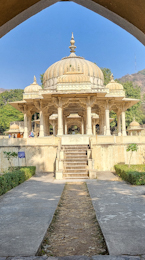
Situated between two steep hills, one of which is home to a popular Ganesh temple, the Gatore is a set of three walled enclosures. Each of them contains several ornate domed chhatris (pavilion; ‘chhatri’ means umbrella). Each chhatri was erected over the spot where a member of Jaipur’s royal family (the Kachwaha dynasty) was cremated. After each cremation, the ashes of the deceased were carried to the sacred city of Haridwar, where they were consigned to the waters of the River Ganges.

The earliest of the chhatris at Gaitor was put up in 1743, after the cremation of Sawai Jai Singh II. Despite the fact that Indian royalty is no longer officially recognised, the most recent chhatri was constructed in 2011, when the titular ruler, Sawai Padmanabh Singh, died. In addition to the larger chhatris dedicated to the maharajas, there are smaller ones to royal children, who died before adulthood.

Unfortunately, none of the chhatris have any labels that help the visitor know for whom each of these structures was erected. An official at the entrance to the Gaitor compound told us that there had been wooden signs by each chhatri, but locals had apparently stolen them … for use as fire wood, maybe.

Apart from the peacefulness of the Gaitor compound, it is filled with the beautiful chhatris, which are set within well maintained gardens. And the whole place is flanked by the wooded slopes of the hills surrounding it.

If you do not have a long time to explore Jaipur, you should not miss visiting both the Gaitor and the Jantar Mantar. If you have a longer time, the Gaitor is a lovely place to linger.

The palace that became submerged by the lake


THE JAL MAHAL (Water Palace) was constructed in about 1699. In the early 18th century, the lake next to it was enlarged, and the palace became partially submerged. Despite many attempts to clear the water from its lower storeys, the palace has remained partially submerged.

An autorickshaw driver told us that he believed that a djinn (supernatural spirit) resides in the Jal Mahal. Every time an attempt is made to drain the palace, four times as much water as has been removed comes back to flood the edifice.

Recently, an entrepreneur bought the palace, hoping to convert it into a luxury hotel. However, his attempts to dry it out have been a failure,  and he has given up.

An astronomical extravaganza in the heart of Jaipur

Happy Christmas

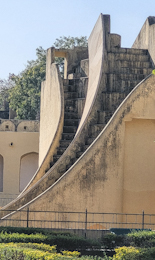
IT LOOKS LIKE MODERN sculpture at first sight. On closer examination, these fascinatingly shaped objects have carefully constructed scales, like the markings on a ruler or a protractor, attached to them. They are astronomical instruments that were constructed for the Rajput king Sawai Jai Singh (1688-1743), and they were completed by 1734. Together, they comprise Jaipur’s Jantar Mantar (literally ‘calculating instruments’). They were used to construct what has turned out to be extremely accurate astronomical tables.

Sawai Jai Singh was very interested in mathematics, astrology, astronomy, architecture, and literature. He studied scientific works by, for example, Ptolemy, Newton, Flamstead, and Euclid. He had Euclid’s “Elements of Geometry” translated into Sanskrit. His interest in astronomy might have been inspired in1702 by his tutor Jagannatha Samrat.

The Jantar Mantar in Jaipur contains 18 separate stone instruments with metal attachments . My knowledge of astronomy is minimal. So, I will not try to explain for what purpose each was, and still can be, used. A Wikipedia page (https://en.m.wikipedia.org/wiki/Jantar_Mantar,_Jaipur) can help with explaining their purposes.

To a visitor, like me, who is unversed in astronomy, and to those who are familiar with modern astronomical instruments, the Jantar Mantar presents the visitor with one of the most extraordinary looking tourist sights that India has to offer. It is not unique. In addition to the one in Jaipur, Sawai Jai Singh built four others in northern India. However, the one at Jaipur is the largest and best preserved.

If one did not know its purpose, the Jantar Mantar observatory compound would seem as if it is one of the world’s most superb sculpture parks.

An amazing cinema in the heart of Jaipur

HAPPY CHRISTMAS EVE

THE RAJ MANDIR cinema was completed in 1976. It was designed in the Streamline Moderne ( or late Art Deco) style by WM Namjoshi for Kushalchand Surana. It was conceived by Mehtab Chandra Golcha. According to Wikipedia, it is the largest single screen theatre in Asia.

We went to see a film called “Pushpa part 2”. It was made in the Telugu language and dubbed into Hindi. It is about sandalwood smuggling and corruption. Despite not being able to follow much of the dialogue,it was extremely exciting and beautifully filmed. It was so dramatic that we left the cinema feeing exhausted.

The cinema is spectacular visually. One enters from the street into a huge, circular foyer decorated in an opulent fashion. The auditorium is spacious and, like the foyer, spectacularly decorated. The screen is curved, and the surround sound system very good.

Even if one cannot follow a film because it is in a language that you do not know, a screening at this cinema is an experience not to be missed in Jaipur.

One hump and four legs on and off the highway

FOUR LEGS AND ONE HUMP ON AND OFF THE HIGHWAY

WHEN TRAVELLING IN RAJASTHAN it is not unusual to see single-humped camels (dromedaries). Often, they are hitched to wagons, both loaded and unloaded. They can haul loads of several times their body weight, which in adults can range from 400 to over 600 Kilograms. They can also be used to pull ploughs.

Unlike wheeled vehicles, camels are extremely agile on the roughest of terrains. They are often employed in off-road tasks. And they differ from other beasts of burden by being able to function well in high ambient temperatures. For example, they can survive without drinking for longer than other creatures. Also, their feet are adapted to be able to endure the extremely high temperatures that the ground can reach when it is heated by the sun. I first became aware of this when my PhD supervisor, Robert Harkness, described the research he had done on the connective tissue of the pads within camel’s feet. He had first become interested in this when he spent some time teaching at a university in Kuwait.

During our visit to Rajasthan and also on earlier visits to various parts of Gujarat, we have often spotted camels, both working and grazing. To someone like me, who grew up in Western Europe, seeing camels, which are not in a zoo, is an exciting experience.

Finally, I cannot resist repeating an old joke I learned when I was a child. In those days, there was an airline called British Overseas Airways Corporation, BOAC for short. Some witty friend of my parents told me that BOAC really stood for: “Better On A Camel”.