NEXT TO THE KITCHEN in our family home in Hampstead Garden Suburb, there was a wood framed bell board. It consisted of a set of circular windows, each labelled with the name of a room in the house. There was an old bell button in my bedroom. If you pressed it, a pendulum hanging behind the circular window labelled for my room would begin to swing in the bell board. Had we had domestic servants, a servant would have heard the bell ring, then looked at the bell board to see which room’s pendulum was swinging, and then attend to whomever was in that particular room.
Part of the bell board at Ightam Mote
I was reminded of this antiquated bit of domestic equipment when I saw a similar one at Ightam Mote, a lovely old mansion owned by the National Trust.
Our house was built in 1908. This was during the era when these bell boards were popular. Although we did not have servants at home, earlier occupants most probably did.
When our daughter was much younger, she had an elderly babysitter called Bridie. Before WW2, Bridie worked as a domestic servant at a house in Golders Green. She told us that she had to wear uniforms: one during the daytime, and a different one in the evenings. I never asked her, but I would not have been surprised if that house in Golders Green also had a bell board.
My wife remembered that her family home in Kolkata had a similar bell board. There were servants in the house, but to discourage laziness, her parents had the bell in her bedroom inactivated.
IN THE 1970S, I used to love eating at the now demolished Swiss Centre on the northwest corner of Leicester Square. Its restaurant was pricey, but served great cheese fondue and steak tartare. Sadly, the Swiss Centre is no more, but there is a lovely souvenir still standing. It is a glockenspiel with bells and animated models of animals and Swiss farmers, which rotate whilst the bells are chiming. It is a bit kitsch but completely charming.
The original glockenspiel was installed in 1985, then removed in 2008. It was reconstructed in about 2011. It has 27 bells, 2 clocks, and 11 moving figures. The show can be watched once every few hours during daytime. A timetable is attached to the lovely apparatus. Compared to much else that now happens in Leicester Square, the glockenspiel has real class.
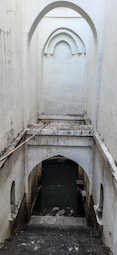
NOBODY KNOWS WHEN the Bahucharaji stepwell was constructed. Legend has it that this well, located in Surat’s Vishal Nagar area, was built by Vanjara people, who came from outside Surat. These people used to visit the city, and set up camp there. This stepwell is said to have been dug by them to provide a supply of water.
The Vanjaras (Banjaras) are descendants of nomadic traders. Found in many parts of India, they used to have an important role in the economy of the Subcontinent. Wikipedia related that: “… the Banjaras had a monopoly on the movement of salt prior to the arrival of the East India Company. More generally, they also traded in cattle, moving the beasts around the country’s bazaars, and they rented out their carts. Although some older sources have suggested that they did not use credit, Habib’s analysis of historic sources suggests that they did and that some were reliant on it.”
A Hindu goddess called Mataji appeared in the dream of a Vanjara and inspired the construction of the stepwell. After the vav (stepwell) was constructed, a temple was built within it. This is dedicated to Mataji.
The entrance to the stepwell is within a temple compound, in which footwear must be removed. We visited the place on a Sunday morning in December 2023. A steady stream of worshippers of all ages entered the stepwell’s ground level entrance. As they descended the steps towards the water in the bottom of the vav, they sounded the temple bells suspended above the staircase. Before reaching the water, the steps pass two shrines each containing effigies of Hindu deities. At one of them, a lady in a beautiful sari was involved in a lengthy puja conducted by a priest. She was accompanied by a large-ish group of people. I noticed that some of them were holding on to her sari.
We squeezed past the group and descended further into the vav until we reached a railing from which we had a clear view of the water far below us. Several tortoises were resting on the step closest to the water in the well.
After admiring the beautifully maintained vav, we left the temple compound. Outside it, we spotted some beautiful cockerels wandering around. A few days earlier in Surat when we were visiting another temple dedicated to Mataji, we saw cockerels and were told that the goddess favoured these creatures. Above the entrance to the Bahucharaji Stepwell compound, there is a bas-relief depicting Mataji astride a cockerel.
As for Mataji, I will not try to explain her because, for me trying to explain anything about Hinduism is nearly impossible. All I can say is that for Hindus, it seems that their beliefs and rituals are simply a part of the rhythm of daily life, rather than something compartmentalised as is often the case for Europeans.
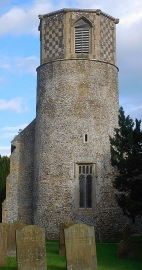
THE HELPFUL FEMALE voice with a North American accent emitting from our mobile ‘phone was quite persistent in trying to direct us onto the A47 road, the most direct route from Swaffham to Norwich, but we chose to ignore the advice we were being given. Instead, we forced ‘her’ to change her instructions so that we could follow a far longer but more pleasant route via Watton and Old Buckenham. As we wound our way between the two last mentioned places, we spotted a church with a round tower, made with flint and mortar, topped with a newer octagonal structure. This was in a Norfolk village that rhymes with freckles: Breckles. The church is St Margarets in the parish of Stow Bedon.
Churches with round towers are a rare breed in England compared with those with square towers. There are only 186 of the rounded versions (www.roundtowers.org.uk/) and some of them are in ruins. Of all the examples of this kind of church, the greatest number can be found in East Anglia, 131 of them in Norfolk. Church towers were built to house bells and sometimes the items used in services (e.g., church vessels). It is unlikely that they were built as part of the country’s defence against invaders because many of them were built after the last invasion of England (www.roundtowers.org.uk/about-round-tower-churches/).
“It has been suggested that the main reason was the lack of suitable local building material. Square towers require strong stone cut and dressed into blocks at each of the corners. But there is no suitable stone to be found in East Anglia and to transport stone from another county was very expensive for a small parish.
The only locally available stone was flint. Flint is a small, knobbly stone which, although creates strong walls when set in mortar, is not suitable for tower corners.”
The round tower of St Margarets was built in the 11th century (https://historicengland.org.uk/listing/the-list/list-entry/1248441), so could have been constructed either before or after 1066, when the Normans invaded. The octagonal structure on the top of the tower, the belfry, is late 15th century (www.norfolkchurches.co.uk/breckles/breckles.htm). Restored in 1856, the nave and chancel were constructed in the 15th and 14th centuries, respectively.
The interior of St Margaret’s is attractively simple. The carved, probably highly restored, wooden rood screen, separating the nave from the chancel, is one of the few decorative features in this small church. However, for me, the greatest attraction is the carved stone font, which is decorated with patterns and four carved figures standing in archways. The latter are carved in a simple, almost naïve or unsophisticated style, which made me wonder whether they date to pre-Norman times. Various sources describe it as being Norman. Whatever it is, it is a lovely piece of carving. When we saw it, it was decorated with flowers and foliage as part of the church’s preparations for celebrating the harvest season.
Having seen this charming church, we were pleased that we did not obey the voice on our GPS app, but instead took a route that our electronic navigator was initially so dead against. The more round about route allowed us to find a lovely church with a round tower.



 yamey
yamey 