UNLIKE MANY PLACES IN ENGLAND, Penzance in Cornwall did not get a mention in the Domesday Book published in 1086 although there is archaeological evidence of a bronze age settlement in the area. The first written mention of the town is in a document dated 1284, when it was listed as ‘Pensans’. The etymology of the town’s name derives from the Cornish words ‘penn sans’ meaning ‘holy headland’.
We discovered recently, on our first visit to the town, that Penzance in the far south-west of the British Isles is very pleasant and full of interesting buildings and other attractions. One of these is the long seafront promenade from which the visitor can see nearby Newlyn in one direction and St Michael’s Mount, Britain’s answer to France’s Mont St Michel, in another. Incidentally, Penzance is further west than anywhere in mainland France.
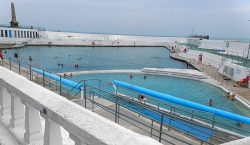
A row of poles carrying large flags, on which pictures of a diving ladies, dressed in old-fashioned blue striped bathing dresses, were printed, attracted our attention. The flags were fluttering vigorously in the strong breeze. They were placed next to the wall surrounding a large triangular open-air swimming pool two of whose walls project out into the sea. The pool was divided into two sections, one with a greater area than the other. Plenty of people were swimming in both parts. The design of the pool immediately made us think that it had elements suggestive of the art deco style that was popular in between the two World Wars.
The pool is known as the Jubilee Pool. A plaque at its main entrance informs that the pool was opened on the 31st of May 1935 (during the year of the Silver Jubilee of the reign of King George V), confirming our suspicion that it was built in the era of art deco. A website (https://historicengland.org.uk/listing/the-list/list-entry/1221190) contains the information that the pool was built to the designs of the Borough Engineer Captain F Latham, and it adds that the pool:
“… is now the finest surviving example of its type with the exception of the Saltdean Lido in Brighton (listed grade II). In Europe, lidos such as the Piscine Molitor in Paris of 1929 were the first to adopt the modernist style in order to embody the worship of sunlight and physical fitness. The seaside lido manifested the transformation of sea bathing in the 1920s from a predominantly health activity into a leisure activity, and because it was freed from the constraints in planning of more conventional pools it presented local authorities with the opportunity to emulate Continental fashions.”
The water in the two sections of the pool differs in temperature. In the lager part of the bath, it is unheated but in the smaller part, it is heated. Currently, a bather pays up to £4.25 to swim in the unheated section, and up to £11.75 to swim in the ‘Geothermal Pool’, whose water is between 30 and 35 degrees Celsius (https://jubileepool.co.uk/tickets/). Despite locals receiving a discount on ticket prices, many choose to swim in the sea amongst the Battery Rocks that surround the pool and the extension of the promenade that runs along the eastern edge of the bath. One local, who was dressed in a wet suit and had just been in the sea thought the ticket prices were a bit steep and told us that during September, the end of summer, the sea is actually quite warm.
The Geothermal Pool is filled with salt water heated by geothermal energy. The idea of installing this feature derives from Charlie Dixon, who in 2010:
“…had just returned from a trip to New Zealand where he had bathed in geothermal pools … Ten years and a £1.8m funding package later (not to mention an incredible amount of work by the Jubilee Pool Directors and staff) the first geothermally heated pool of its kind in the UK opens to the public on 1st September 2020 …
… The system operates by extracting warm water from one geothermal well (410m deep – the height of one and a half Eiffel Towers!!), taking heat out of that water using heat pumps and distributing it to the pool via a heat exchanger, before re-injecting the cooler water back into the ground. This combined system means that the temperature of the pool can be sustained with a very low carbon footprint. The initial pool heating results suggest that it’s about 80% geothermal but ultimately all the energy is coming from our geothermal well. We are using the heat pumps to concentrate that energy to the exact temperature required for the pool.” (https://jubileepool.co.uk/pool-info/geothermal/).
Although the Jubilee Pool geothermal system is the first of its kind in the UK, it was not the first pool or lido to use naturally heated water. The Romans heated the water at Bath with naturally warm spring water.
We wandered along the eastern side of the pool towards a carved stone obelisk that overlooks the triangular pool and the expanse of Battery Rocks. It stands on the site of a gun battery that was built in 1740 when Britain’s relations with Spain deteriorated. The obelisk, a war memorial, was designed by Sir Edward Warren and erected in 1922. It was unveiled by Mrs Bolitho on the 14th of May 1922. She was the wife of Thomas Bedford Bolitho (1835-1915), a Cornish politician (Liberal Unionist MP), banker, and industrialist, of Trewidden (Cornwall). Bolitho is a western Cornish surname and that of a prolific writer and biographer, Hector Bolitho (1897-1974), whose biography of Jinnah, the creator of Pakistan, was published in 1954. Hector was born in New Zealand and migrated to the UK in about 1924. Hector’s grandfather emigrated from Cornwall to New Zealand. It would be interesting to know whether Hector and Thomas were related, even remotely.
We saw plenty of folk bathing in the sea near the pool. They sheltered behind towels that flapped about in the breeze whilst they slipped in and out of their bathing suits. None of them, with whom we spoke, complained about the water’s temperature. In addition to humans enjoying the environment I spotted several cormorants contemplating the sea from their perches on the rocks. The Jubilee Pool and the rocks near it are some of the lovely features that make a visit to Penzance delightful.



 yamey
yamey 