REMNANTS OF LONDON’S ROMAN wall can be seen from various points in the Barbican Estate, whose construction began in 1965. The not entirely unattractive residential brutalist concrete jungle, known as The Barbican is sited next to the northern edge of what was formerly Roman Londinium. According to a history of the area (www.cityoflondon.gov.uk/services/barbican-estate/barbican-estate-history):
“The name of the Barbican comes from the Low Latin word ‘Barbecana’ which referred to a fortified outpost or gateway: an outer defence of a city or castle or any tower situated over a gate or bridge which was used for defence purposes. The “Barbecana” was probably situated somewhere between the northern side of the Church of St. Giles Cripplegate and the YMCA hostel on Fann Street.”
By the 1850s, the district of Cripplegate, where the Barbican is located, was very crowded with dwellings and business premises. Much of the area now occupied by the Barbican had been destroyed by bombing during WW2. The Estate was built to replace what the Luftwaffe had destroyed.
Apart from several water features, there is one oasis of greenery on the otherwise extremely urban site. This is the Barbican Conservatory. Opened in 1982, it is located above the Barbican’s main theatre and can be entered through an entrance close to that of the Barbican’s Art Gallery. Despite it having been in existence for so many years and having known about it for several decades, it was only yesterday (6th of April 2022) that I first ventured inside it. We had just viewed the current exhibition in the Gallery, “Postwar Modern: New Art in Britain 1945-1965”, an impressive display of rather unexciting artworks. Entering the Conservatory was literally “a breath of fresh air” after viewing the exhibits that had been arranged to illustrate the depressing emotional aftermath of WW2 as depicted by artists in Britain.
I was surprised to learn that the Barbican Conservatory is:
“… the second largest in London (after Kew Gardens) and home to over 1,500 species of plants, but is one of the city’s lesser-known green spaces.” (www.atlasobscura.com)
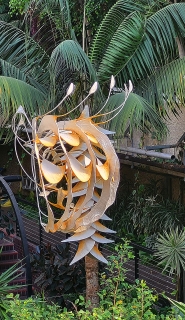
Apart from the plants, many of them exotic, which are arranged on various levels and can be viewed from both a lower floor and an elevated walkway, there are three ponds. One contains koi carp and the other, raised above ground level, is home to two terrapins, which were found in ponds on Hampstead Heath. The Conservatory is divided into two main sections. The larger is the tropical section, where visitors are permitted to wander about. The other, which was locked up yesterday, is the arid section, containing cacti and succulents.
Despite being in the midst of a manmade, visually intriguing, but harsh urban environment, the Conservatory with its tall trees, bushes, flowers, and other vegetation, feels like another world – a primaeval paradise from which the modern world can be glimpsed in the background.


 yamey
yamey 