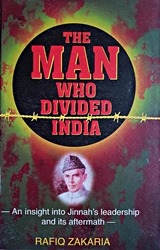
Mohammed Ali Jinnah (1876-1948) saw the realisation of his ambition, the formation of a sovereign nation for Indian Muslims: Pakistan, a year before he died as its supreme leader. Jinnah was a brilliant barrister and orator. His brilliance is described by Rafiq Zakaria in his book “The Man who divided India“. The author, clearly recognising his subject’s skills, does not rate him highly as an individual. His lucid, well-reasoned text makes this very clear.
At first, Jinnah, who was always attracted to politics, strove for Hindu-Muslim unity/harmony in pre-independence India. Various factors, including his disapproval of the anti-British Khilafat uprisings of India’s Muslims following WW1, led to him being sidelined by both the Indian National Congress and the main Indian Muslim political groupings. This led to him leaving India and establishing a legal practice in London and also attempting (in vain) to become involved in British parliamentary politics.
Returning to India after a few years in London, Jinnah recommenced his struggle to become prominent in the Indian polical scene. To do this, he abandoned the idea of working for Hindu-Muslim unity for the opposite – the alienation of India’s Muslims. This proved successful. Under his leadership of the Muslim League, he promoted the idea of a separate sovereign state for India’s Muslims by indoctrinating his followers to believe that as the Congress became more powerful and when the British left India, Muslims would be at the very least dominated by the Hindus. By 1947, when the British gave up their hold on India, the formation of Pakistan, a sovereign state for Indian Muslims, was guaranteed.
The formation of Pakistan was associated with mass movements of people: Muslims into Pakistan, Hindus and Sikhs out of the newly created country. During this ‘Partition’, there was massive loss of life and much irreversible misery both in Pakistan and India. Furthermore, Pakistan was not one contiguous territory, but two widely separated portions: West Pakistan and East Pakistan (now Bangladesh).
Zakaria describes how Jinnah, the great leader of the Muslims, was really a very unobservant Muslim. Throughout his life, Jinnah ate pork, enjoyed alcohol, hardly knew the Koran, and never learnt Urdu, the language of the Muslims of the Indian subcontinent. According to Zakaria, Jinnah did not hold his fellow Muslims in high regard, to put it mildly. It appeared to me while reading the book that Jinnah took advantage of Muslim fears of possible domination by the Hindus to further his ambitions of achieving political prominence, which were indeed successful.
Zakaria uses the last few chapters of his fascinating book to discuss the legacy of Jinnah’s creation, Pakistan. He paints a gloomy picture. Having espoused the idea of the separateness of the Muslims, and promoted the idea that the Indian Muslims were a ‘race’ or ‘nation’ separate from their non-Muslim Indian neighbours, Jinnah, like his hero the Turkish leader Kemal Ataturk in Turkey, decided that Pakistan should become a ‘modern’ secular state rather than some kind of Islamic entity. He wanted to govern Pakistan using the model of British imperialism, which the Indian subcontinent had just freed itself. This has not happened in Pakistan; it is now an Islamic state.
Zakaria emphasises that far from unifying India’s Muslims, Jinnah’s creation of Pakistan has achieved the very opposite. The Muslims of the subcontinent are now divided between Pakistan, India, and Bangladesh. Many families have members now separated by international borders. Many Muslims in India continue to live with the fear that they are somehow threatened by the Hindu majority in the country. In addition, within Pakistan itself, different factions of Muslims (Sunnis, Shias, and others) are in permanent conflict with each other. In Bangladesh, there are also problems. And, if that were not bad enough, the political situation in modern Pakistan is extremely unstable and life there is far from peaceful. From what I have read in Zakaria’s interesting and highly readable book, Jinnah’s dream of unifying India’s Muslims has turned into a nightmare.
To conclude, it should be mentioned that Zakaria, an Indian Muslim, has served the Indian Congress Party, which opposed Jinnah in the years before independence, as a high-ranking official. Despite that, I felt that his book attempts quite successfully to give a balanced view of Jinnah and his politics without concealing his own views.



 yamey
yamey 