
Some old baggage discovered in an attic and a Roman toga

WHEN MY FATHER sold our family home in Hampstead Garden Suburb in the early 1990s, he gave some of his unwanted possessions to some neighbours, who still live opposite. They stored much of it in their attic. Recently, a plumbing problem required them to empty the attic. Soon after this, we paid them a visit as we had not seen them since before the start of the covid19 pandemic and its associated lockdowns. Amongst the stuff they removed from their attic, they found a sturdy, brown leather suitcase in a well-worn canvas protective covering. The covering was stencilled with the letters ‘BSY’, these being my father’s initials.

The canvas case bears an oval label, which was provided by the “Holland-Afrikalijn”. It states that the suitcase was “For the cabin” and the name of the ship’s destination was “Southampton”. The ship carrying this case was the “Jagersfontein”, and the label bears the date “3/9/55”, There is another torn label, which was issued by South African Railways and what is left of it is “T Elizabeth”, which probably was “Port Elizabeth” before it was torn. This suggests that the case must have travelled to and/or from Port Elizabeth by rail. A third label, which is circular and was stuck on by the shipping company bears a large capital “Y”.

By September 1955, I was three years (and a few months) old. That year, my parents, who were born in South Africa, took me from London, where we lived, to be shown to family and friends in that country. I remember almost nothing of that visit apart from two things. One of them was getting my small foot caught in the groove of the tram-like track of a mobile dockside crane. The other thing was being afraid of the cacti in a greenhouse in a park in Port Elizabeth, the city where my father’s sister and his mother resided.

I know that we also visited King Williams Town, where many of my mother’s family lived. This visit was recorded in a 1955 issue of the town’s “Cape Mercury” newspaper. I discovered it while I was researching information about my mother’s grandmother, who lived in the town. The newspaper article, which is full of small inaccuracies, described me as being “… an adorable little son, aged three …”.

The Jagersfontein has an interesting history (http://ssmaritime.com/fontein-ships-1.htm). Built in Danzig (Germany) in 1939 and given another name, it was badly damaged during WW2, and it sunk. In 1947, she was recovered from the sea, towed to Holland, and refurbished by the Dutch. In September 1947, she began sailing again, as a passenger-cargo liner.

During the voyage from Southampton to South Africa, I crossed the Equator for the first time in my life. My mother told me that when the ship carrying us crossed the Line, a fancy-dress party was held for the children onboard. Some of the parents knew that this would happen and had come prepared with fancy-dress costumes for their children. However, my mother was unaware that this would happen. Being a creative person, she took some of the white bed linen from our cabin, and fashioned a Roman toga for me to wear at the party.

My mother died 44 years ago. Only a few days before we saw the suitcase at our old neighbours’ home, I was rummaging through some photographs that I had not seen since her death. It shows me in my rapidly fashioned bedsheet toga, standing between two larger children dressed up to depict Belisha beacons (that mark so-called ‘zebra’ pedestrian crossings). A small cloth with black and white stripes, representing a zebra crossing, separated the two beacons. Behind the three of us are some adults, whom I cannot recognise.

Empty, the leather case, which looks almost new, weighs 6.3 kilogrammes (13.9 lb). In 1955, passengers travelling by ships such as the Jagersfontein did not need to worry about the weight of their luggage. There were plenty of porters to carry it. We have been given the suitcase, which our daughter is keen to have because it is a family heirloom with sentimental value. Along with the photograph and the newspaper cutting, the case is a wonderful reminder of my first ever travel adventure.

Lost property

When we visited the museum at the Harrapan archeological site at Dholavira in Kutch (part of Gujarat, India), we found that there was a sale of guides to various historical sited in India, all published by the Archaeological Survey of India. With the exception of a couple of volumes that were printed in Hindi, we bought one of each, about 18 in all and at radically reduced prices.

After a couple of days in Dholavira, staying at the very overpriced Rann Resort, we travelled to Bhuj, where we stayed before taking a bus to Ahmedabad.

The air conditioned bus, which was not particularly comfortable, took eight hours. It was a part of the fleet of Gujarat State Road Transport (GSRTC). I was very tired when we pulled into the central bus station at Geetamandir in Ahmedabad, and disembarked with our several pieces of luggage.

Several hours later when we were comfortably settled into our hotel, I realised that I had left my cloth bag, containing my collection of books acquired in Dholavira, on the bus. My wife, who is fluent in the Gujarati language, suggested that we return to the bus station to try to recover the bag of books. I agreed, but felt that there was little chance of success.

We were directed to a booth where GSRTC officials in charge of controlling the bus service to and from Bhuj sat. My wife explained the problem and immediately the official began tapping on his keyboard. A screen marked “journey report” appeared. From this, the official was able to get the telephone number of the conductor who had been on our bus. He was off duty and our bus was on its way back to Bhuj. However, he provided the phone number of his colleague, ‘X’, who was now the conductor on ‘our’ bus that was returning to Bhuj.

We rang X, who soon found the book bag on the luggage rack close to where we had been sitting. He told my wife, in Gujarati, that he would be retutning on a bus that would arrive at Ahmedabad central bus station at about 5 pm the next day, and would bring us the bag of books. This sounded promising, but you never can tell what might or might not happen.

As we were setting off for the bus station the next afternoon, X rang us to tell us when he expected to reach it and where we should wait for him. At a few minutes before 5 pm, the bus on which we had travelled the day before pulled into the Geetamandir bus station. Soon X was walking towards us, holding our cloth bag filled with books. My admiration of GSRTC increased immensely.

We offered X some confectionery as a small token of our gratitude. He refused it twice, saying that recovering lost property is part of his duty. When we said that he should give the gift to his family, he accepted it.

Often Asian folk traditionally refuse an offer two or three times out of politeness before accepting. In the case of conductor X, I do not believe it was politeness that he did not accept our small gift immediately. Instead, he was behaving professionally and correctly.

A few hours earlier, we had been shown various interesting features by a guardian in the Jumma Masjid in Ahmedabad. When he had finished, we handed him some Rupees, expecting that he was probably poorly paid, if at all. We were most impressed when he refused the money, which would have been useful for him, and, instead, showed us which charity collection box in which to put it. Like X, the bus conductor, this fellow in the Masjid was too dignified to accept a tip for what he felt it was his duty to do.

Postscript.
The Asian habit of refusing three times can backfire when practised in Europe. A friend of ours of Middle Eastern upbringing became a junior doctor in an English hospital. After a few weeks, he asked an Egyptian colleague how to obtain a cup of tea.
“Simple,” the Egyptian said, “just get it from the lady who pushes the tea trolley around.”
Our friend replied: “Yes, she brings her trolley to me and she offers me a cup and I refuse. And then without even asking me a second or third time, she pushes the trolley away. So, I don’t get a cup of tea.”

Travelling on a budget

Suitcases that become trollies.

Trollies that run over the feet of others.

Wheelies that fit overhead lockers.

Hand baggage that is too big for a hand.

Waiting in long queues.

Cases filled to the brim to avoid paying for baggage in the hold.

Seats that cannot be reclined

Baggage for flights that often run late

To airports far from where you actually want to go.

Suitcases to avoid waiting at the baggage claim.

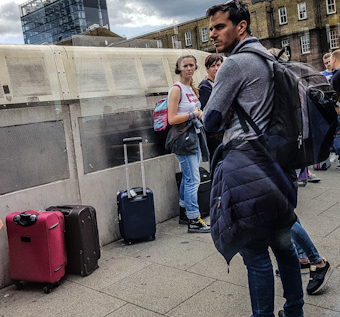
The joys of ‘budget’ airlines.