Man, nature, hills, and mountains in the Western Ghats of India

WE VISITED BANGALORE’S Chitrakala Parishath, an art school, on the last day of an exhibition called “Hidden Gems of the Western Ghats”. We were alerted to it by a good friend, Ajay Ghatage, who posted something about it on Facebook.


The Western Ghats are a line of hills and mountains that separate the Deccan Plateau from the western coastal strip of India, the shore of the Arabian Sea. The ghats are in the most part forested.


The exhibition included sculptures, many of them beautiful stone carvings, paintings, and a few ‘installations’. Each work expresses its creator’s reaction to the nature and its exploitation (and/or despoliation) by mankind. And the majority of the artworks on display did this well, beautifully, and often highly imaginatively.


Amongst the installations, there was one by Shivanand Shyagoti that particularly attracted my attention. It consisted of a tree trunk into which hatchets had been stuck. On the wooden handles of each of these choppers, there were line drawings of the woodland creatures whose habitat would be disturbed by deforestation.


The other works on display were at least as imaginative as the one described above. What was impressive about the majority of the artworks was that although they often conveyed messages about the fragility of the natural environments of the Western Ghats, they did it subtly, creatively, and,  most importantly, beautifully.

Two interesting artists at a farm in Somerset

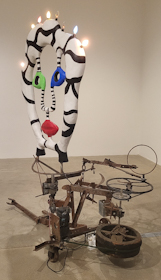
DURSLADE FARM NEAR Bruton in Somerset is home to a branch of the international commercial art gallery, Hauser and Wirth.  Until 1 February 2026, there is a wonderful exhibition of artworks by Jean Tinguely (1925-1991) and his partner, wife (for a while), and long-term collaborator Nikki de St Phalle (1930-2002). Both artists produced highly original and very imaginative creations.


A collaboration by Tinguely and de St Phalle

The sculptures created by Tinguely are frequently examples of kinetic art in which elements of the sculptures are made to move by motors, which are parts of the artworks. His sculptures often resemble unusual machines. Some of his works were collaborations with Nikki de St Phalle.


Nikki’s works are often colourful, playful, and figurative. In one room of the exhibition, the viewer is introduced to an interesting method of creating artworks used by de St Phalle. She used a rifle to fire bullets filled with paint at various targets. When the bullets hit the targets, they splattered the paint contained within them. A few examples of this procedure are on display in the show.


The exhibition is held both inside and outside  the buildings at Durslade Farm. The works outside were by de St Phalle. Those by Tinguely are all inside. Every 10 minutes, the sculptures with motors are activated for a few minutes. They are now too fragile to be run continuously or left in the  open air.


Hauser and Wirth Somerset  (at Durslade Farm) is now a popular destination not only for its art shows but also for its restaurants, garden, and pricey farm shop. However, its art exhibitions are always superb, and the current one is no exception.

Three generations of artists in one family

SIR WILLIAM ROTHENSTEIN (1872-1945) was born of German-Jewish parents in the Yorkshire city of Bradford.  His father was involved in Bradford’s textile business. Trained at the Slade School of Art (part of London’s UCL), William became a well-known painter and cultural figure. Between 1920 and 1935, he was director of the Royal College of Art. Rabindranath Tagore dedicated his work “Gitanjali” to William. One of William’s sons, Michael Rothenstein (1908-1993), who was born in Hampstead, became a noted printmaker. He married Betty Mona Desmond Ayers (née FitzGerald; 1915-2017), who was known as ‘Duffy Ayres’. She was an English portrait painter.

Michael and Duffy had two children, one of whom is Anne Rothenstein (born 1949). She is a self-taught artist, who lives and works in London. Until 12 April 2025, there is an exhibition of her paintings at the Stephen Friedman Gallery in London’s Cork Street. Her attractive paintings, which seem deceptively simple when compared with those made by her grandfather William, depict portraits, interiors, and landscapes. However, they are far from simple. They are subtle and sometimes dreamlike. And as the gallery’s handout noted, her portrayal of perspective is unusual: the landscapes seem flattened. The paintings on display are oddly compelling and this along with their somewhat muted colouring, enhanced my enjoyment of Anne’s art.

As soon as we entered the gallery and I saw the artist’s name, I wondered whether she is related to the famous Sir William Rothenstein. When the gallery assistant informed us that she is from the same family, I was excited. Already, I knew of William’s connections with Hampstead and that he hosted Tagore, when the great Bengali visited London, but I had no idea that both his son and his granddaughter were artists (although far less well-known than him).

Two sculptors: one famous and one forgotten

DURING THE 1950S and the first half of the 1960s, my mother, Helen Yamey, created sculptures in the sculpture workshops of St Martins School of Art, which was then located on Charing Cross Road. Although my mother was not a student at St Martins, she worked alongside one of the school’s teachers of sculpture, the noted sculptor Anthony Caro (1924-2013). Caro became famous for his metal sculptures that consist of pieces of metal either welded or bolted together. While my mother was making sculptures at St Martins, she like other sculptors including Phillip King, Tim Scott, and William Tucker, was undoubtedly influenced by, and learned from, Caro’s work. She learned welding and created several abstract sculptures that consist of pieces of steel welded together. Unlike Caro, who achieved great fame, my mother, who was unambitious and only created sculpture to fulfil a creative urge, my mother and her sculptures became forgotten.

Today, 8 March 2025, we visited the Annely Juda Fine Art Gallery in central London to see a small exhibition of sculptures by Anthony Caro. Unlike many of Caro’s works, the metal sculptures on display, are not enormous. They are small enough to be fitted comfortably into one’s living room or a small garden. Indeed, one of the sculptures, in my opinion the most attractive, has the title “Table Piece CCCXLI”. It was constructed in oxidised steel. The five Caro pieces in the exhibition display a variety of compositional style, and together demonstrate the artist’s versatility. They were all made between 1970 and 1990. My mother left St Martins before this period, sometime in the mid-1960s. I know that she maintained an interest in Caro’s output, but. Sadly, I cannot recall what she thought of its quality.

The exhibition at Annely Juda continues until 15 March 2025. You can read about my mother’s life in art and her time at St Martins in my book “Remembering Helen: My Mother the Artist” [ available from Amazon, e.g.: https://www.amazon.co.uk/REMEMBERING-HELEN-MY-MOTHER-ARTIST/dp/B0DKCZ7J7X/ ]

Finding a box of photographs and rediscovering a forgotten artist

UNTIL ABOUT 1991, my widowed father resided in my childhood home in northwest London. For as long as I can remember, there was a collection of black and white photographs in a cardboard Kodak photographic paper box. The photographs contained images of sculptures, which my mother Helen Yamey (1920-1980) had created at St Martins School of Art in London during the later 1950s and first half of the following decade. In 1991, my father married again, and moved from our childhood home to another address. Every now and then, after my father moved, I used to ask him what had happened to the photographs. He used to reply that he did not know where they were. Maybe, he suggested, they were stored somewhere in the garage of his new home. He died in 2020. After that, I thought that it was extremely unlikely that I would ever set eyes on the photographs again.

A year or two after my father’s demise, his widow, my stepmother, arranged to meet me at a café. When she arrived, she was carrying a plastic carrier bag, which she handed to me. To my great delight, I found that it contained the Kodak box filled with photographs of my mother’s sculptures. I posted a few of these images on the Internet. Some months after that, my friend Edesio mentioned that he was impressed by the images of my mother’s sculptures, and suggested to me that I should write something about my mother and her art. This I have done.

When I began writing my mother’s biography, our daughter Mala, who is an art historian and a curator, sent me a pdf file containing the contents of a catalogue of an exhibition held at London’s Grosvenor Gallery in the 1960s. It contained mention of some of my mother’s work that appeared in the exhibition. Mala did a little more research and discovered the existence of catalogues of other exhibitions in which my mother’s sculpture was included. I investigated these catalogues and came across a few more, I was surprised by what I discovered.

During the first half of the 1960s, my mother’s sculptures were selected to appear in exhibitions alongside artworks created by artists, many of whom are now quite famous. These include, to mention but a few, David Hockney, Henry Moore, Barbara Hepworth, Howard Hodgkin, Bridget Riley, Kim Lim, and LS Lowry. These exhibitions were held when I was between 8 and 13 years old. In those days, I was not particularly interested in my mother’s artistic activities and was too young for the names of these artists to mean anything to me. In addition, I do not recall even having been told that my mother was participating in exhibitions, let alone showing her work alongside that of these now famous creators.  So, until I studied these catalogues more than 40 years after my mother died, I had no idea that for a while she was in the vanguard of 20th century British sculpture. Had I not been stimulated into beginning to write about her, I would not have known that my mother, who never boasted about her achievements, had been an artist of such a high calibre.

I have written my memories of my mother in a book called “Remembering Helen: My Mother the Artist” (available from Amazon: https://www.amazon.co.uk/dp/B0DKCZ7J7X/) . In it I have tried to describe her upbringing; what she was like as a mother; and her achievements in the world of sculpture. I have included many of the images I found in the box of photographs, and our daughter has written some insightful notes on her grandmother’s sculptural styles and the techniques. I hope that my book will help bring my mother’s artistic  achievements out of obscurity. Modest as she was, I feel that it would be good if she were to get at least a little of the fame she deserved.

An especially wonderful art gallery in a town in Cornwall

DESPITE BEING OVERRUN with tourists, the small fishing port of St Ives is one of my favourite places in Cornwall. Since the early 19th century, this picturesque place has attracted artists. With the decline of the pilchard industry in the 1880s, many of the buildings associated with this became vacant, and some of them were occupied by artists who converted them into studios. With the advent of the railway (in 1877), a means for easily transporting large canvases to London became available. It was not long before St Ives became an artists’ ‘colony’. In 1889, the St Ives Arts Club was founded as a place where artists could meet and socialise. It still exists. Its ground floor is used for temporary exhibitions. The upper floor is for members only, but I was lucky enough to have visited it with my friend, the late Michael Jacobs, who was writing his book, “Good and Simple Life: Artist Colonies in Europe and America”.

In 1927, the St Ives Society of Artists was formed. Its aim was (and still is) to raise the artistic standards of the artists’ colony and to exhibit works that they considered to be of significant quality. It was housed in various buildings in the town before 1945, when it moved into its present accommodation, the deconsecrated gothic church of St Nicholas. Exhibitions are held both in the church itself and in the crypt below it. The works of St Ives artists, who were considered avant-garde, such as Barbara Hepworth, Peter Lanyon, and Patrick Heron, were displayed alongside those of the town’s less adventurous artists, but were given less favourable positions in the exhibitions than the conventional creations. In 1946, several of the modernist artists held an exhibition in the crypt. They became members of a newly created Crypt Group. There were a couple more exhibitions by members of the Crypt Group in 1947 and the following year. Following a disagreement at an extraordinary general meeting of the Society in 1948, many of the members resigned including those who were included in the Crypt Group – some of Britain’s leading modern artists of the time.

In 1949, some of the modernist artists in St Ives, including Barbara Hepworth, Ben Nicholson, Peter Lanyon, Bernard Leach, Sven Berlin and Wilhelmina Barns-Graham, founded a new organisation – The Penwith Society. Later members included the sculptor Henry Moore, Terry Frost, and Patrick Heron. Because of its association with Britain’s pioneers of modern art, the Penwith is a tangible, important landmark in 20th century British art history. In 1961, the Penwith occupied a disused pilchard packing factory, and over the years it has expanded into neighbouring buildings. As its website (https://penwithgallery.com/about-us/) explained:

“Today the Penwith offers a year-round programme of exhibitions by Society Members and Associates, as well as those by other artists from Cornwall and further afield. The Penwith continues to be at the forefront of presenting contemporary work of quality.”

Every time we visit St Ives, we visit the Penwith. Of all the numerous (commercial) galleries in St Ives, the Penwith consistently contains artworks of the highest quality and greatest visual interest. The exhibition areas are spacious and well-lit.  One area in the gallery is called the ‘Hepworth Room’, which is used for exhibitions, but also contains a fine sculpture by Barbara Hepworth. A small courtyard, used to exhibit sculptures, contains a plaque, which reads:

“This foundation stone was laid by our friend and benefactor Dame Barbara Hepworth 10 January 1973”

It must refer to one of the many extensions made to the place since it was adopted by the Penwith in 1961.

I always enjoy visiting the Penwith. My advice to a visitor, who is short of time, is to forget the Tate St Ives, and instead make a beeline for the Penwith. Having said that, the Barbara Hepworth Sculpture Garden should also not be missed.

Much Moore to be seen at Kenwood House in north London

INSIDE KENWOOD HOUSE (in north London), the visitor can see a glorious collection of paintings by famous artists such as (to name but a few): Vermeer, Rembrandt, Constable, Gainsborough, Reynolds, Cuyp, Romney, and Van Dyck. These works are part of the Iveagh Bequest, which was the collection of paintings bought by the art collector, Irish brewing magnate, and philanthropist Edward Cecil Guinness, 1st Earl of Iveagh (1847-1927).

In the grounds of Kenwood House, there are two sculptures created after Iveagh’s death. They are both by sculptors, who are considered as some of the greatest British artists of the 20th century. One of them, which is near the house, is by Barbara Hepworth (1903-1975), and the other, which we examined when we walked past it today, illustrated above, is by Henry Moore (1898-1986). His large bronze sculpture is called “Two Piece Reclining Figure No. 5”, and was completed in 1963-1964. It has been lent to Kenwood by the Tate Gallery.

Apart from being superb sculptors and having works at Kenwood, Hepworth and Moore have other things in common. Both studied at the Leeds School of Art, where they met. And both lived in Hampstead, which is close to Kenwood, for a while between the two World Wars. While they were in Hampstead, they had studios close to each other: Hepworth in Mall Studios, and Moore in nearby Parkhill Road. You can find out more about their lives in Hampstead in my book “Beneath a Wide Sky: Hampstead and its Environs”.

William Hogarth and Damien Hirst as neighbours in a church in London

ST BARTHOLOMEW THE GREAT church in the City of London was founded in 1123 by Rahere, a courtier of King Henry the 1st, who reigned from 1100 to 1135. It was originally built as the church for an Augustinian priory, which was abolished and partly destroyed during the reign of King Henry VIII. When this happened (in 1539), the priory church’s nave was demolished, leaving only the apse and beyond it, the Lady Chapel. The choir, which used to be at the west end of the apse and at the eastern end of the demolished nave, now stands at the east end of what is now the nave, but was formerly the apse. The current nave (formerly the apse of the original church) is a magnificent example of Norman architecture. I could go on describing this magnificent church in great detail, but I will not because plenty of people have done it before me (e.g., https://en.wikipedia.org/wiki/St_Bartholomew-the-Great and https://medievallondon.ace.fordham.edu/exhibits/show/medieval-london-sites/stbartsgreatchurch). Instead, I will mention a couple of the many interesting items in the church that caught my interest during a visit today (the 2nd of April 2024).

Both the objects of interest stand in the southwest corner of the church, close to the entrance that leads to the path that runs along the location of the long-since demolished apse of the priory church. The two things stand a few feet from each other. One of them is a carved stone font, said to be one of the two oldest fonts in London – the other being in the parish church of St Dunstan & All Saints in Stepney. What interested me about St Bartholomew’s font, which is still in use, is that it was here that the painter William Hogarth (1697-1764) was baptised. He had been born in a house in Bartholomew Close near the church in the Smithfield district of London.

Hogarth was a successful artist in his time, and has become recognised as one of the famous British artists of the 18th century. Not far from the font, there is a dramatic gold coloured sculpture by one of the most famous British artists of our times – Damien Hirst (born 1965). The sculpture, which is on loan from the artist, is called “Exquisite Pain.” It is Hirst’s depiction of St Bartholomew holding his skin, having been flayed. The church’s website (www.greatstbarts.com/visiting-us/artworks/damien-hirst-exquisite-pain/) revealed:

“St Bartholomew, one of the original twelve disciples, was sent as an Apostle to Armenia, where he was killed by being skinned alive. The classic iconography of the saint sees him naked, his muscles exposed, his skin hanging over his arm – and in his hands, the instruments of his torture. This statue sees Damien Hirst conform to this imagery, but give it a unique twist: the instrument in his hand is not a standard knife, but a scalpel, used in the hospital across the road which also bears the saint’s name.”

I think it is a wonderful sculpture. However, like most works of art, it might not suit everyone’s taste, but there is no doubting that its dramatic impact and skilful execution are remarkable.

While Hirst’s fame is great today, and his works command high prices, I wonder whether his reputation as a notable British artist will survive as long as Hogarth’s.

The artists John Mallord Turner and Mark Rothko and abolition of slavery

AFTER BEING DISAPPOINTED by the large temporary exhibition of playful but repetitive works by the artist Sarah Lucas (born 1962) at Tate Britain, we had a coffee and then revisited the rooms containing paintings and sketches by John Mallord Turner (1775-1851). It has been many years since we last viewed these paintings, and seeing them revived our spirits after having had them somewhat lowered by the Lucas exhibition.

One of the Turner galleries contains a particularly fine painting by the American artist Mark Rothko (1903-1970). It hangs amongst a series of Turner’s often unfinished late experiments on canvas. They were mostly items found in Turner’s studio after his death. Without outlines, these almost ethereal paintings are examples of the artist’s experimentation in ways of depicting light and colour. If one did not know when these works were created, one might easily guess that they are the works of an artist working during the age of Impressionism. As an aside, many of Turner’s finished works are extremely impressionistic, and I consider him to be the pioneer of what later became Impressionism, and one of the best creators in this style. These experimental works were displayed at an exhibition in New York City at its Museum of Modern Art in 1966. That year, Rothko remarked:

“This man Turner, he learnt a lot from me”.

The Rothko painting hanging amongst the Turner experiments was created in 1950-52. Later, in 1969, Rothko donated a set of his paintings to the Tate, hoping that they would be hung close to those of Turner. They are not; they are hanging at the Tate Modern.

Moving away from the room in which the Rothko painting is hanging, I came across another Turner painting that interested me, “The Deluge”, which was first exhibited in about 1805. In the bottom right corner, Turner has painted a black-skinned man rescuing a naked white woman. On close examination, the man can be seen to have a chain around his waist. The Tate’s caption to this picture includes the following:

“Painted at a time when the cause for Britain to abolish its enslavement of people of African descent was gaining ground, this detail is significant.”

Some years after it was painted, Turner gave a print of this work to a pro-abolition Member of Parliament.

“The Deluge” is not the only painting by Turner relating to his sympathy for the abolition of slavery. His “The Slave Ship”, first exhibited in 1840, is another powerful example. This painting, now in Boston (Massachusetts), is based on the dreadful incident when, in an attempt to cheat the insurers, the captain of a slave ship, the Zong’, caused 132 slaves to be thrown overboard (in 1781).  Turner had learned about this crime from the anti-slavery activists with whom he associated. Although Turner, a liberal, was sympathetic to the abolition of slavery, he was not totally divorced from the benefits that transatlantic slavery brought to Britain, as was pointed out by Chris Hastings in the “Mail Online” on the 28th of August 2021:

“One of Britain’s greatest painters has fallen victim to woke culture, as art-lovers are being warned not to ‘idolise’ J. M. W. Turner because he once held a single share in a Jamaican business that used slave labour.”

The website of London’s Royal Academy gives more detail:

“It would be fair to assume that Turner’s views were strongly pro-abolition at the time he painted this work. However, scholars have pointed out that earlier in his career he apparently had no qualms about investing in a company that ran a plantation … In 1805 Turner invested £100 to buy a share in a business called Dry Sugar Work. Despite the name, this enterprise was a cattle farm on a Jamaican plantation run on the labour of enslaved people. The business was owned by Stephen Drew, a barrister who bought the estate from William Beckford in 1802. The firm went bust in 1808.”

Some many months ago, we saw a play at the National Theatre, “Rockets and Blue Lights” (written by Winston Pinnock). It concerns an ageing Turner seeking inspiration from a remembered incident like the awful event that took place on the “Zong”. During the play, it was alleged that because of his disgust with the slave trade, Turner gave up using sugar. Whether or not this was the case, I cannot say.

Fascinating as are abolitionist and the Rothko ‘connections’ with JMW Turner, the well-displayed paintings in the Turner galleries are all superb and well worth visiting.

An artist and a traffic roundabout

THE FOLLWING FIVE ROADS meet at West London’s busy Hogarth Roundabout: The Great West Road, Church Street, Burlington Lane, Hogarth Lane, and Dorchester Grove. Excepting Church Street, they are all major thoroughfares, which carry a great deal of traffic. The roundabout is named after the artist William Hogarth (1697-1764), whose former home, Hogarth’s House – now a museum, is close by.

The museum at Hogarth’s House contains a large collection of prints created by Hogarth. All of them illustrate 18th century life in Britain in exceptional detail. The artist did not portray scenes straightforwardly. He portrayed the people and what they were doing in a satirical – sometimes comical – way. So, that what we see today is not only how things looked in Hogarth’s time but also what he felt about them.

Amongst the prints on display, there is one created in 1997 by the cartoonist Martin Rowson (born 1959). It depicts the chaos, dirt, and traffic at Hogarth Roundabout as Hogarth might have done had he been alive to see it. This entertaining print, which was made to commemorate Hogarth’s 300th birth anniversary, includes details copied from Hogarth’s prints. It is a fascinating addition to the collection of the small museum.