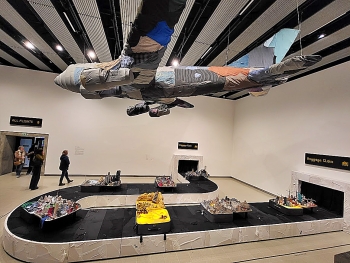
THE MOBILE GULL APPRECIATION UNIT was created by Mark Dion in 2008 for the 2008 Creative Folkestone Triennial. On wheels, this enormous model of a seagull can be towed to different locations. The seagull can be entered and is used by people trying to persuade viewers to understand and appreciate gulls, which are often regarded as pests. Personally, I have nothing against these creatures.
Folkestone in Kent has become a town filled with art works. Every 3 years it hold an art festival, the Folkestone Triennale. This year it began two days ago. This is one of the permanent works.
THE ARTIST LEONARDO Drew was born in 1961 at Tallahassee, Florida (USA), and now works in Brooklyn (New York City). Until 7 September 2025, an entire, large room at the South London Gallery in Peckham is occupied by a work by Drew, which has the name “Ubiquity II”.
At first sight, the viewer is confronted by what looks like the chaotic result of a big explosion. The room is filled with fragments of wood, some of which is piled in heaps leaning against the walls, and the rest scattered on the floor, on which visitors tread. On closer examination, it can be seen that there are fragments of mirrors amongst the debris, and almost every piece of wood has paint or some other modification on it.
Despite looking like disorganised chaos, it is not. The artist carefully selected each of the fragments, modified them (often with paint), and then carefully arranged them to produce what the viewer sees. He has created the depiction of chaos and destruction in a most careful orderly way. As the gallery’s website put it, Drew:
“… creates reflective abstract pieces that play on the tension between order and chaos. Transforming and eroding materials by hand in the studio, he explores the cyclical nature of life and decay.”
And given what is happening in the world today, this powerful depiction of order and chaos is particularly relevant.
THE ANNELY JUDA Fine Art Gallery is currently in London’s Dering Street, but it will soon be moving to a new location in Mayfair’s Hanover Square. To celebrate the gallery’s forthcoming departure from Dering Street, its final exhibition at that address is called “Demolition”. It is a collection of artworks created by Tadashi Kawamata (born 1953 in Japan). He lives and works in Paris (France).
The name of the exhibition describes what the viewer will see: demolition. The artist has dismantled the gallery’s walls and panelling and used the fragments and debris from them to create a series of art works, which together make the gallery look like a building site. This might sound ridiculous, but the sculptural forms he created from the fragments of the gallery’s structure are both intriguing and exciting. It looks like someone had exploded a bomb within the gallery. However, certain elements remain untouched: cctv cameras, light switches, smoke detectors, and electrical sockets. Kawamata is well known for his site-specific creations. In addition to the sculptural ensembles that he created using the fabric of the gallery, there are several beautifully intricate three-dimensional maquettes of other projects the artist has planned or carried out.
Now, Annely Juda is a commercial gallery. I asked a member of its staff whether the amazing works that were on view in the gallery were for sale. He said that they are, and the artist will recreate the works for clients in their own spaces.
This amazingly unusual exhibition will continue until 5 July 2025.
LOVE HIM OR HATE him, there is no denying that the artist Damien Hirst (born 1965) has plenty of imagination. Between 1997 and 2003, he created a restaurant in London’s Notting Hill Gate. It was called Pharmacy, but had to change its name after the Royal Pharmaceutical Society of Great Britain objected to it. Its new names were anagrams of the old: first Achy Ramp, and then Army Chap. Its decorative theme was pharmaceutical. For example, its walls were lined with cupboards containing (empty) drug and medicine packaging, as well as clinical equipment. It gave the visitor the impression of being in part of a busy hospital or clinic. From what I can remember of the place, its décor was vastly more exciting than the costly fare served to its customers. I was sad when it closed as it was a distinctive landmark in the area.
In 2016, Damien Hirst opened Pharmacy 2 on the first floor of his recently completed Newport Street Gallery (near Lambeth Palace). For a few years, this pharmacy themed restaurant offered a range of food and drinks, none of which were cheap. The interior of Pharmacy 2 follows on from the original art-installation-cum-restaurant design of the Notting Hill Gate version. An online article (www.dezeen.com/2016/02/18/damien-hirst-pharmacy-2-restaurant-mark-hix-newport-street-gallery-caruso-st-john-london/) describes the place well:
“Similar to its predecessor, which was designed by Barber & Osgerby’s interiors company Universal Design Studio, the interior follows a clinical theme inspired by Hirst’s 1992 artwork Pharmacy. Images of tablets and brightly coloured pills have been embroidered onto leather banquettes and embedded into the marble floor. Bar stools are topped with pastel-coloured pill-shaped seats. Walls are covered with a silver-coloured wall chart of pills and pharmaceutical products first produced for the original Pharmacy restaurant … A neon prescriptions sign hangs above the bar, along with a series of sculptures based on molecular structures. Windows are covered with dark-coloured translucent vinyls. Stark lighting is used to reaffirm the restaurant’s pharmaceutical theme.”
These words give some idea about this fantastic place, but it must be seen to be believed.
Pharmacy 2 has not been functioning as a restaurant for several years. When we visited Newport Street Gallery in May 2025, Pharmacy 2 was open to the public, and visitors can serve themselves with tea and coffee without charge. On each of the restaurant’s tables, there are art books for visitors to browse. The young man, an invigilator, who was keeping an eye on the place told us that occasionally the restaurant is revitalised for feeding visitors participating in special events. At these ‘pop-up’ events, meals are costly.
Pharmacy 2, like its predecessor in Notting Hill Gate, is an art installation. It is appropriate that the canteen of the Newport Street Gallery is not merely a restaurant but also an amazing work of art.
THE HUGE TURBINE Hall that forms the entrance and centrepiece of London’s Tate Modern is used for temporary exhibitions. Until 16 March 2025, the Turbine Hall is home to a somewhat weird but visually fascinating art installation, “Open Wound, created by Mire Lee, who was born in South Korea in 1988.
At first sight, it seems that discarded skins of various shapes and sizes are hanging from the ceiling. Standing on the floor beneath some of them is a tall tower that carries what looks like a piece of ageing industrial machinery suspended from an overhead crane. This rotates slowly while drops of liquid fall from it onto some of the skins and elongated sausage-like pieces of fabric before dropping into a pool on a large piece of stretched material. Set in the lofty, rather inhuman, Turbine Hall, this installation made me feel as if I were inside an enormous abattoir.
Apart from being intriguing to look at, I was not sure what to make of it. The Tate’s website noted:
“Lee believes ‘being moved is the strongest thing you can experience through art.’ Reflecting on our current historical moment, Open Wound conjures ‘the mood of a deserted construction site’, an atmosphere of ‘futility and melancholy, where something has started to wither.’ Despite this, the collective ‘skins’ of the living factory suggest an eerie solidarity. They mutate the Hall into an intimate space of ‘dream and distant memory’, in which such feelings can be shared.”
Well, having seen the work in the Turbine Hall, these words made sense. I am not sure that I would recommend people going out of their way to see this installation, but if you had other reasons to visit the Tate Modern, then do spend a few minutes looking at Mire Lee’s creation.
FIRELEI BÁEZ WAS born in the Dominican Republic in 1981. She studied art in the USA, where she now lives and works. The South London Gallery (‘SLG’) in South London’s Peckham district is hosting her first solo exhibition in the UK. The show continues until the 8th of September 2024. The exhibition is distributed between the main gallery building and a converted fire station, which is a few yards away.
The large exhibition space in the main building is occupied by a wonderful immersive installation. The viewer walks beneath a huge blue canopy with multiple small oval holes suspended from the ceiling. Light filters through the material of the canopy producing the effect of sunlight dappled by leaves of trees, creating the feeling that one is walking in a forest. Recordings of bird sounds enhance this illusion. On the walls of the room there are large, boldly coloured aluminium cut outs, representing silhouettes of Ciguapas – figures from the folklore of the Dominican Republic.
In the converted former fire station, there are yet more works by Firelei Baez. On the ground floor, there are huge floor-to-ceiling, extremely colourful abstract paintings. The artist’s idea is to immerse the viewer in an excitingly vibrant sea of colours. The first floor has two galleries. In one, there are large, richly coloured silhouettes depicting Ciguapas. In the other, there are many pages from books, which the artist has transformed by overlaying parts of each of them with paint or ink. In doing this, she provides the viewer with alternative versions of what was originally on the page before she added her artwork. Although libraries and book-collectors might well object to extracting pages from books and then painting over them, the effects Firelei produced are both witty and attractive. In addition, they make you think twice about what was originally on the page.
For a north Londoner like me, Peckham seems to be a distant part of the world, but actually it is not to difficult to reach it by public transport. And many of the exhibitions we have viewed at SLG, including the one described above, makes the trip to Peckham well worth making.
THE VICTORIA EMBANKMENT was constructed along the River Thames in the 1860s. It was built to enclose a newly constructed sewer: the Main Low Level Sewer, which was part of the grand sewage system improvement project designed by Sir Joseph William Bazalgette (1819-1891). The wall of the embankment facing the river was constructed from large brick-shaped, carved granite stones, each weighing about 1 tonne. Several of these have had to be removed to construct a new sewage conduit – the Thames Tideway Tunnel.
58 of the granite stones have been repurposed to become a series of open-air public art installations. This series was created by Matthew Barnett Howland, Oliver Wilton, and CSK Architects. Small groups of these have been placed in seven locations: St Peter’s Hill, Carter Lane Gardens, St Paul’s Cathedral, Christchurch Greyfriars Church Garden, King Edward St, Little Britain and Smithfield Rotunda. Today, the 31st of July 2024, we came across the group placed in Little Britain, which is not far from Barbican Underground Station. What we saw were 3 of the huge locks of granite arranged in a straight line. A gentleman was using one of them as a bench while he looked at his mobile telephone. Next to them, a wooden sign explained what is going on. This was useful because if there had been no sign next to them, we might not have given them a moment’s notice.
You might well be wondering why this series of stones were placed at seven places in London. I will leave it to someone else to explain:
COLLECTING IS A HOBBY, which is often very personal. People devote much of their spare time collecting all manner of things, from used beer cans to Persian carpets. What often seems to be a pointless collection of junk to most people, is an extremely important treasure to the collector. We used to visit a pub in Wadebridge (Cornwall), which has now changed owners. It used to contain about 300 working clocks. I asked the former owner, now sadly deceased, why there were so many clocks. She replied that some people have children, but she had clocks. Her collection was as important to her as children are to their parents. Something like this must be true for those who have made collecting their hobby, but I hope that their children (if any) are also highly valued by them.
Today, the 26th of July 2024, we travelled to Croydon to see an art installation, “Come as you really are”, created by the artist Hetain Patel (born 1980 in Bolton, UK), whose parents are British Gujaratis. The art show is being held until the 20th of October 2024 in what was once Grants department store, which opened in 1895 and finally closed in 1987. A man outside the building stopped us, and told us that he remembered being taken to Grants by his grandmother, who bought sewing materials there. Part of the former shop became a Wetherspoons pub called the Milan Bar, which ceased trading in 2022. The disused bar, which occupies two floors – ground and basement – is the site of Hetain’s literally incredible artwork (for want of a better word).
What Hetain has created and curated is a display of passionate collectors’ collections alongside a selection of his own creations (including a carpet covered car and a short video). Wandering around the former Wetherspoons pub is a cross between entering a dream world and the best junk shop you have ever seen. The experience is both extraordinary and visually amazing. The ‘show’ has been arranged under the auspices of Artangel, whose website (https://artangel.org.uk/project/come-as-you-really-are/) explained:
“The project began with a nationwide call-out inviting members of the public to share the activity to which they dedicate their spare time. Standing shoulder to shoulder with handmade submissions by hobbyists are new and existing works by Patel.”
The website further noted:
“Come As You Really Are by Hetain Patel features thousands of objects created, modified or collected by hobbyists across the UK, shown alongside a new artist film. Each hobby represents a decision to commit valuable time to living life on one’s own terms in a society dominated by consumerism.”
So, Hetain has made a collection of hobbyist collectors’ arrangements of their own collections, and distributed them artfully within the rooms of the former Milan Bar pub. The result has to be seen to be believed and to be enjoyed properly. As the website concluded:
“Come As You Really Are presents a variety of hobbies that showcase an individual’s freedom of expression and ingenuity, and in doing so broadens our perception of who gets to be called creative and where the impulse to create stems from. At the heart of this project is a nationwide community of people whose labours of love are a lens through which the artist presents an alternative portrait of the UK.”
We visited the ‘show’ from Kensington, but Artangel hopes that the majority of visitors will be from Croydon and its environs. They are aiming to bring art to the people. It is hoped that similar events will be held at various places all over the UK during the next few months.
I DOUBT THAT Auguste Rodin (1840-1917) would have ever imagined that a copy of his sculpture “The Kiss” (created 1901-1904) could have ended up being displayed bound up in one mile of string. Situated in the lower ground floor foyer of London’s Tate Britain gallery, that is what can be seen currently (August 2022). The British artist Cornelia Parker (born 1956) decided to wrap-up/tie-up a replica of “The Kiss” as described. You might wonder why. I cannot tell you, but make the observation that we all perceive things differently. And one of the skills that has united artists over the centuries is that they can express to other people the way they perceive and understand the world they observe. Rodin’s bound sculpture stands close to the entrance of an exhibition dedicated to works by Ms Parker, which runs until the 16th of October 2022.
Part of “Perpetual Canon” by Cornelia Parker
The exhibition consists of artworks of varying sizes including visually dramatic installations, each large enough to fill a spacious room in the gallery. All the works are labelled. These labels explain how they were created and the concepts, some of them with political aspects, that the artist intended to express. When I look at works of art, I am primarily stimulated by their appearance and the visceral emotions they evoke in me. I am less interested in the concepts being portrayed and the artist’s explanations. Therefore, amongst the exhibits in the Parker exhibition, it was the installations that both interested me and excited me most.
The installation “Thirty Pieces of Silver” consists of domestic silver plate items that were squashed beneath a steam roller. Each piece is suspended above the ground by fine threads attached to the ceiling. They are arranged in thirty separate groups and lit from above. The shadows of the silver objects are projected on the floor below them. This delicate-looking installation’s name is taken from the 30 pieces of silver, which Judas received for betraying Jesus.
A spectacular installation, “Cold Dark Matter: An Exploded View”, is housed in another room. Parker arranged with the Army School of Ammunition to use Semtex (as used by terrorists) to blow-up her garden shed (filled with tools and other stored objects). Then, all the fragments were recovered, and one by one they were suspended from the ceiling of the gallery in such a way that the ensemble resembles a still from a film made whilst the shed was exploding. In the middle of all the suspended debris, there is a single light bulb shining. This throws the distorted shadows of the blackened fragments onto the gallery’s walls.
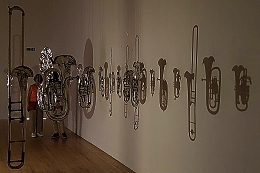
In another room, there was an installation, which also made effective use of reflections projected on to its walls. “Perpetual Canon” consists of a collection of silvered brass instruments, which have been flattened. Each of them is suspended from the ceiling by a fine thread, and they are arranged in a circle which surrounds a centrally located light. The light throws shadows of the instruments onto the four walls surrounding them. Like the two previously described works, this provides a very effective and intriguing visual experience.
Another installation, “The War Room”, impressed me least amongst this category of Parker’s works on display. One of the last rooms in the exhibition houses an installation called “Island”. This consists of a common design of garden greenhouse. Its floor consists of worn floor tiles that used to line the corridors of The House of Commons. The glass panes are covered with white dots made from cliff chalk. They are related to Parker’s reaction to Brexit. Contained within the glasshouse, there is a light whose brightness pulses like that of a lighthouse: increasing gradually, and the slowly diminishing. This causes the shadows of the dots and the frame of the greenhouse to be projected on to the walls of the room containing it. Like the light producing them, the intensity of the shadows pulsates gradually.
As already mentioned, the exhibits’ labels explain what Parker is trying to express. Interesting as that is, it was the visual impact of these installations that impressed me most. Parker, like all great artists, has interesting ideas expresses them most imaginatively and effectively.
IN 1899, RUDYARD Kipling (1865-1936), who was born in Bombay (when India was under British rule), wrote a poem called “The White Man’s Burden”. The content of this piece was in harmony with the then current idea that the ‘white race’ was morally obliged to ‘civilise’ the non-white races of the earth, and through colonisation to encourage their economic development and ‘progress’. Well, this was an illusion happily believed by most of the colonisers. The reality was that colonisation was not designed to benefit the colonised but to increase the prosperity of the colonisers. The white man’s burden was in truth much more the burden which had to be borne by the non-white races, which were colonised. This is beautifully characterised in an art installation, “The Procession”, on display in London’s Tate Britain until the 22nd of January 2023. Conceived and created by the Guyanese-British artist Hew Locke (born 1959 in Edinburgh), I have seen it twice so far, and loved it each time.
“The Procession” consists of a large number of models of people dressed in colourful and fantastical costumes. They are arranged as if they are taking part in a carnival or parade. Many of the models appear slightly grotesque or even menacing. If these models were real people, they would inspire awe and maybe fear. Some of them carry banners, others carry skulls, and there are some supporting poles from which objects are either suspended, or on which objects are supported.
There are banners in the procession. Some of these depict colonial dwellings and institutions. Others show enlarged photographs of company share certificates and financial bonds. Some of the characters in the parade wear clothes on which these old-fashioned records of financial investment are printed. Thus, the artist has portrayed the fact that success of the investments of the European and American colonists and their backers rested on the shoulders of the hard-working black colonial subjects, who derived few if any benefits from their labour.
“The Procession” is not only a highly original way of conveying the unfortunate history of colonization, but also a feast for the eyes. It is both a reminder of Britain’s not always too glorious colonial past, as well as a celebration of the cultural diversity, which this country enjoys. The installation is housed in the magnificent neo-classical Duveen Galleries (opened in 1937), whose design is derived from architecture characteristic of the ancient imperialist regimes, which dominated the Mediterranean many centuries ago. Was it accidental or deliberate to place an essentially anti-imperialist exhibit in rooms that evoke an imperial past and by their immensity dwarf the exhibits? Whatever the answer, this is an exhibition for which it is well-worth making a detour.