Art Deco Modernism greets the traveller at Richmond

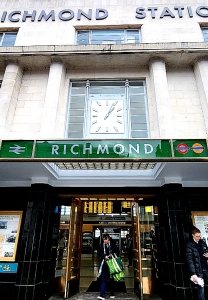
WE VISIT RICHMOND-ON-THAMES often, frequently arriving on the District Line of the London Underground.  However, it was only yesterday, 31 October 2025, that, while waiting for a bus outside the station. I noticed that its façade is a fine example of the Art Deco style of Modernist architecture, which achieved popularity between the two world wars.

The first Richmond station was opened in 1846. The current station was built in 1937. It was designed by Southern Railway’s Chief Architect James Robb Scott (1882-1965), whose other works include the offices and Victory Arch at London’s Waterloo Station. Richmond station’s façade is mainly constructed with white Portland stone. The main entrance has black features constructed using polished black granite. Within the recently restored ticket hall, there is a green glass frieze that surrounds the hall and contains the original wording that indicates the various services offered within the large room. The walls of the hall are lined with travertine cladding and the light fittings hanging from the ceiling are of a Modernist design typical of the era during which the station was built.

Until 2025, many of the original Art Deco features of the station, both internal and external, were either hidden by modern panelling or were in poor condition. Between 2023 and 2025, the station was carefully restored to its original splendid state.

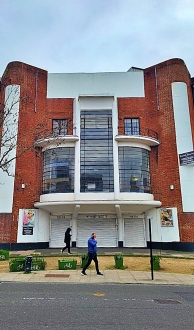
After catching our bus, I noticed that we passed several other Art Deco buildings near to the centre of Richmond. These were blocks of flats. Before returning to the station, we stopped outside one of these, Lichfield Court. This was designed in the Streamline Moderne style, a type of Art Deco, by George Bertram Carter (1896-1986), and completed in 1935. Incidentally, Carter had been a pupil in the office of Edwin Lutyens between 1919 and 1922. Apparently, this block of flats incorporates some innovative features, which we did not have time to see.

Until our most recent visit, I never associated Richmond with Art Deco architecture. On our next visit, I hope to wander around, examining the examples of this style in greater detail.

Art Deco in a north London Suburb

EXAMPLES OF THE ART DECO style that was popular during the era between the two World Wars can be found all over London. In the newer part of Hampstead Garden Suburb (north London), there are a few examples of this style.

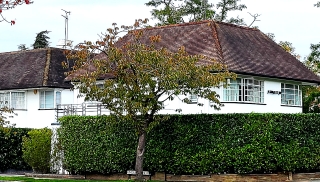
Kingsley Close, which leads west from Kingsley Way, contains only houses built in the Art Deco style.

You can read more about these and other examples of this style in Hampstead Garden Suburb in my book about the Suburb, which is available from Amazon: https://www.amazon.co.uk/GOLDERS-GREEN-HAMPSTEAD-GARDEN-SUBURB/dp/B0BHG873FB/

An amazing cinema in the heart of Jaipur

HAPPY CHRISTMAS EVE

THE RAJ MANDIR cinema was completed in 1976. It was designed in the Streamline Moderne ( or late Art Deco) style by WM Namjoshi for Kushalchand Surana. It was conceived by Mehtab Chandra Golcha. According to Wikipedia, it is the largest single screen theatre in Asia.

We went to see a film called “Pushpa part 2”. It was made in the Telugu language and dubbed into Hindi. It is about sandalwood smuggling and corruption. Despite not being able to follow much of the dialogue,it was extremely exciting and beautifully filmed. It was so dramatic that we left the cinema feeing exhausted.

The cinema is spectacular visually. One enters from the street into a huge, circular foyer decorated in an opulent fashion. The auditorium is spacious and, like the foyer, spectacularly decorated. The screen is curved, and the surround sound system very good.

Even if one cannot follow a film because it is in a language that you do not know, a screening at this cinema is an experience not to be missed in Jaipur.

Architecture in London and an ancestral place in Bavaria

FACING THE CHINESE embassy in London’s Portland Place, there is an imposing Art Deco edifice standing on a corner plot. It is the home of the Royal Institute of British Architects (‘RIBA’). We visited the place in August 2024 to view a small exhibition called “Raise the Roof: Building for Change”. Amongst other things, it explores the role of British architects, such as Edwin Lutyens and Herbert Baker, in enforcing the image of British imperialism during the 1930s in South Africa and India. After viewing this, we wandered around the RIBA building, which, as was explained in the exhibition, contains materials collected from the Empire as well as images depicting the arrogantly supposed superiority of the British colonisers over the colonised.

The building contains various informative panels, which explain aspects of its history. It was constructed between 1932 and 1934. The architect George Grey Wornum (1888-1957), who was born in London, designed the RIBA building.

In one of the meeting halls, there is an elegant carved wooden screen, The Dominion Screen, which was carved in Quebec pine and designed by the artist Denis Dunlop (1892-1959). It contains vignettes of life in five former British possessions (only 4 of which were Dominions): Australia, South Africa, India, Canada, and New Zealand. It was paid for by William Lewis Gerstle (1868-1947), who was born in San Francisco (USA). His daughter, Miriam (1898-1989) married George Grey Wornum in 1923. She was a designer. Seeing the name Gerstle on the information panel next to the screen rang a bell in my mind.

There was an extensive Gerstle family living in the Bavarian town of Ichenhausen (near Günzburg) during the 19th century. I knew this because when researching my mother’s family, I took a great interest in this small town. It was where two of her ancestors were born. At least one of their relatives married a Gerstle from Ichenhausen. I wondered whether Miriam Gerstle’s family were originally from Ichenhausen.

When I got home, I did a little research on the Internet, and soon discovered that Miriam’s father, William, was the son of Lewis Gerstle, who was born in Ichenhausen in 1824. He died in San Francisco in 1892 (www.geni.com/people/Lewis-Gerstle/6000000008091395228). Like many Jewish people from Ichenhausen, he left the small town to seek his fortune elsewhere – in his case, in the USA. He arrived in California in 1850. During this period, many other members of his family migrated to the USA (see: www.angelfire.com/ab7/yamey/ICH.html). Many members of my mother’s family (descendants of Jakob Seligmann [1775-1843] and Moses Wimpfheimer [born 1784] of Ichenhausen) did the same thing; they went to larger German cities, such as Augsburg, to the USA, to France, and to South Africa, where my mother was born.

It turns out that Miriam Wornum is my fourth cousin twice removed!

I am pleased that after so many years of having passed the RIBA building, we finally got to see its interior, which, incidentally, is open to the public. It is a fine example of the architecture that was fashionable in the 1930s. What I had not expected was to discover that its architect was married to a lady whose ancestors were born in the same small German town as those of my mother.

DON’T EXPECT TOO MUCH FROM THE END OF THE WORLD AT A CINEMA NEAR LONDON’S HOLBORN

THE GARDEN CINEMA is in Parker Street, which is near both Holborn Underground station and Covent Garden. This gem of a place opened in 2022. Housed in the building which formerly contained the offices of businessman Michael Chambers, who founded Chambers and Partners in 1989, a research company for law firms around the world, it was the realization of Mr Chambers’s dream to create a cinema for film enthusiasts such as he is.

The ticket office is on the ground floor. Stairs and lifts lead to the basement, where the bar, various small seating areas – some quite discrete, and the two auditoriums are located. The premises are designed and decorated with many Art Deco features and a good selection of sculptures and prints. The darkly coloured wallpaper (with nods to the William Morris style) and subdued lighting give the place a cosy, intimate night club atmosphere. The bar is reasonably priced. The staff are friendly and helpful. This is a cinema complex quite unlike any other I have visited in London – it is both stylish and intimate.

We watched a Romanian film made in 2023: “Do Not Expect Too Much from the End of the World”. Before I discuss this excellent movie, let me tell you one more unusual thing about The Garden Cinema. There were no advertisements (commercials) prior to showing the main film – only several trailers of forthcoming shows in the cinema. This is quite different from other ‘independent’ cinemas, in which the feature film is always preceded by ads including one for the car company (currently Kia), which supports independent cinemas.

The Romanian film, which runs for almost three hours, is a ‘whacky’ and gritty black comedy with serious comments about life in post-Communist Romania. The brilliantly acted film blends skilfully ‘doctored’ flashbacks to life in Ceausescu’s Romania with scenes in Romania since the war in Ukraine commenced. One of the many things that this highly entertaining film emphasises is how the difficult, regimented, but relatively simple life under the dictatorship contrasts with the hectic, corrupt, and very hard life in capitalist Romania. Nothing was easy during Ceausescu’s ‘reign’, but after it ended, nothing has made life any easier. The film made me think that the tyranny of the dictator has been replaced by the tyranny of corruption and exploitation of cheap labour by countries outside Romania. Another thing that I felt was that the film showed how when the shackles of a highly oppressive regime were released following the death of the dictator, Romanian society seems to have gone crazy. Whether this is an exaggeration by the film makers or truly reflects contemporary life in Romania, I do not know. All I can say is that the 163 minutes of the film sped past remarkably quickly because I found it so highly enjoyable and engaging.

Even if I had not enjoyed the film so much, I would have thought highly of the Garden Cinema – a place I hope to visit many more times in the future.

A short piece about a tall Art Deco building in London’s Bloomsbury

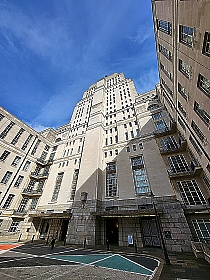
Senate House in London’s Bloomsbury was designed in the Art Deco style by Charles Holden (1875-1960), who also designed many buildings for the London Underground including quite a few stations on the Piccadilly Line. It was once, London’s tallest building.

Senate House was built between 1932 and 1937, and is the administrative centre of the University of London. Currently, there is a small exhibition about the planning of the building on the first floor.

An Art Deco hotel in Ryde on the Isle of Wight

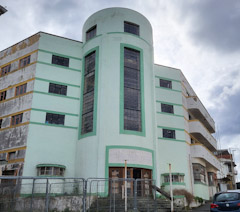
WE PARKED OUR CAR in Ryde on the Isle of Wight. I noticed that we had stopped outside a building that looked as if it had been transported from Marine Drive in Bombay to the Isle of Wight. Like many of the buildings that line Marine Drive, this one in Ryde is a beautiful example of the Art Deco architectural style, which became popular in the 1930s.

The former Royal York Hotel

The building in Ryde was constructed as the former Royal York Hotel. Completed in 1938, it was designed by JB Harrison and HP Gilkes.

When the hotel was opened, Ryde had become a popular destination for ’high society‘ holidaymakers. The then state-of-the-art hotel would have been in high demand. Partly because of the increasing ease of foreign travel, the hotel’s customers gradually decreased in number. So, in 2006, the hotel closed forever, and remained disused and looking dejected.

When we saw it in October 2023, there was scaffolding on the edifice and evidence that work was being carried out. I have read that there are plans to work on the building to create residential flats as well as a new hotel within it. Let us hope that this splendid example of Art Deco architecture will be preserved.

A yak in the classroom

THE RIO CINEMA in London’s Kingsland Road district (in Dalston) is a fine example of a film theatre constructed in the Art Deco style. It was designed by Frank E Bromige, who specialised in designing cinemas in that style, and constructed in 1937 on the site of an earlier Edwardian-style film theatre, which first opened in 1909. The Rio has been showing films ever since then. Since 1976, the Rio has been run successfully, and independently of any cinema chain, as a not-for-profit charity. The cinema’s Art Deco exterior has been faithfully maintained and the interior’s original design has been reconstructed. There are two screens. The largest one, the main auditorium, looks much as it might have done when it was built in the late 1930s. There is a smaller auditorium in the basement. This has a large screen and comfortable raked seating.

Today, the 18th of March 2023, we watched a film in the smaller auditorium. Called “Lunana: A Yak in the Classroom”, this film was shot mainly in the tiny Himalayan Kingdom of Bhutan. It is a beautiful film, beautifully made. Without giving the story away, it is about the experience of a young Bhutanese teacher sent from the capital to teach in a remote village called Lunana. The tiny elementary school in that high altitude settlement surrounded by breathtakingly attractive mountain scenery is the remotest school in the world. The film shows how Lunana impacted on the young teacher and vice-versa.

Apart from having a good story, some humour, and much emotion, the film provides a fascinating view of Bhutan. “Lunana” allows the viewer to realise the spectacular nature of the country’s landscape and rural traditions. What particularly interested me was the depiction of a lifestyle so remote and different from what we are used to here in the west and in many parts of India, even also in the urban areas of Bhutan’s neighbour Sikkim. The subject of global warming is introduced, but in a quite subtle way. The villagers in Lunana are portrayed as being simultaneously innocent, playful, spiritual, and philosophical. Although “Lunana” is a highly enjoyable film and Bhutan is portrayed in an affectionate and appealing way, I felt that the country, which is undoubtedly spectacularly attractive, is not one that I am in a hurry to visit. It is an unusual and unique film, and it was appropriate to have watched it in one of London’s unique individual cinemas.

The silent screen

HOBSON STREET IN the heart of Cambridge is one way and is used by traffic avoiding the pedestrianised section of Sidney Street. Hobson Street is lined with buildings of various ages. One of these, which has always attracted me, is a disused cinema whose facade has Art Deco features.

Built in about 1930 to replace an earlier cinema constructed in 1921, it was The Central Cinema. Its white tiled facade has Egyptian and Art Deco details.

In 1972, the cinema closed and was converted, as many other old cinemas have been, into a bingo hall. This establishment thrived until 2009 when the British government banned smoking in public places. Apart from three days when the building was occupied by squatters for 3 days, the old cinema has been boarded up and disused.

Various plans have been proposed for its future use, but none of them have been carried out. One of the problems is that because it is a protected edifice, any future plans have to preserve its original features. And as most of the new ideas for the old cinema involve adding windows, and adding them would infringe the protection order, all of the new plans have had to be abandoned. The protection order has saved the building but hindered its future development.