THE BIOGRAPHY OF STANLEY Spencer, which I ordered online, was too large to fit through the letter flap on our front door. So, as is usual in such situations, the postman left a red and white postcard informing me that I could collect my oversized parcel from the local post office. Until October 2019, undelivered packages could be collected from a busy post office in Queensway. Since then, and throughout the 2020 ‘lockdown’, post can be collected from a new and much improved centre on nearby Westbourne Grove.
Much of the architecture on the stretch of Westbourne Grove between Chepstow Road and Queensway is unremarkable. An exception is number 26, which houses the Al Saqi bookstore. This elegant establishment specialises in selling (and publishing) books about the Middle East and North Africa. In 1978, two friends, André Gaspard and Mai Ghoussoub, left war-torn Lebanon to settle in London. They founded the Al Saqi book shop because:
“They yearned to recreate something of the heady intellectual freedom of pre-war Beirut, and to supply a then-untapped market for English and Arabic books on the Middle East and North Africa.” (https://saqibooks.com/about/history/).
They began publishing as ‘Al Saqi’ in 1983 and have been selling books, including some banned in certain countries, for well over thirty years.
Interesting as the bookshop might well be, its premises catch the eye and intrigue the passer-by. As the “Arab Weekly” wrote in December 2015 (https://thearabweekly.com/al-saqi-not-your-average-london-bookstore), the shop is;
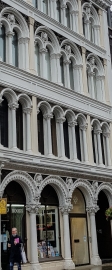
“Not your average London Bookstore … London – Al-Saqi bookshop is housed in a conspicuous building in London’s Bayswater district. With colonnades and arches topped by 11 staring busts, its architecture recalls ruins that are found across Europe, North Africa and the Middle East.”
It was the shop’s exuberant and unusual façade that has often caught my attention.
It was not Al Saqi who designed the façade of the building housing it. After he had spoken with a customer in Arabic, I asked a learned looking man, who was working in the shop, about the history of the building in which it is housed. He had no idea.
The architectural historian and his co-author Bridget Cherry mention the building in “The Buildings of England, London 3: North West”. They wrote that the highlights of Westbourne Grove include:
“… No. 26 built as an ‘Athenaeum’, 1861, by A Billing, stuccoed with columns and a good deal of sculpture (musical angels, busts of Milton, Shakespeare, etc.)”
A Billing was Arthur Billing (1824-1896), whose career included construction of, and restoration of, many churches in London and south-east England. Most dictionaries define an Athenaeum as an institution for the promotion of literary or scientific learning. a library or reading room.
Another source (https://historicengland.org.uk/listing/the-list/list-entry/1066120) describes Saqi’s home as having once been a “… Theatre … built as a Shakespearean theatre”, but does not refer to it as an Athenaeum. Just as I was beginning to despair of discovering whether number 26 was originally an Athenaeum or a theatre, or both, I stumbled across an informative website (https://archiseek.com/2013/vestbourne-athenom-westbourne-grove-b-wswater/). It describes the building as having been originally named ‘Westbourne Hall’ and quotes an article published in an issue of “The Building News” dated 31st of May 1861.
From the article, we learn that the newly built Westbourne Hall was attached to the Bayswater Athenaeum, which was on nearby Havelock Terrace (which, strangely, does not appear on a detailed map published in the late 1860s). From the detailed description of the façade of Westbourne Hall, it is certain that the premises of the bookshop are in the former Westbourne Hall, not the Athenaeum. The gaslit auditorium, equipped with lights installed by Mr G Reed, “the eminent gasfitter of Westbourne Grove”, had raked seats with “carved ends”. There was a gallery above the entrance end of the hall. The hall was equipped with what was then a “new patented system” of heating and cooling designed to keep the audience comfortable. The article added:
“When the new reading rooms, refreshment and committee rooms, and other offices are completed, the business of the Athenaeum will be removed into them, and look out upon Westbourne-Grove.”
So, it appears that The Athenaeum moved into Westbourne Hall. The article also gives an idea of the place’s original intention. It was to provide a place where the “respectable population” of the area could hear worthy events such as Shakespeare being read by:
“… a silver voiced popular preacher …Lectures on the Holy Land, Revelations, and Negro Slavery, an evening with amatory Thomas Moore …”
Another issue of “The Building News” (see https://archiseek.com/2013/vestbourne-athenom-westbourne-grove-b-wswater/) gives a very full description of the building’s remarkable exuberant façade.
The subsequent history of the Westbourne Hall is found on an informative website (www.british-history.ac.uk/vch/middx/vol9/pp221-226). Here, slightly edited by me, is what is written:
“Westbourne hall in Westbourne Grove could hold 400 people for lectures and entertainments in 1860, when its lessee opened adjoining premises in Havelock Terrace as Bayswater Athenaeum and Literary Institution. An ornate four-storeyed building with a hall for 1,000, designed by A. Billing, was built on the site of the first hall in 1861 and licensed for music alone by T. E. Whibley in 1863. The Athenaeum, although welcomed for its educational value, had become the Athenaeum divan by 1865 and may have closed soon afterwards. Westbourne hall continued to be used for concerts, plays, and public meetings until 1875 or later …”
A playbill preserved in the National Archives (https://discovery.nationalarchives.gov.uk/details/r/6497ee39-a6e5-4a92-9acc-551fda7680ed) gives a flavour of what was on offer at Westbourne Hall:
“Wednesday July 1st 1868.
‘Benefit and last appearance of Miss Lydia Howard, the Baby Actress, when she will sustain her characters of Katherine! in “The Taming of the Shrew”, Falstaff! in “King Henry the Fourth”, Prince Arthur! in “King John” and Matilda Mowbray! Hector Mowbray!! Foppington Mowbray!!! Cobbleton Mowbray!!!! in The Four Mowbrays’. Also appearing: Miss Hazelwood and Mr J S Fitzpatrick Paddington”
That must have been a memorable evening. According to Anne Varty in her book “Children and Theatre in Victorian Britain”, Lydia, who was not yet five years old, ‘retired’ from the stage in 1869. Child actors and actresses were popular in Victorian times. As for the other ‘stars’ of that evening in Westbourne Grove, I have not yet found anything about them. “The Four Mowbrays” was a one-act farce by John Poole (c 1786-1872), first performed in the late 1820s.
So, there you have it more or less: the story behind the building where books on Middle Eastern and North African subjects are on sale. It is appropriate that this former Athenaeum/ theatre is still being used for cultural purposes. I am curious to know whether there is anything remaining of the Westbourne Hall’s former auditorium. Part of the building is now used by the HBA (Hirsch Bedner Associates) Gallery. A photograph of this organization’s premises looks like the space being used might well have been part of the auditorium (see https://foursquare.com/v/hba-the-gallery/5151a5e1e4b0cbcf6b5f4568). So, all is not lost.



 yamey
yamey 