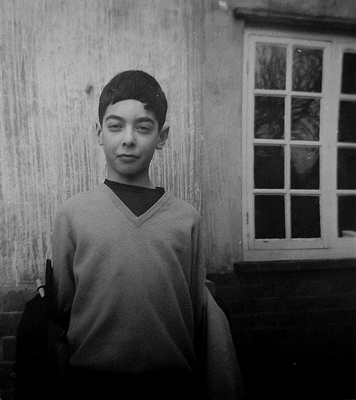
To many readers the early 1960s must seem as remote today as the 1860s seemed to me when I was a young boy at school in the 1960s. Between 1960, when I was eight years old, and 1965 I attended a prestigious private preparatory (‘prep’) school near Hampstead in north-west London. For those who are unfamiliar with private schooling in Britain a prep school prepares children for examinations that allow them to gain admission to Public Schools (i.e. private secondary schools).
In British schools today, teachers get into big trouble if they so much as touch one of their pupils. Even an affectionate pat, let alone a punitive slap, can get a teacher into ‘hot water’ both with the parents and with the school authorities. This was not the case at my prep school in the first half of the 1960s. Let me tell you about three of my school teachers.
Mr Rotherham taught us Latin. He was a short, slightly plump man. His face was always bright red. It looked as if he was about to burst yet another blood vessel. He was not a man to mess with. If he thought that a pupil had done something wrong, even a small grammatical mistake, he would race up to the miscreant’s desk, and seize a bunch of the poor boy’s hair. Then tugging at the hair, Mr Rotherham would pull the boy off his chair and drag him around the class room, shouting abuse. This procedure was known as a ‘Rozzie haircut’.
Mr Bathurst, who I quite liked, taught us history. Every year, we would begin with the date that Julius Caesar first landed in England and would end at 1914. The aim of the history, which we were taught at prep school, was to drum into us a series of important dates. What actually happened on those dates and the significance of those occurrences was of no importance. It was important that we could arrange in chronological order a set of items such as for example: Archbishop Laud, Agincourt, The Corn Laws, Waterloo, Magna Carta, and The Armada. Their importance was unimportant. It is no wonder that it took me many years before I realised how exciting it is to study history. On the whole, Bathurst, or ‘Batty, as we referred to him out of his earshot, was a kindly fellow. However, if you annoyed him, there were two possible outcomes. He would have called you up to the front of the class and then gripped one of your ears before twisting it painfully. Alternatively, the victim of his wrath had to lay his palm on the desk in order that Batty could hit the ‘criminal’s’ fingers with the edge of a wooden ruler.
Mr P also taught Latin. His first name was Denzil. This was also our nickname for him. Denzil’s fingers were crooked, distorted perhaps by a joint disorder. His voice was very nasal. In the early 1960s, teachers were not forbidden from smoking in class. Denzil used to hold his chalk in a crooked finger of his right hand, and a lighted cigarette in a curved finger of his other hand. His handwriting on the blackboard was illegible. Occasionally, he would show off, claiming that he was ambidextrous. He used to let go of the cigarette and replace it with a second piece of chalk, and then write on the blackboard with both hands at the same time. The result was terrible, even more illegible than when he wrote with only one hand. If someone annoyed Denzil, he would come up to the person, and sharp clip an ear with the knuckle of one of his twisted fingers. We called this short, sharp, painful blow the ‘Denzil blip’.
Well, none of this would be tolerated in today’s Britain, and quite rightly so. In the words of the former Prime Minister Harold Macmillan, let me tell today’s school kids that they: “… have never had it so good…”
51.550187
-0.166274


 yamey
yamey 