WHERE ONCE THERE WAS A PUB IN HAMPSTEAD THERE IS NOW A SUPERMARKET

HAMPSTEAD IS RICH in historical curiosities. One of them is an unexceptional little road that has an interesting story.

Just south of Tesco’s supermarket (the former Express Dairy) on Hampstead’s Heath Street there is a narrow cul-de-sac called Yorkshire Grey Place. It enters Heath Street across the road from The Horseshoe pub and Oriel Place. I have often wondered about this short, uninviting blind-ended lane and its history. Just under 50 yards in length, it runs west from Heath Street.

At long last, I began looking on the Internet for some history (if any) of this bleak little roadway lined on both sides with high buildings. It gets its name from a pub that used to exist near it – The Yorkshire Grey. The pub was already in existence by 1723, but was demolished in the 1880s (https://londonwiki.co.uk/Middlesex/Hampstead/YorkshireGrey.shtml) – in 1886, according to FE Baines in his “Records of Hampstead” (publ. 1890). An online history of Hampstead (www.british-history.ac.uk/vch/middx/vol9/pp15-33) provided the following information about the pub and its surroundings:

“North of Church Row the Yorkshire Grey had been built by 1723 and cottages called Evans Row probably faced it c. 1730. In 1757 the inn and 14 houses occupied by a brickmaker, clockmaker, carpenter, apothecary, and others were ‘late freehold’ but in 1762 they were described as copyhold (one alehouse, two houses, and 11 cottages).”

This area was one of the slums of Hampstead – it was devoid of water supply and drainage.

During the planning and construction of Fitzjohns Avenue, which began in 1875 and was only completed by about 1887, there was some discussion about whether it should end on the High Street or give direct access to the road up to Hampstead Heath. Prior to the late 1880s, the recently built Avenue stopped south of Hampstead village. Its route from there into the centre of Hampstead village was subject to some controversy. This was described in “Hampstead, Building a Borough 1650-1964” by FML Thomson, as follows:

“… The shopkeepers in the High Street feared loss of trade if any traffic was diverted to a new route, and held out for a scheme which would debouch Fitzjohn’s Avenue into High Street at the King William IV ; while the gentry wanted the direct route to Heath Street and the Heath, arguing that this gave a bit of slum clearance of Bradley’s Buildings, Yorkshire Grey Yard, and Bakers’ Row as a bonus. The dissension continued when the scheme was revived with a number of public meetings in 1881, dominated by the gentry element which was increasingly exasperated at having its carriages bottled up in Fitzjohn’s Avenue without any proper exit.”

As it turned out, the “gentry element” had their way, and the slum clearance that affected Yorkshire Grey Yard was carried out – the pub disappeared as a result. In relation to this, the online history of Hampstead, already quoted revealed:

“In 1883 the Metropolitan Street Improvement Act authorized redevelopment of the whole area at the joint expense of the local authority and M.B.W. In 1888 High Street was widened, Fitzjohn’s Avenue (then Greenhill Road) was extended to meet Heath Street, and soon afterwards Crockett’s Court, Bradley’s Buildings, and other slums, including Oriel House and other tenemented houses, were replaced by Oriel Place, shops, and tenement blocks.”

The pub has long gone, but I managed to find two pictures depicting it. One is a painting showing the place in about 1863 (https://artuk.org/discover/artists/lester-harry). It was the work of Harry Lester. The other is a black and white photograph in the book by FE Baines, which was published a year after the pub was demolished. A detailed map surveyed in 1868 showed that the pub was quite a large building with a substantial yard next to its east facing façade. To its west, the yard opened on Little Church Row (now part of Heath Street). This and a blind-ending road called Yorkshire Grey Yard are shown on the map. Immediately south of the pub, there was another cul-de-sac running from east to west – it was unnamed. I believe that this is what is now called Yorkshire Grey Place.

The map drawn in 1868 shows the layout of the area around today’s branch of Tescos before Fitzjohn’s Avenue was conceived. Another map drawn in 1915 shows how the topography of the area changed following the completion of the Avenue. The Yorkshire Grey pub existed before the nearby, still existing, Horseshoe pub was established – it appears on the 1915 map. Originally named ‘The Three Horseshoes’, it moved from Hampstead High Street to its present address in 1890. Had the Yorkshire Grey pub survived, it would have been about 110 feet away from the Horseshoe.

Once again, wondering what is in a name – in this case Yorkshire Grey Place – has opened my eyes to an interesting bit of the history of Hampstead. Finally, it is interesting to note that the Victorian building that houses Tesco’s was built in 1889 – three years after the Yorkshire Grey pub was demolished to make way for buildings along the northern continuation of Fitzjohns Avenue. So, next time you are queuing to pay in Hampstead’s Tesco, remember that you are standing on land where once the patrons of the Yorkshire Grey once trod.

You can read much more about Hampstead and its surroundings in my book, which is available from Amazon:

https://www.amazon.com/BENEATH-WIDE-SKY-HAMPSTEAD-ENVIRONS/dp/B09R2WRK92/

An oil painting hanging on a wall in a café in Hampstead

EVERY TIME I VISIT Hampstead, I feel pleasant twinges of nostalgia not only because I was brought up in the area but also because of my associations with the place after childhood. One place, which still exists, and has done so since it first opened in 1963, is Louis Patisserie on Heath Street. Originally, its shop sign bore the words “Louis Hungarian Patisserie” because it had been established by a Hungarian called Louis Permayer.

Sometime in 1970 or maybe the following year, I took a young lady, who is now my wife, to Hampstead on our ‘first date’. We had a genteel afternoon rendezvous at Louis. My wife remembers that she had coffee, and that it had been served with a separate bowl containing freshly whipped cream. Back in those days and for many years afterwards, Louis, with its wood-panelled walls, seemed to me to have a ‘touch of class’ as well as being evocative of Central Europe. The cakes and other baked items they used to sell were all good quality versions of what you might expect to find in a ‘Konditorei’ in Vienna or a ‘Cukrászda’ in Budapest.

Today (the 26th of February 2024), it was windy and extremely cold when we got off the bus in Hampstead. For old time’s sake, we entered Louis to warm up with hot beverages. Louis has long since changed hands, but the wood-panelling and several other original features still remain. However neither the hot beverages nor the patisserie items were of the same high quality as they used to be long ago. There are now other places in Hampstead where both the coffee and the food are superior to what is available at Louis, but none of these places bring back happy memories.

High on the end wall of the sitting area within Louis, there is a large, framed painting of a pond with buildings along one side of it. These are reflected in the water. In the foreground, three figures are depicted fishing with rods. The picture is painted with muted colours, or, possibly, the colours have faded since it was completed. Despite having visited Louis on numerous occasions, I had never looked at the painting properly until today. At the lower left corner of the painting, there is the artist’s name and a date:

“DC Towner 1972”

The artist was the painter and ceramics expert Donald Chisholm Towner (1903-1985). For many years, he was a resident of Hampstead, as this biography ( www.barnebys.co.uk/auctions/lot/donald-chisholm-towner-SrpyTddupt ) explains:

“… Towner was born at Eastbourne and studied at Eastbourne and Brighton schools of art and at the Royal College of Art under William Rothenstein 1923-1927. He moved to Hampstead in 1927 where he lived until his death and produced many paintings of the area and residents. D.C. Towner showed at the RA, Burgh House, NEAC etc.”

William Rothenstein (1872-1945), mentioned above, lived in Hampstead between 1902 and 1912, but by the time he taught Towner he was living elsewhere. It is unlikely that Towner lived in Hampstead because of Rothenstein. It was more likely that he chose the area because it was already favoured by many other artists.

Although DC Towner is not one of the greatest of the artists who lived and worked in Hampstead, his family name has related to the arts in another way – possibly better known than for his paintings. When his father, Alderman John Chisholm Towner of Eastbourne, died in 1920, he left 22 paintings and £6000 for the establishment of a public art gallery. Rehoused in a new gallery opened in 2009, the Towner Gallery still exists in Eastbourne. We visited it in its beautifully designed new home in 2019.

As the picture in Louis was painted in 1972, we would not have seen it on our ‘first date’. I do not know when it was purchased or acquired by the owner of the café. Who knows, but maybe the artist used to enjoy ‘Kaffee und Kuchen’ in the place where I took my future wife out one afternoon long ago.

PS: If you wish to see another of Towner’s paintings in Hampstead, you should visit the Lady Chapel of St John’s Parish Church in Church Row. In it, you can see Towner’s depiction of Church Row, where he lived, and his self-portrait – he used a mirror image of his own face for the Christ in this painting. The picture in the church was created to commemorate the artist’s mother, Grace Towner (1862-1949), who lived in Church Row and was buried nearby in St John’s cemetery.

THE ONLY REMAINING VISUAL EVIDENCE OF A CREEK IN WEST LONDON

IN MY BOOK about west London, “Beyond Marylebone and Mayfair: Exploring West London”, I described a stream that used to flow through Hammersmith. It was located where part of Furnivall Gardens now stands today. I wrote:

“… Furnivall Gardens, a pleasant open space created in 1951, and named after a distinguished scholar of English literature and an important pioneer in the sport of rowing, Dr Frederick James Furnivall (1825-1910) … Before WW2, the area of the park was covered with industrial buildings including the Phoenix Lead Mills, which stood east of The Creek, an inlet of the Thames that was filled-in in 1936.

In earlier times, The Creek, which extended as far inland as today’s King Street, was centre of Hammersmith’s flourishing fishing industry. Writing in 1876, James Thorne described The Creek as follows: ‘… a dirty little inlet of the Thames, which is crossed by a wooden footbridge, built originally by Bishop Sherlock in 1751 … the region of squalid tenements bordering the Creek having acquired the cognomen of Little Wapping, probably from its confined and dirty character.’

The Creek, an outlet of the now largely hidden Stamford Brook, is long gone, but there is a storm outlet in the bank of the Thames close to where The Creek emptied into the river. This can be seen from Dove Pier at the western end of the Gardens.”

Today, the 25th of February 2024, we were walking past Furnivall Gardens along the riverside path. It was low tide. A wide, not too clean, beach lined the river. At one point, the beach was interrupted by what looked like the mouth of a small stream. This was lined on both sides with wooden fencing. The stream, which issued from below the riverside walkway ended abruptly in an archway that was filled by a sturdy door or dam. The position of this sluice gate in relation to the nearby Dove pub, Dove Pier, and Furnivall Gardens is correct for what must have once been the mouth of Hammersmith’s erstwhile Creek. I had noticed the archway with the heavy-looking door many times before, but today, because of the low tide, it was the first time that I could clearly the remnants of the mouth of the Creek. I suppose that there is some leakage from the now covered-up Creek that causes the appearance of the mouth of a small stream when the tide is out.

My illustrated book about West London is available as a paperback and a Kindle from:

Entangled messaging at an exhibition at London’s Royal Academy

I LEAVE SOME EXHIBITIONS feeling both inspired and exhilarated. Some other displays of art neither thrill nor depress me. However, the current show at the Royal Academy of Art (‘RA’) in London’s Piccadilly – “Entangled Pasts 1768 – now” – left me feeling both disappointed and a little irritated. Before proceeding further, I should explain that 1768 was the year in which the RA was founded. The exhibition is, to quote its associated handout, to explore:

“… connections between art associated with the Royal Academy and Britain’s colonial histories.”

It does this by mixing artworks by academicians with those by other artists in a series of mostly poorly lit, gloomy galleries. Each of the rooms is supposed to contain works that are connected with a particular theme, although I found that the linkage between the artworks and the theme within each gallery was weak to say the least.

The sad thing is that many of the exhibits on display are interesting works of art, but seeing them altogether reminded me of visiting a poorly organised jumble sale. Although the works in each room were supposed to be thematically linked, that was hard to realise by looking at them as a group. The overarching concept of the exhibition was to, yet again, remind us of Britain’s unsavoury history of relations with ‘people of colour’. Consequently, many exhibits were ones that had been exhibited before in shows with similar messaging. One gallery managed to combine the unpleasant history of Britain’s involvement with the slave trade with another topical subject – climate change. This is probably because there are many who link colonialisation with industrialisation and its effects on climate.

Although I am presenting you with a negative view of the exhibition, I should in all fairness point out a couple of things I loved. One was an installation consisting of models of ships suspended from the ceiling by fine threads. This visually exciting work was created by Hew Locke, and was in one of the few rooms that was brightly lit. The other exhibit, which occupied two galleries was a collection of painted wooden cut-outs depicting people at a carnival. This work, which was accompanied by a soundtrack with voice and music, was created by Lubaina Hamid – like Locke a Royal Academician – in 2004. I was also interested to see the original painting of Dido Elizabeth Belle and her cousin Lady Elizabeth Murray by David Martin (1737-1797), who was a Royal Academician. These two ladies were associated with Kenwood House in north London, where a photograph of the painting is on display. It was nice to see the original. There were other artworks I liked in the exhibition, but felt that their impact was spoiled by being displayed alongside other works without much evidence of thoughtful curating.

I felt that “Entangled Pasts” was yet another ‘blockbuster’ show designed to earn income, which is greatly needed in the present difficult economic climate. This exhibition exploits the race card to attract visitors, which it appears to be doing. Just in case I have not discouraged you from seeing the show, you should know that it ends on the 28th of April 2024.

Bushy eyebrows running in the family

PEOPLE WHO HAVE met me often remark on my bushy eyebrows. Barbers are always keen to trim them, but I will not let them do that.

Many years ago, sometime in the 1980s if I remember correctly, my father and I were invited to a birthday party to celebrate the 70th birthday of my Dad’s step-brother Frank Walt. It was a large gathering held in a house in London’s St Johns Wood. Apart from my father, there was nobody at the occasion, whom I had met before. While I was wandering about rather aimlessly, a small lady came up to me, and declared in a North American accent:

“You must be a Halperin. You have the Halperin look.”

At that time, I had no idea what she meant by this. Even though I had no clue about what she was talking about, what she said made me feel good – I felt it was special to be recognised as part of a ‘clan’ by someone who did not know me ‘from Adam’, as the saying goes.

I now know about the Halperin family. Put simply, my father’s mother was Leah (née Halperin). She was one of the six children of Joseph and Deborah Halperin. A few days ago (in February 2024), a cousin sent me a photograph of Leah’s brother Wolf Halperin. I looked at it, and immediately realised what my fellow guest at Frank’s party had meant by the ‘Halperin look’. Wearing a Fedora hat, Wolf’s eyebrows immediately reminded me of mine and those of other members of the Yamey family. Seeing this was uncanny.

Wolf Halperin died many years ago, long before I began visiting India. Last November (i.e., 2023), we visited a small shop in Baroda (Gujarat). It was not our first visit. We had been there once about 5 years earlier. The shopkeeper recognised us immediately. As he said (in Gujarati) “I remember you”, he pointed at my eyebrows.

A RIVERSIDE HOSTELRY AND THE COMPOSER OF A PATRIOTIC SONG

WE USUALLY PASS this place early on Sunday mornings. As it opens at 12 noon, we had never been able to enter it until a few days ago. Situated on the riverside in Hammersmith with its entrance in a narrow passage that is the east end of Upper Mall, it is The Dove pub. As it looks so quaint and ‘olde worlde’, we have long planned to visit it during its opening hours.

The Dove pub has been in existence since the early 18th century, or maybe the century before. Its north facing façade was created in the early 19th century. It is said that King Charles II (reigned 1660-1685) might have entertained his mistress Nell Gwynne here. Although there is no certainty about that, there is evidence that the Scottish poet James Thomson (1700-1748) spent time in The Dove. In 1740, he composed the poem “Rule, Britannia!”, which was later set to music by the composer Thomas Arne (1710-1778).  He is said to have written the poem in The Dove, where there is a memorial commemorating the birth of this famous British patriotic song. Later regular visitors to the pub included Ernest Hemingway, Dylan Thomas, and William Morris (who lived a few yards away).

We decided to visit the pub after a late afternoon performance of an enjoyable film, “Taste of Things”, at the nearby Riverside Studios. On entering The Dove, there is a bar to the right and a small seating area to the left. The bar is one of the shortest in the UK – it is only 7 feet long. To comply with legal requirements, a second bar had to be built. This is reached by climbing a few steps into a larger middle room, which was heated by a real coal fire and lined with pictures. We took a table in this cosy dining area, and enjoyed acceptably good food. Another flight of steps leads down into a third seating area with windows overlooking the Thames. Beyond this, there is an open terrace with views of the river.

The Dove is wonderfully old-fashioned. Even though it is in the heart of west London, it feels just like a traditional country pub in the middle of nowhere. Most of the clientele in the pub on the Monday evening we visited it were local people. I suspect that during weekends and public holidays, the locals become outnumbered by visitors who are not local.

Having ‘broken the ice’ and entered the pub, I am sure that we will become regular visitors there, but it is unlikely that we will compose a song that can rival “Rule, Britannia!”- however much we drink.

CREATIONS IN GLASS FROM INDUSTRY AND ARTISTS AND A PUNJABI PUB

TWO TEMPLE PLACE was built for the American businessman William Waldorf Astor (1848-1919) in 1895. Located close to Temple Underground Station and Middle Temple, this distinctive edifice is said to be designed in the ‘neo-Gothic’ style, although I would prefer to describe it, and especially its interior, as ‘Tudor Revival’. Every year, between late January and late April, the building, which is now owned and maintained by the Bulldog Trust charity, houses an exhibition, which is always worth viewing. This year’s exhibition, which continues until the 21st of April 2024, is called “The Glass Heart”.

The exhibition is described on the Two Temple Place website (https://twotempleplace.org/) as follows:

“It will explore the narratives central to glass art and manufacturing, and celebrate the timeless skills, artistry and innovation required to work with this challenging material.”

And it does that very successfully by exhibiting a superb collection of glass creations ranging from industrial products, such as Pyrex, through stained glass, to intriguing artistic creations that defy the imagination. I will not attempt to describe all of these exhibits – each one of them both fascinating and beautiful – but I will concentrate on one small collection of items relating to the Red Lion – a pub in West Bromwich (West Midlands).

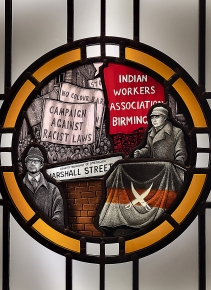
The Red Lion is a ‘desi’ pub owned by Indians, whose families originated in the Punjab, and came to work in the factories of Britain’s Black Country. Although all are welcome, the pub is mainly a socialising place for local people whose families came from the Subcontinent. It is one of several desi pubs in the former industrial heartland. In 2016, Steven Cartwright, who runs a studio that produces creative and decorative glassworks, was commissioned to create some stained-glass windows to decorate the Red Bull. His mission was to create traditional pub style stained-glass, but with an interesting slant – it was to celebrate the rich culture of the desi pub in the West Midlands. To do this, as Steven explained on his website (www.cartwrightglassdesigns.co.uk/projects/red-lion):

“I designed the window to give the appearance of a traditional pub but with a twist. The window utilises some of the colours and elements of the sub continent and tells the story of the punjabi community who migrated to the area in the 50’s. It also celebrates the establishment of the Indian workers association by Avtar Singh Jouhl and the visit of Malcolm X at their invitation.”

At the exhibition in Two Temple Place, there is a small piece of this pub’s stained-glass and some photographs of the rest of it.

What particularly intrigued me was the mention of The Indian Workers Association (‘IWA’) of Birmingham. The IWA was founded in the 1930s by Indian workers from Coventry to combat racist objections to them both by the British trade unions and the British people in general. The quote mentioned Avtar Singh Jouhl. He was born in the Punjab (British India) in 1937, and after the 1947 Partition, he came to London to study at the London School of Economics, arriving in 1958. Three years later, he moved to Smethwick in the Midlands, where he became an industrial worker. There, he saw and experienced racist anti-Indian conditions that prevailed at the time, He joined the IWA, and soon, along with others, he founded its Birmingham branch.

In February 1965, Jouhi invited the civil rights campaigner Malcolm X to visit Smethwick. A few days before his assassination, Malcolm X said of Smethwick:

“This is worse than America. This is worse than Harlem.”

In Jouhi’s obituary (The Guardian, 4th of November 2022), the following was written:

“The anti-racism campaign that attracted Malcolm X to Smethwick was spearheaded by Avtar Singh Jouhl, who has died aged 84 … Jouhl, as general secretary (1961-64; 1979-2015) and national organiser (1964-79) of the Indian Workers’ Association (IWA), challenged trade union members, factory owners and publicans to end this racism … When it came to breaking the colour bar in the town’s pubs, the IWA’s tactics were similar to those used by the Freedom Riders in the US in the previous decade. White university students were enlisted to order drinks, then hand them to British Indians, such as Jouhl. The landlord would invariably eject them, while the students challenged the eviction. The IWA then used evidence of these actions to successfully oppose the publican’s licence when it came up for renewal … This targeted campaign led to discrimination in pubs being outlawed in the Race Relations Act (1965) and paved the way for Britons of Indian heritage to become publicans themselves and set up what are commonly now known as “desi pubs”.

It was his actions described above and many others that helped to suppress racism in the Midlands and elsewhere in Britain. And it is very pleasing to see that what he achieved is being celebrated in glass in a pub owned and frequented by the people whom he helped. I visited the exhibition at Two Temple Place because I enjoy viewing glass artefacts. Little did I know that I would leave the exhibition having been introduced to an important political movement, about which I had known nothing.

A statue, a reformer, and a crescent in London

LONDON IS FULL of reminders of the past. Almost wherever you go, you will come across a memorial (be it a plaque on a wall, or a monument, or a statue, or even a street name) to someone or something of historical interest. Today, the 20th of February 2024, after spending a pleasant hour with my friend Royden Clogstoun (related to the Victorian photographer Julia Margaret Cameron) at the British Library, I walked to Twinings tea shop, which is on the Strand (opposite the Royal Courts of Justice). I began heading south along Mabledon Place, which soon becomes named as Cartwright Gardens. This road runs along the straight edge of a green space shaped like a segment of a circle. The green space is bounded by a road that forms part of a circle – this is also called Cartwright Gardens. Until 1908, this crescent-shaped road was called Burton Crescent in honour of its developer James Burton (1761-1837).

Many of the buildings on the crescent are now hotels. The green space contains tennis courts and a bronze statue. This monument was added to the open space – the garden of Cartwright Gardens – in 1831, that is about 20 years after the area was developed. The statue depicts Major John Cartwright (1740-1824), who lived for a time in what was then Burton Crescent. Born in Marnham (Nottinghamshire), he served in the Royal Navy from the age of 18. In 1771, he retired from the navy for a time for health reasons.

When the colonists in the North American colonies began to rebel against their British rulers, Cartwright refused an appointment in the armed forces because he believed that the colonists had just reasons for their cause. In 1774, he wrote “”American Independence the Glory and Interest of Great Britain.”, which was a plea in favour of the colonists. According to the plaque beneath his statue, he was:

“…the first English writer, who openly maintained the Independence of the United States of America …”

And, furthermore, he:

“… he nobly refused to draw his Sword against the Rising Liberties of an oppressed and struggling People …”

Yet, this is not all he did in the face of existing conventions of his time. He was an active campaigner for parliamentary reform. His goal was to introduce secret ballots and universal suffrage (for men) – to give all men the right to vote in parliamentary elections. He did not live long enough to see his goal attained. For, it was only in 1918 that the Representation of the People Act was passed in Parliament. This allowed all men aged over 21 to vote regardless of the value of their property, and women aged over 30 provided their residence had a rateable value of over £5.

I knew nothing about John Cartwright and his remarkable outlook on life until I stopped to look at his statue today. However, I knew about his younger brother Edmund Cartwright (1743-1823). He invented the power loom, one of the machines that paved the way for the industrialisation of textile production and helped the birth of Britain’s so-called Industrial Revolution.

Had I taken a bus from the British Library to the Strand, instead of walking leisurely, I would not have passed through Cartwright Gardens, and it might have been a long time before I became aware of John Cartwright and his revolutionary ideas.