IT IS NOT UNCOMMON to see gravestones with inlaid engraved brass images in English churches. Known as ‘monumental brasses’, they began to be used in the 13th century instead of three-dimensional effigies and images throughout Europe to commemorate the dead. These often-elaborate brasses are set in depressions carved in the tombstones where they are placed.
During a recent visit to the Suffolk village of Long Melford, we wandered around inside its enormous 15th century Holy Trinity Church. The long side aisles of this edifice are paved with tombstones, many of which have empty depressions where once there had been monumental brasses. A person looking after the church explained to us that long ago, the brasses had been prised out of the gravestones. This had been done both during the Reformation in the reign of Henry VIII and later by the puritans. Later, when the church had run low on funds, it sold some to a local blacksmith for what was then a huge amount – about £8 and 10 shillings.
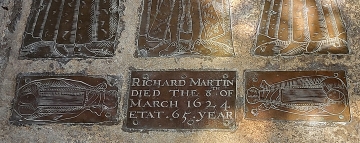
So much for the lost brasses. Fortunately, at the eastern end of the church, several monumental brasses have remained in place – some of them intact, and others damaged. To the south of the high altar, there is a set of intact 17th century brasses commemorating members of the large Martyn family. Included amongst these brasses are two of particular interest – they are Chrism brasses (see photograph above), which commemorate children who died before their mother was “churched” (that is before the mother has gone to church to give thanks to God for the birth of a child). The Chrism brasses depict babies in swaddling clothes. In addition to these brasses, there is another one depicts a brother and sister. The girl is holding a skull, which means that she died before her parents.
Churches in England, and especially that at Long Melford, offer many fascinating insights into how people lived in the distant past. The brasses – those which have gone and those which remain – are fine examples of history on display.
DURING THE REIGN of King Henry VIII, many English churches were vandalised because of the monarch’s divorcing the country from the Roman Catholic Church. Many artefacts were destroyed in churches to erase their connection with the Church in Rome. These included carvings and stained-glass windows. Holy Trinity Church in the wool town of Long Melford in Suffolk was no exception. Above the south entrance to the church, you can see empty stone frames that once contained stone effigies of saints. Much of the 15th century church’s mediaeval stained-glass was also destroyed.
Luckily for us, some of the stained-glass survived. This is because it used to be located in the windows of the clerestory high above the long nave – out of reach of the people sent to destroy it. In recent times, the surviving windows have been restored and placed in the windows lining the north wall of the church. These windows are much lower than those in the clerestory, and are easily viewed from the ground. The windows depict both dignitaries and religious subjects, which were the main targets of the vandals who were destroying religious images.
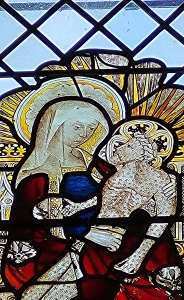
One of the windows is particularly interesting because it shows the Virgin Mary holding the dead body of Christ soon after it had been removed from the Cross. In other words, it is what is known as a Pietà. This subject matter was, and still is, extremely important in Roman Catholic imagery, and had they been able to reach it, those who attacked the church would have certainly wanted to destroy this. A knowledgeable gentleman, who was helping in the church, told us that the pre-Reformation Pietà in the church was an extremely rare survival from the time before Henry decided to break with Rome. What is more is that unlike many images of the Pietà, the dead Christ is shown with his eyes wide open.
The Pietà image in the surviving mediaeval stained-glass is just one of many interesting things that can be seen in the magnificent, large parish church at Long Melford. As the Michelin Guidebooks often say, the place is “worth a detour”.
ONE OF ISTANBUL’S many attractions is that it is intimately associated with water: the Golden Horn, the Bosphorus, the Black Sea, and the Sea of Marmara. Incorporated within the city’s excellent public transport system, there are many boat services on all these bodies of water. During our recent visit to the city in April 2024, we took a boat from Kabataş on the European shore of the Bosphorus to Büyükada – one of the Princes Islands out in the Sea of Marmara. This pleasant journey took about 1 hour and 40 minutes. As we sailed across the smooth sea, flocks of seagulls followed us, and were fed by other passengers, who threw them bread and other titbits.
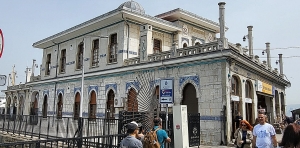
One of the piers at Büyükada has a beautiful old quay building in which passengers can wait for their boat and do a little shopping. Equipped with ticket windows, which are no longer in use because modern ticket machines have replaced them, the building is decorated with lovely tiling and stained-glass windows. As with many old buildings we saw in Istanbul, this one was supplied with a panel describing (in both Turkish and English) its history.
The pier was built in 1899. It was rebuilt with the addition of the present two-storey terminal building, which was completed in 1915 to the designs of its architect, Mihran Azaryan (1876-1952) from Izmit. He was an Ottoman Armenian. It is worthy of note that by the time that his building was built, the Ottoman rulers had been involved in the death of many Armenians.
The upper floor had a café between 1918 and 1923. And between 1950 and 1951, it had been the island’s first ever cinema. Between 2000 and 2001, the edifice was beautifully restored, and although the ticket windows no longer serve any purpose, its octagonal waiting room-cum-ticket hall is a rare survival.
Having seen this superb example of a ferry terminal, I kept my eyes open during the many other boat trips we made along, and across, the Bosphorus. Many of the landing stages have ornate terminal buildings – often with tiling and stained-glass windows, and sometimes with their names still in the old Turkish script. However, the terminal at Büyükada is the most impressive of all those we saw.
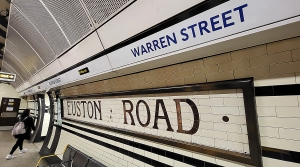
THERE ARE THREE Underground stations close to each other and very close to London’s Euston Road. Warren Street station is 285 yards west of Euston Square station, which is about 376 yards southwest of Euston Underground station.
When Warren Street station (on the Northern Line) was first opened in 1907, it was named ‘Euston Road’. An old station name sign on the platform has been retained as a souvenir (see photograph above), and it reads “.Euston Road”. Had this name remained unchanged, there would have been three stations with ‘Euston’ in their names. So, in 1908, no doubt to reduce the possibility of confusion, the present Warren Street station lost its original name and was given its current name.
MUCH HAS CHANGED IN Istanbul since we last visited it in October 2008. Many places we saw then have either been restored or are closed for restoration. One place that was not open to visitors in 2008 is the Tekfur Sarayi, a palace built next to the ancient city walls of Istanbul. We came across it in April 2024 after having made an abortive visit to the nearby Kariye Mosque (once a Byzantine church), which was closed for restoration.
The Tekfur Sarayi, which used to be known as ‘Palace of the Porphyrogenitus’, is one of three Byzantine palaces still surviving in Istanbul. This edifice was constructed either in the late 13th century or early in the 14th. According to Wikipedia, the palace was:
“… named after Constantine Palaiologos, a son of the Emperor Michael VIII Palaiologos. “Porphyrogenitus”, meaning literally “born to the purple”, indicated a child born to a reigning emperor. The emperor would show off the newborn heir from the balcony and have them proclaimed “Caesar Orbi”, or “ruler of the world””.
The palace was badly damaged during the Ottoman conquest of Constantinople in 1453, and was later used to house part of the Sultans’ menagerie. By the end of the 17th century, the animals were moved, and the building housed a brothel. In 1719, the building was repurposed to house a factory for making decorative tiles, and this is how it remained before going out of business during the first half of the 19th century. Next, it became a poorhouse for some of the Jewish people in Istanbul. Following this, it became a bottle factory for a few years before being abandoned. What makes the building of special interest is that it is a rare surviving example of secular Byzantine architecture.
In 2010, the building was extensively restored and 5 years later a new roof and glazed windows were added. After that, new wooden floors and ceilings and staircases were added. In addition, a stylish lift was installed close to the palace. This allows visitors to reach the high second floor with ease. From a terrace on the second floor, there is a superb panoramic view of the city. In 2021, the place became a museum, whose exhibits include displays of the kind of tiling that used to be made in the palace and informative explorations of the stages in the traditional methods of manufacturing tiling. On the ground floor, there are a couple of archaeological remains of the kilns in which the tiles were fired. Apart from the exhibits, the elegantly contemporary design of the museum and what can be seen of the palace itself add much to the enjoyment of a visit to the Tekfur Sarayi.
The ground floor opens out into a courtyard where more archaeological finds can be viewed. A short staircase from the yard leads to a small garden from which one gets a good view of both the palace and the city walls stretching away from it. Although we were hoping to see the Kariye Mosque, but were unable to do so, visiting the Tekfur Sarayi more than adequately compensated us.
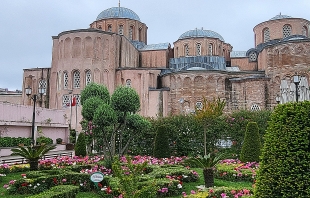
THE MOLLA ZEYREK mosque stands high on one of Istanbul’s seven hills. From its garden, which has a pleasant café, you can enjoy a wide panorama that includes views of the Bosphorus, the Golden Horn and bridges crossing it, the Galata Tower, the great Suleymaniya Mosque, and many other historic buildings around it. Turn your back on the view, and look across the well-kept flower garden, then you will see what looks like a large Byzantine church with three apses and several domes. However, as you stroll around this building, you will soon notice that it has its own minaret. This mosque was a church before 1453 when the Ottomans captured Constantinople/Istanbul.
As is the case with many other places of historic interest in Istanbul, there is an informative notice outside the mosque, written in three languages (Turkish, Arabic, and English). It outlines the history of the mosque. The building, designed by the architect Nikeforos, was built in the 12th century by Eirene (died 1134), the wife of Emperor Ioannis II Komnenos (ruled 1118-1143). Her father was King Laszlo I of Hungary. The edifice which is, in fact three churches joined in one building were the churches of the large Pantokrator Monastery. This institution included a 50-bed hospital, a library, an old-age home, a sanctuary for lepers, a medical school, a pharmacy, and a holy spring. The triple church was exceptional because:
“Except for the Church of the Holy Apostles, no other Byzantine building received as many imperial burials. John II (1118-43) and Eirene (Piroska of Hungary), their son Manuel I (1143–1180), and his wife Bertha of Sulzbach, were buried there, as were the Palaiologan emperors Manuel II and John VIII in the 15th century. In front of Manuel’s black marble sarcophagus was the Stone of Unction (a marble slab on which Christ’s body laid after his crucifixion), which Manuel brought from Ephesus around 1170. The large funerary chapel of the Archangel Michael is described by the typikon as a heroon – the shrine of a hero later used for the imperial mausoleum of Constantine and his imperial successors at the Church of the Holy Apostles.” (www.thebyzantinelegacy.com/pantokrator-monastery)
These monuments can no longer be found in the building.
Soon after Mehmet the Conqueror captured Istanbul, the monastery was converted into a madrassa. It became the first educational establishment created by the Ottomans in Istanbul. The monastery’s monk cells became cells for the madrassa and the triple church, suitably modified with a minaret, a mimbar, a mihrab, and other Islamic features, became a mosque with two classrooms for religious instruction. One of the new establishment’s professors was Molla Mehmed Efendi, nicknamed ‘Zeyrek’ – now, part of the mosque’s name. This learned man not only offered education to those who were already Muslim, but also to those who converted to Islam. In addition, he was instrumental in persuading many local people to convert to his religion.
Apart from the former church complex, now mosque, the other monastery/madrassa buildings have disappeared. This century, what had become an unusable, badly dilapidated structure was restored, and is now back in use as a mosque. The mosque occupies the southernmost of the three chapels. The other two chapels, although attractively painted, were empty spaces. One of these once served as the Byzantine Imperial mortuary chapel.
The Molla Zeyrek Mosque was formerly a Byzantine church. When the Ottomans took Istanbul, rather than destroying the places of worship of their Christian enemies, they recycled or repurposed them – they modified the churches and converted them to become mosques. Probably, the best-known example of this is Istanbul’s enormous Ayasofya-i Kebir Cami-i Şerifi (i.e., the ‘Hagia Sophia Grand Mosque’), constructed in the 6th century. Apart from Ayasofya, which we walked past almost every day during our recent 16-day visit to Istanbul, The Molla Zeyrek mosque was one of the most impressive and largest former Byzantine churches that we saw in the city. However, my favourite of these recycled churches was near where we were staying: the Kucuk Ayasofya Mosque, in whose charming walled garden we enjoyed numerous glasses of tea, met many friendly Turks, and watched the antics of the garden’s large feline population.
I have visited many cities in America, Asian and Europe. Many of them are fascinating, but now I can safely say that amongst these wonderful places, Istanbul has become my favourite because here the past, present, and future blend together with an exciting vibrance.
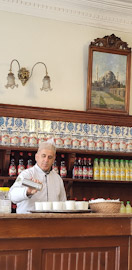
BOZA IS A TURKISH drink, popular both in Turkey and in the Balkans. It is made from fermented grains – such as millet and wheat. It originated in Central Asia. We tried some today. It was light yellow, had the consistency of custard, and tasted both sweet and slightly sour. It was also slightly fizzy (because of the fermentation). It was mixed with cinnamon powder and another customer told us that it is usually drunk with dried chickpea seeds.
We came across the boza shop – an old-fashioned place with tiling – in the Vefa district of Fatih in the European part of Istanbul. The shop is called “Vefa Bogacisi” and it was founded by Haci Sadik Bey.
Haci Sadik Bey came from Prizren in Ottoman Albania (now in Kosova) in 1870. He noticed that the boza then sold in Istanbul (by numerous sellers) was fairly runny, dark in colour, and sour. He developed a new version of it, which was lighter in colour, and as already described in my first paragraph.
At first, like other vendors of boza, he sold it on street corners. Eventually, his customers encouraged him to open a shop in the then upmarket district of Vefa. This he did in 1876. It was in this shop, which we encountered quite by chance, that we sampled boza. The business is still run by the same family – the fourth generation since Haci Sadik Bey opened his shop. Opposite this shop, there is another, which sells the chickpeas (‘leblebicisi’).
Finally, although Haci Sadik Bey (died1933) and his brother Ibrahim (died 1944) came to Istanbul (during the Turco-Russian War), I have not yet discovered whether or not they had Albanian heritage.
Within the shop, locked in a glass case, there is a glass drinking vessel from which the father of Modern Turkey Mustafa Kemal Atatürk (1881-1938) drank boza on Monday the 4th of January 1937. It was good to know that we tried boza in the same place as that great man.
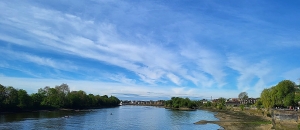
WE MADE ANOTHER visit to Beykoz (on the Asian shore of the Bosphorus), hoping to eat paça soup at the place where we had enjoyed it a few days earlier.
The closed restaurant
We were surprised to find it closed, and shocked to discover that the man who ran it had just passed away. A notice to that effect was stuck on the windows of the small restaurant. As my late father often said when faced with disappointment: “these things happen” and “such is life”
Saddened, but hungry, we found another place which served the delicious meat soup. Its tiny dining area overlooked the waterfront. The food was good.



 yamey
yamey 