A tower in Bath financed by sugar and slavery

I BECAME AWARE of William Thomas Beckford (1760-1844) in the late 1960s when my late friend Michael Jacobs and I were fascinated by the gothic revival that began sometime in the 18th century and continued with great vigour into the following century. Although I never read it, the ‘Gothic’ novel “Vathek” was written by Beckford, who also built the (now demolished) gothic revival style Fonthill Abbey. My interest in Beckford gradually drifted into the back of my mind and remained there until we made a visit to Bath (Somerset) in July 2024. Our hosts suggested that we visit the recently restored Beckford’s Tower, which is located on a hill just north of the Lansdown district of Bath. Kindly, they drove us there, and what we saw was interesting.

Beckford had a house in Bath’s Lansdown Crescent. It was set in extensive grounds that spread from his house to where the tower is located. The Italianate neo-classical tower was designed by the Bath-based architect Henry Goodridge (1797-1864), and completed for Beckford in 1827. It is 154 feet high and contains rooms that Beckford used as a library and living rooms. The grounds between Beckford’s house and his tower were landscaped to become Beckford’s Ride. Along the way, there is a manmade grotto, which has been recently restored.

After Beckford’s death, the tower and the land associated with it were donated to Walcot Parish, which used the area to create a burial ground. In 1931, the tower and the rooms at its base were badly damaged by fire. The cemetery was closed in 1992, and the following year, the site – tower and graveyard – were purchased by the Bath Preservation Trust, who have restored it. Between 1997 and 2000, extensive repair work was carried out on the tower. Further work was undertaken between 2022 and early 2024. This rendered the tower structurally sound and safe for it to be opened to the public. Before ascending the elegant spiral (helical, actually) staircase in the tower, the visitor can view exhibits relating to the life of Beckford in the rooms at the base of the tower. Amongst these, I spotted an early edition of “Vathek”, written it the language in which it was first published: French.

The author of “Vathek” was extraordinarily wealthy. His father, Sir William Beckford (1709-1770), was born in Jamaica, and later became Lord Mayor of London (1762-1769). His wealth, and therefore that of his son, was derived from his sugar plantations he owned in Jamaica. These were worked by the hundreds of slaves he owned. Thus, the tower was financed by the labour of these unfortunate unpaid labourers. Unlike several colonial apologists I have met and heard, the website of the restored tower, and many exhibits and notices within the edifice, emphasise the way in which the author of “Vathek” was able to pay for the tower and his extravagant lifestyle. The website (https://beckfordstower.org.uk/about/history/) includes the following:

“Through marriage and ruthless ambition over four generations, the Beckford family became one of the most powerful on the island of Jamaica. Their vast fortune was built on the profits of sugar plantations, directly created through the stolen labour of thousands of enslaved Africans.

William Beckford’s father, Alderman William Beckford, used the family’s wealth to rise through British politics, and was twice Lord Mayor of London. He presented himself as a hero of liberty for British citizens, whilst people on his plantations in Jamaica were trafficked and forced into slavery, stripped of their dignity, traditions, familial ties and African names, and given the surname Beckford.”

The Lord Mayor is commemorated by a statue in London’s Guildhall.

Professor Robert Beckford (born 1965), son of black Jamaican parents, wrote (https://www.theguardian.com/commentisfree/2023/sep/19/plaque-statue-slave-trader-murder-ancestors-william-beckford-london) in connection with this statue that it ought to be labelled as follows:

“William Beckford inherited 3,000 enslaved Africans in Jamaica, whom he mercilessly exploited to accumulate great wealth in Britain. His enslaved Africans were victims of routine sexual violence, torture, bodily mutilation and mass murder. Today, we recognise slavery as a crime against humanity and an unresolved stain on the national consciousness. We display this statue not because we wish to honour Beckford, but as a reminder of how we as a nation have sanitised, obscured and neglected racial capitalism and racial terror as foundational narratives of our modern history.”

In 1835, after the British Parliament had abolished slavery, former slave owners were compensated financially as the tower’s website explained:

“In 1835 following the abolition of slavery Beckford [author of ‘Vathek’] received a compensation payment of £12,803 (nearly £1.3 million today), the ‘value’ of the lives of 1,860 enslaved people.  He immediately acquired the neighbouring property at 19 Lansdown Crescent and embarked upon a further period of commissioning new furniture and interiors for his home and the Tower.”

Despite its association with slavery, the unusual Beckford’s Tower, is, like the Egyptian pyramids also built with slave labour, interesting both historically and architecturally. It has been beautifully restored. During the latest round of restorative work, care was taken to adapt the tower “… for sustainable energy use …” by installing some solar energy panels on the flat roof of the building that forms the lower part of the tower.

If you are visiting (or living in) Bath, a trip to see and enter Beckford’s Tower is well worth making. And when you are there, do not miss climbing the tower’s dramatic staircase to obtain a superb view of the city of Bath and the countryside beyond it.

Two Albanian heroes

JUST AS THE ALBANIAN Skanderbeg (Gjergj Kastrioti: c1405-1468) heroically resisted the invasion of his country by the Ottomans in the 15th century, Khwaja Safar, also an Albanian, bravely led forces opposed to the Portuguese, who were attacking his adopted country India during the 16th century. Both were forcibly converted to Islam. One remained a Muslim, and the other returned to Christianity.

Khwaja Safar was a soldier; a merchant; the treasurer of Cairo; advisor to the Sultans of Egypt and Gujarat; and the Governor of the city of Surat. His parents were Albanian, yet he is remembered by a name which is not Albanian. You can discover why this is when reading my book about his extraordinarily fascinating life. “An Albanian in India” is available both as a paperback and a Kindle (eBook) from Amazon:

From brewery to library in a small town in Cornwall

THE TOWN OF Redruth in Cornwall was once the centre of a flourishing mining industry. Now, although it contains a few attractive buildings that remind the visitor of its heyday, it has a slightly forlorn feeling.  Amongst the many places in Cornwall that attract the visitors, Redruth is not highly rated. However, it has an attraction that is well worth visiting. Located at the western edge of the old town, it is called ‘Kresen Kernow’.

Kresen Kernow is the Cornish for ‘Cornwall Centre’. Recently opened (in 2019), it houses the historical archives of Cornwall, a library, and a café. What makes it so very special is its architecture and the ‘recycling’ of a former industrial building. This used to be the on the site of the Devenish Brewery, which had been the Cornish Brewery Company Ltd until 1934. In 1991, the brewery was sold to new operators and renamed the ‘Redruth Brewery’. This closed in 2004, and the edifice fell into decay, and was damaged by fire both in 2011 and 2013.

During the early 2000s, Cornwall Council began to consider having a new archive centre and local studies library. After much deliberation, the former Redruth Brewery was chosen as the site for a new home for Cornwall’s archives. In 2015, the derelict brewhouse was purchased by the council, and after the site was cleared and decontaminated, construction commenced. The building was chosen because despite the damage it had suffered, its shell was recognised as being of great beauty.  Making use of much of what was left of the original brewhouse, the architects of the Purcell Practice designed a new building. Pictures of the project before and after it was completed can be seen on their website (www.purcelluk.com/projects/kresen-kernow/).

Completed in 2019, the result is a beautiful blend of modern design and the remains of the original structure. With clean lines and plenty of natural illumination, the building consists of a harmonious combination of interconnecting spaces. On the ground floor, there is a spacious reception area in which there are exhibition display cases and an area for temporary exhibitions. There is also a café. Apart from public spaces, there are several for use of the staff of the archives. The first floor has a library and rooms where people can carry out research on archival material.

Behind the refurbished building, there is a courtyard in which there are sculptures of ‘ordinary’ people. They resemble a group of people who have suddenly frozen during conversations. They were created in 2015 by two artists from Glasgow: Craig Little and Blake Whitehead.

I hope that the presence of Kresen Kernow and the gradual recognition of the beautiful 19th century and earlier buildings in the town will help elevate Redruth to the ranks of places worth visiting in Cornwall.

Discovering sculptures by Barbara Hepworth in St Ives (Cornwall)

EVERY TIME WE visit the town of St Ives in Cornwall, we come across something we have not seen before. On our most recent visit at the end of June 2024, we came across three sculptures by Barbara Hepworth (1903-1975), which were new to us. I will describe two of them in this essay, and leave the third for another time.

Hepworth migrated from Hampstead (in north London) with her second husband, the artist Ben Nicholson (1894-1982), and children, to St Ives in Cornwall at the outbreak of WW2. She lived there until the end of her life. From 1949 onwards, she lived and worked in Trewyn Studios, close to the busy heart of St Ives. This building is now a Barbara Hepworth Museum and Sculpture Garden maintained by the Tate Gallery. Visitors can see Hepworth’s studio and her garden next to it. The garden was laid out to designs created by Hepworth and her friend, the composer Priaulx Rainier (1903-1986). The garden contains works by the sculptor, which are arranged exactly as their creator had planned. We pay a visit to this lovely place every time we visit St Ives.

On our latest visit, we took a wrong turning, and headed down a narrow, sloping street. To our great delight we found a large outdoor sculpture by Barabara Hepworth, standing outside the front of the town’s Guildhall. Entitled “Dual Form”, this large abstract artwork made of cast bronze was created in 1965. It is part of an edition of 7 castings. The artist presented it to the town in 1968. It has blueish hues.

The other sculpture that we had not seen before is in a side chapel of St Ives’s gothic parish church of St Ia. Unlike “Dual Form”, it is figurative rather than abstract, and it is carved in shiny white stone. It depicts the Madonna and Child. Hepworth created this work following the death of her elder son, Paul Skeaping, who was an RAF air pilot. He was killed in an accident in Thailand in February 1953. The sculpture was unveiled in the church, where she found peace during her grieving, in 1954.

The two sculptures described above give a good idea of the breadth of Hepworth’s artistic talent. More evidence of her amazing creativity can be discovered in her former home, now a museum. In another piece, I will describe another sculpture and something I had not realised about Hepworth’s connection with St Ives.  

A deserted dairy product factory in a small town in Somerset

WHEN TRAVELLING BETWEEN London and Cornwall, we often stop at the small town of Wincanton in Somerset. Close to the A303 trunk road, it has retained a certain ‘ye olde worlde’ charm. Once. It was a town with many coaching inns, but although many of these have closed, the buildings that housed them are still recognizable. One of the buildings on the main street houses a small museum of Wincanton. Amomgst the exhibits, there was a glass case containing old objects connected with the ‘Cow and Gate’ dairy products company. Amongst these, there were two glass feeding bottles used for feeding milk to babies.

The Cow and Gate company began life in 1882 as the ‘West Surrey Central Dairy Company’. In 1904, Dr Killick Millard developed a powdered milk, which in 1908 was marketed by the company as ‘Cow & Gate Pure English Dried Milk’. In 1929, the West Surrey Central Dairy Company Limited was renamed ‘Cow and Gate’. None of this information was available in the form of a label or information notice next to the Cow and Gate exhibit. So, I asked the lady looking after the museum why there were Cow and Gate exhibits in the museum.  She explained that until (before [?]) the 1990s. Cow and Gate had a large factory in Wincanton, which had its own railway line, a branch of the now closed (in 1966) Somerset and Dorset Joint Railway.

We strolled downhill to the south of the old part of the town, and came across the former Cow and Gate factory. With three storeys, a centrally located clock tower. and windows fitted with Crittall frames, it is a fine example of interwar Modernist industrial architecture. Today, many of the windowpanes are broken and the building has a deserted, neglected appearance. Boards with the name of Myakka – a design company – are attached, but there was no sign of life within the building and the yard surrounding it. We could not enter the old factory, but Myakka have posted pictures of its interior on it company website (https://blog.myakka.co.uk/home/myakka-architecture/). Although nobody seems to remember who designed it, it is a well-known landmark in Wincanton. Everyone we asked directions to it, knew it well.

Over the years, Cow and Gate expanded, and needed a fleet of vehicles to transport its products all over the country. This led to them founding a logistics company, ‘Wincanton’, which is still thriving more than 70 years after it was formed. In 1958, Cow and Gate merged with United Dairies to become ‘Unigate’, which was taken over by Irish foods firm Greencore in 2011. As for the derelict Modernist factory in Wincanton, nobody seems to know what will become of it.

Not what it appears to be at a country house near the city of Bath

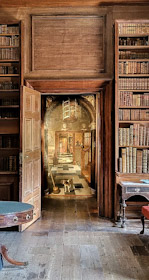
THERE IS A LONG corridor in Dyrham Park house near Bath. It seems to be extremely long when seen from one end of it, but this is an illusion. The extreme length has been created by putting a troupe l’oeil painting at one end of the corridor. This painting is a work of the Dutch artist Samuel van Hoogstraten (1637-1678), who was one of Rembrandt’s most successful students.

In addition to this trompe l’oeil by Hoogstraten, there is another one placed above a grand staircase at Dyrham House. These two paintings are not the only ones at Dyrham. One of the former owners of the house, William Blathwayt (1649-1717), was a collector of paintings by Dutch masters. Not only did he purchase Dyrham Park, but also, amongst many other achievements, he established the War Office as part of the British Government.

Inspired by Claude Lorraine and Nicolas Poussin in Wiltshire and Somerset

WHEN I WAS a teenager, I made excursions – day trips – to places outside London with a small group of friends. Being too young to have driving licences, we had to rely on public transport. One place that we always wanted to get to is on the border between Somerset and Wiltshire: the gardens at Stourhead. Sadly, despite much research we could never find a way to reach it by public transport. It was only many years later (in the second half of the 1990s) that using a car, my wife and I were able to visit this place that my friends and I yearned to reach in the 1960s. We have visited Stourhead several times, both before and after the covid19 pandemic. Our latest trip there was on the 8th of July 2024. Despite it having rained extraordinarily heavily the previous day, the paths in the garden were not waterlogged.

The gardens were laid out between 1741 and 1780. They were designed to resemble the arcadian scenes as portrayed in paintings by Claude Lorraine, Nicolas Poussin, and Gaspar Dughet. The designer and source of inspiration for the gardens was the banker Henry Hoare II (1705–1785), also known as ‘Henry the Magnificent’. The resulting horticultural creation is a remarkably successful realisation of what had inspired him. A central water feature – a lake – is fed by streams and rivulets. Around the lake, are a series of picturesquely positioned neo-classical pavilions, a bridge, a Tudor cottage (which existed before the garden was created), and a man-made grotto.

One of the neo-classical structures, The Pantheon (designed by Henry Flitcroft; 1697-1769 – he died in London’s Hampstead), contains a set of 18th century sculptures of Ancient Greek gods and heroes. It also contains a well-preserved Ancient Roman statue, which one of the Hoares bought while travelling in Rome. It was interesting to enter this building because on all our previous visits, it had been locked closed. Another pavilion, smaller than The Pantheon, contains a huge white vase made from Coade Stone (made from clay, quartz, and flint), which was regarded as a ‘wonder’ material by architects and designers in the 18th century. In those days, it was cheaper than most stones and timber. It is named after the businesswoman Eleanor Coade (1733-1821), who was very successful at marketing this material invented by Daniel Pincot. The reason I write about this is that currently there is a small exhibition about Eleanor Coade in the small neo-Classical pavilion that faces The Pantheon across the lake.

Even if you are unable to enter any of the pavilions surrounding the lake, a visit to Stourhead Gardens is a magical experience. Here, nature has been guided into creating the 18th century ideal of a classical landscape. It brings to life the Latin expression ‘Et in Arcadia Ego’, which means something like ‘even in Arcadia, there am I’.

A tiny chapel and a Catholic martyr both in a port in Cornwall

WHENEVER WE VISIT the picturesque port of St Ives in Cornwall, we come across things we had not noticed on previous visits. On our latest visit, made in early July 2024, we discovered a monument that we had not noticed before and entered a chapel, which we had seen often, but never entered.

The monument is a bas-relief plaque mounted on one of the walls of the Roman Catholic Sacred Heart and St Ia Church. It is dedicated to the memory of John Payne, the portreeve (harbour master) of St Ives. He was executed in 1549 because he was a Roman Catholic. His demise occurred during the 1549 Prayerbook Rebellion. In case you had never heard of this – and it was news to me – the Prayerbook Rebellion (aka the ‘Western Rising’) happened because of something that happened during the reign of King Edward VI. Edward’s uncle, Edward Seymour, encouraged iconoclasm and the use of English (instead of Latin) during church services. This was unpopular in large parts of England, and when in 1549 the “Book of Common Prayer” was introduced, revolt against it broke out in Devon and Cornwall.

John Payne was hung in the marketplace of St Ives. His death was ordered by Sir Anthony Kingston, the Provost Marshal (c1508-1556).  Payne was not the only Cornishman who was executed for his Catholic beliefs. The monument in St Ives is not only dedicated to him but also to:

“… all the men of St Ives who died to defend the Catholic faith in the Western Rising – 1549”

I am not sure when the memorial plaque was placed on the church, but it does bear the dates “1549” and “1949”.

Further into the town than the monument just described, one reaches the Smeaton Pier, where fishing boats unload the seafood, which they have caught. Wedged between a public toilet (for ‘gents’) and the small St Ives Harbour Master’s Office, there is a tiny chapel dedicated to St Leonard. This small building built with stones is entered via a few granite steps. Consisting of a small room (about 10 feet long and 6 feet wide. No one knows when it was constructed, but records indicate that it underwent some repairs in1577. The chapel was probably used by seamen setting out for sea and also provided shelter in bad weather. In 1971, the chapel was renovated and opened as a museum and a memorial to the fishermen of St Ives.

On the outside of the chapel, there is a plaque commemorating the record breaking 600-mile passage made by the St Ives lugger Lloyd from Scarborough to St Ives in 1902. The journey took 50 hours. Within the chapel, there are glass cabinets containing historical maritime items as well as old photographs and some models of sailing ships.

Although small, both the chapel and the memorial add to the fascination of the wonderful town of St Ives. In a future essay, I will tell you about some more of the things we ‘discovered’ during our latest visit to the place.

A window for Sir Francis Drake in deepest Devon

NO ONE KNOWS exactly where the Explorer and naval commander Sir Francis Drake (c1540 – 1596) was ‘buried’ at sea. What is known is that his corpse clad in armour was put into a lead coffin, and then dropped into the sea somewhere near Portobelo (now in Panama).

On the 400th anniversary of his death, a stained glass window which is part of a sundial was installed at the Drake family home in Devon: Buckland Abbey. The window depicts a chart of the Atlantic Ocean on which a small cross has been marked in the approximate location of Drake’s burial. The window/sundial was designed by Christopher Daniel.