Narrative art in the round at London’s Barbican Centre

THE CURVE AT London’s Barbican Centre is as its name suggests, a curved space. When the Centre was built, the Curve was designed as a space to act as a sound barrier or buffer to contain the sounds emanating from the concert hall that it surrounds. Nowadays, it is used as a space for temporary exhibitions. Until the 5th of January 2025, the Curve will contain an exhibition, “It will end in tears”, of paintings Pamela Phatsimo Sunstrum, who was born in Botswana in 1980.

Ms Sunstrum’s paintings are on grainy wooden panels, and are truly wonderfully executed. The series of paintings are all linked by a narrative – an imagined story of a woman who lands in a colonial country in Africa in the early to mid-20th century, and has an adventure that ends up with a court case. For this exhibition, the Curve has been divided by wooden partitions into a series of rooms, connected to each other by an elevated walkway. Each room is designed to resemble a different stage set. For example. one is a kitchen. and another is a courtroom. The viewer walks along the walkway from room to room, seeing the series of paintings arranged in the order that the story unfolds. The heroine of the story is an imagined woman named Bettina. The artist created Bettina in her own image – each depiction of Bettina is the artist’s self-portrait. The resulting set of pictures along with the wooden partitions makes for an enjoyable and intriguing experience.

The paintings are like ‘stills’ from a movie. Although their style and subject matter is completely different, I was reminded of series of paintings such as those by Vittore Carpaccio (c1460-c1525) in Scuola di San Giorgio degli Schiavoni (in Venice), which show scenes from a legend with a Christian religious theme.

Ms Sunstrum’s site-specific exhibition at the Curve is what the series of guidebooks issued by the Michelin tyre company would describe as “vaut la détour” (‘worth the detour’).

A baptismal font in with stone carvings a church in Hertfordshire

WARE IS AN ATTRACTIVE small town on the River Lea in Hertfordshire. Coaches travelling between London and Kings Lynn passed through Ware because it was on the route of the Old North Road (now followed approximately by the modern A10). The parish church of Ware, St Mary the Virgin, is large and spacious as befits the size of the town. Much of what we can see today was built over several centuries, from the 12th to the 15th. It was the church’s stone font that attracted my attention.

The octagonal font is believed to have been donated to the church in 1408 by the then Lord of the Manor, Thomas Montagu (1388-1428), Earl of Salisbury. Each of its eight sides contains fine bas-relief carvings. Many of them depict saints connected with birth, baptism, and childhood. For example, ther is a carving of St Christopher carrying the young Jesus across a river. Most of the faces on the carvings are in remarkably good condition considering their age and that they were in place long before the iconoclastic activities of Protestants took place. The church’s guidebook mentioned that in the 1540s, the faces of the statues were attacked, but fortunately the workmen, who might well have been men of Ware, responsible for defacing did a “token job”, only defacing the faces of the Virgin and St Margaret because they could be seen by people entering the church. Luckily for us living in the 21st century, these workmen managed to protect what is an attractive piece of church art.

The cathedral of the Ukrainians near to London’s Selfridges

THE NATURAL HISTORY Museum in South Kensington, a well-known landmark, was designed by the architect Alfred Waterhouse (1830-1905). Not too distant from this edifice, there is a church he designed in 1891. It is an unusual building with an oval nave, and it stands on the corner of Duke Street and Weighhouse Street. It was built originally as a place of worship for the Congregational King’s Weigh House congregation. During WW2, the church was badly damaged, and in the 1950s, after the church had been repaired, the congregation had declined significantly.

In 1968, the church was acquired by the Ukrainian Catholics in the UK, and it became known as the ‘Ukrainian Catholic Cathedral of the Holy Family in Exile’. Now, it is called the ‘The Ukrainian Catholic Cathedral of the Holy Family’. Fitted with a colourful iconostasis that hides the high altar, its congregation practise the Orthodox rites but look to the Pope in Rome as their religious leader. The oval shape of the nave, with an oval gallery running around it on the first floor makes for an interesting and unusual feeling of space within the church. The building contains much decorative tiling, which was put there when it was built. In 2022, when the Russians attacked Ukraine, the cathedral became a rallying point for Ukrainians residing in Britain.

With its adaptation to the needs of its Ukrainian congregation and its unconventional design, this church near Selfridges is well worth a visit.

Dragons in Mayfair and an artist from Pakistan

ONE GREY SEPTEMBER afternoon, we stepped into the Almine Rech gallery in London’s Mayfair a few days before its wonderful exhibition of paintings, “Summer of Dragons”, by Hiba Shahbaz was due to end (on the 28th of September 2024). Each of the works on display depict dragons, and some of them also include human figures, often scantily dressed.

Hiba was born in Karachi, Pakistan. She studied Indo-Persian miniature painting in Lahore’s National College of Art. Then, she studied in the USA at the Pratt Institute in Brooklyn (New York City), where she was awarded her Master of Fine Arts degree. She now lives and works in the USA.

The skills she gained while training to paint Indo-Persian miniatures can be seen in the much larger paintings, which are on display at Almine Rech. Some of the paintings evoked memories of Chinese or Japanese art. Others depict dragons in the company of naked women. All the paintings, including some wooden boxes decorated with paintings, were completed in 2024. I suspect that had she remained in Pakistan and produced the same images, those containing the nudes might have been severely frowned upon.

We left the gallery, feeling very satisfied with what we had seen. Although the clouds above us had become more threatening, the visual experience of the exhibition brightened our moods.

Once watercress grew in the flowing waters of a stream in Oxfordshire

BITTER TASTING, WATERCRESS is a member of the cabbage family (Brassicaceae). It is rich in health-giving nutrients. In Britain, it is grown in fast flowing chalk streams. It used to be grown in streams on Hampstead Heath, and there is a row of cottages that formerly housed watercress workers on Hampstead’s Willow Road. Another place where it was once grown is the Oxfordshire village of Ewelme.

A trout stream runs past Ewelme. It was here in the late 19th century that the Smith family from the village of South Weston, not far from Ewelme and the larger town of Watlington, began cultivating watercress in the stream. The watercress beds stretch for about ¾ mile along the stream, and have now been preserved as a nature reserve. By the beginning of the 20th century, the watercress beds at Ewelme were flourishing, producing large crops. Hampers containing 56 lb of watercress were carried by wagon to Watlington railway station, and from there they were transported by train to the Midlands and Manchester. The cress from Ewelme was highly regarded all over the country.

The Smith family kept the watercress beds going until the mid-1960s, when they were sold to new owners. The beds were kept going but became increasingly less viable economically. They were closed in 1988. However, visitors to Ewelme can see the two rows of rectangular beds, each enclosed by low  partitions. A boardwalk runs along the length of the beds, separating the two rows. The stream flows through the beds. What can be seen now was the result of much restoration work carried out by local volunteers. A small visitors’ centre stands next to the beds. Near the beds, there is a house called Watercress Cottages, where a member of the Smith family used to live.

Ewelme is an attractive village with many historic buildings. A visit to the watercress beds, now the home of waterfowl, is an unusual experience and well worth making.

In a library on an island off the coast of Essex

MERSEA ISLAND IS south of Colchester in the mouth of the Blackwater River, which flows through the south of Essex. Connected to the mainland by a cuseway, which gets submerged twice a day when  it is high tide, Mersea Island feels like it is many hundreds of miles away from London, even though it is about 60 miles from Trafalgar Square and only a few miles from Chelmsford and Colchester. The island has two settlements: West Mersea and the much smaller East Mersea.

Although there are some working people on the island, many of its residents are retired. We did spot a few (less than five) people, who did not look as if their heritage was white British, but the island cannot be described as having a multi-ethnic population. The island is an outpost of the Anglo-Saxon heartland. It seems to be a friendly community. People with whom we spoke were very amicable. Having said this, a surprise greeted us when, out of curiosity, we stepped inside West Mersea public library, which is run by Essex County Council.

The library is a modern structure with a simple but pleasant, spacious reading room. Immediately after entering, we spotted a bookshelf with a notice above it. This had the words “Author of the Month”. The author whose books were prominently displayed on the shelves were by Vaseem Khan. He was born in east London in 1973, and studied at the London School of Economics. Then, he worked for ten years in India. His experience of India led him to begin writing detective novels set in India. My wife, Lopa, has read and enjoyed many of his books.

I am not sure why we were so surprised to see Vaseem Khan’s books given pride of place in the library in West Mersea. Maybe, it was because our experience of the island is that its population is far from being cosmopolitan.  Lopa spoke to the librarian, saying how pleased she was that Vaseem Khan had been highlighted, and then began mentioning other British Indian authors such as Abir Mukherjee and Imran Mahmood. The librarian had read books by all these authors and spoke knowledgeably about them. She had chosen Vaseem Khan to be the author of the month because she had met him at a literary festival, and then invited him to speak in her library. We left the library having been highly impressed by what she had discussed with us.

One thing we forgot to ask her was how often Vaseem’s books were borrowed in comparison with other fiction writers’ volumes on the shelves. I would liked to have discovered whether her display of Vaseem’s books attracted much attention from the local, seemingly Anglo-centric, users of the library.

Some mouthwatering experiences on the stages of theatres in London

OVER THE YEARS, we have watched several plays, which are best seen after eating rather than when hungry. In all of these, the actors have prepared and even cooked food on the stage. Many years ago, we watched a play about the artist Van Gogh’s stay in London. The stage set for this drama, which we saw over 20 years ago, included a kitchen. During the show, a roast meal complete with meat and vegetables was prepared in front of the audience. It smelled great, but we were not invited to eat any of it.

More recently we saw a play called “The Arab-Israeli Cookbook” on the small stage of the tiny Gate Theatre, which is above a pub in Notting Hill Gate. The audience was seated only a few feet away from two ladies, one of whom was preparing Israeli dishes, and the other Palestinian food. The drama explored the ongoing conflict in that country beset by conflict and tragedy: Israel. What was being prepared on stage was delicious. I am pleased that we had eaten before watching the preparation of mouthwatering food, which we were not offered.

Today, the 21st of September 2024, we watched a play, “My English Persian Kitchen”, written by Hannah Khalil. Starring only one actor, Isabella Nefar, it is showing at the Soho Theatre in Dean Street until the 5th of October 2024. Throughout the 70 minutes of this one act play, Ms Nefar prepares an Iranian herb and noodle soup, Ash-e-Reshteh, on a kitchen unit placed in the middle of the stage. While she tells us the secrets of making this soup, she also relates the problems of being a married woman in Iran and how she fled from the country and her husband. She also describes her arrival in London and how she reacted to life there, and how others reacted to her. Every now and then, she has flashbacks to her difficult marital experiences back in Iran. As the play comes to an end, her soup becomes ready to eat. She invites the audience on the stage to taste what she had prepared while we were watching. All in all, it was a great piece of drama. My wife tried the soup, and said it tasted good. I did not try it because it contains beans and lentils, neither of which I particularly enjoy.

I went to Soho Theatre after having a lighter than usual lunch. As the actress prepared the dish, the cooking smells did increase my feelings of hunger. I should have eaten more before reaching the theatre.

When nature challenges the flow of traffic.

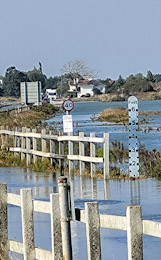
THE ISLAND OF MERSEA is connected to the mainland of Essex by a causeway,  which was originally constructed before the medieval era. It is the only way that vehicles, motorised or otherwise,  can travel between Mersea and the rest of Essex.

Twice a day, the tide rises. When it does, not only do the mudflats close to the island become submerged beneath the sea but also the causeway.

The flooded causeway

After visiting East Mersey, we drove to the causeway and had to stop in a long queue of traffic. It was high tide, and the water had not only covered the causeway but also about 200 yards of the roadway approaching it. It was interesting to see how even in the 21st century,  a simple thing such as high tide can bring life to a standstill.

From Flanders to Devon and  thence to an island in Essex

FROM FLANDERS TO DEVON AND THENCE TO ESSEX

THE MEDIAEVAL CHURCH of St Edmund King and Martyr in the tiny village of East Mersea, on an island close to the coast of Essex, is a joy to visit.

The south wall of the church has some relatively modern windows, which are mostly glazed with clear glass. However, parts of the windows contain small pieces of stained glass, which look quite old. Chris Parkinson at the museum in West Mersea told us that these small fragments of what had once been larger window range from the 15th to the 18th centuries. They were brought to Essex from Devon by the Sunnock family, who came from Topsham and nearby Exeter.

The Sunnocks were a prosperous family. In the 19th century, after the Napoleonic Wars, English gentlemen toured France and the Low Countries, buying up antiques including bits of stained glass from religious establishments. The Sunnocks acquired a large collection of old stained glass this way, and brought it with them when they bought a home on Mersea Island.

During WW2, their Essex home was requisitioned by the military, and the glass was stored in a truk. After the war, some of the glass was restored in Norwich, and then installed in the windows of the church in East Mersea, where it can be seen today.