Today, I came across an interesting article ( https://substack.com/home/post/p-202342382 ) about Albanians in New York City published on Substack by Jake who lives in that city. Reading it jogged my memory. I remembered something we came across on our visit to Albania in May/June 2016. Here is what we found in a tiny village in the south of the country. …
Tuesday, 31 May 2016. Many people had encouraged us to visit Dardhë, which is a village south of Korçë. To reach there, we had to drive via Korçë onto the main road to Ersekë. This thoroughfare was appalling. Its tarmac had been removed in anticipation of repairing the highway. We drove at snail’s paste along it, bumping constantly on the sharp rocks that lay along the roadway and raising clouds of white dust like thick smoke. After a while, we turned off onto a smaller but much better surfaced road that led across the plain to the village of Boboshticë. Soon after passing this place, we began climbing through wild, barren rocky landscape. Gradually the road began climbing ever more steeply and curling around sharp hairpin bends until we crossed the col of a pass, and then we began driving through a well-forested mountainous landscape. The village of Dardhë is perched high on these hills with a view down to a cultivated valley far below.
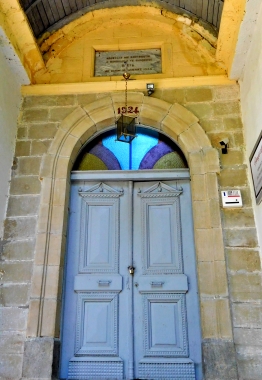
We parked our hired car close outside a stone building, which bore the date 1936. It had a newish sign saying it is the Pleqesia (presbytery) of Dardhë. It is close to a small steeply sloping park full of trees that provided much shade, which contains a building that houses a museum (the Muzeu Foto-Historik), which was closed. The headstone of the arch of the museum’s main entrance has the date 1924. A plaque on a wall, cracked in one corner, topped with a 5-pointed star, and dating back to the Communist times, read (roughly translated):
“In this building during the national liberation war important international meetings were held concerning the regional character of the province. It was the centre of partisan forces and warehouse for food and propaganda materials.”
Dardhë is mentioned twice in Roderick Bailey’s book about the SOE in Albania, The Wildest Province. It fell into German hands, and out of fear the inhabitants appeared to welcome them. Various members of the SOE recorded having spent time in the village, notably Major JG Hibberdine, who kept a detailed diary of the awful times he and his comrades-in-arms spent in Albania (between late 1943 and mid 1944). Major P Kemp recorded that the villages’ inhabitants were “Catholics”, and that 2 of his fellow ‘Britishers’ attended mass in a church above Dardhë. Given that the church in the centre of Dardhë is Orthodox, Kemp must have been referring to Shen Pjeter, which is in the hills above the village. In fact, on our way to Dardhë, we stopped briefly at a point above the place where there is a roadside shrine dedicated to St Peter and bearing a Roman Catholic, rather than an Orthodox, cross.
The museum building bore another memorial plaque, which recorded the fact that the building had been constructed with input (financial?) from the Dardhë society, named “BLETA”, its members residing in the USA. I contacted someone who works with BLETA, which still exists and has its headquarters in Worcester (Massachusetts), and was told that the present-day museum was originally a school, constructed in 1924 with help from the organisation. Many inhabitants from Dardhë emigrated to the USA. According to one source, their families formed the nuclei of the first Albanian communities both in the USA and in Romania. One of these migrants from Dardhë was Josif Pani (1868-1934), who was deeply involved in the important American Albanian patriotic groups, notably Vatra (meaning ‘hearth’), whose members included prominent Albanians such as Faik Konitza and former Prime Minister Fan Noli.
In the park next to the museum there is a monument, a bust of a man wearing a neck scarf (like those worn by Communist ‘young pioneers’) and on his head what looks a like an Indian ‘Nehru cap’. It is dedicated to the memory of partisans fallen in WW2. The base of the monument has an embossed metal plate recording the list of the dead. These people died on various dates between 24th December 1942 and 20th August 1944. More than half of the 17 deceased died on 9 September 1943. All those listed were born in Dardhë and were described as “rene deshmor”, which means ‘martyred’. On 24 December 1942, Dardhë was attacked by Italian forces. On the 9th of September a year later, a day after the Italians had given up their alliance with the Germans, their forces left Dardhë, sacking the place before doing so.
We visited the Orthodox church of St George, which is close to the museum. It was being restored. The BLETA organisation is helping with this. There was scaffolding on its bell-tower. Many of its fittings, including a lovely iconostasis and 2 intricate chandeliers made with gold coloured double-headed eagles, are of recent manufacture. An elaborately carved wooden icon stand appeared to be far older.
I wandered around the village, looking at its old stone houses that perch on the steep slopes of the mountainside. Their roofs are tiled with overlapping flat stones that resembled thick slates. There was a stone arch over the gates to a drive that led to a building near where we had parked. The stonework of the side of the arch that face inwards has a 5-pointed star embedded in its headstone. The side of the arch facing the street did not have one. Next, we had drinks in a large hotel above the village, the Dardha. Its overhanging roofs made it look like an alpine chalet. We were almost the only customers in this vast place when we entered it. Although Dardhë is undoubtedly a pretty place and full of interest, it failed to impress me as much as it had those who recommended that we visit it. However, the drive to and from it was well worth doing because of the spectacular scenery that we saw.
The thing that made the village truly remarkable for me was seeing the school, now a museum, whose construction had been financed by migrants from the village, who had made themselves a more prosperous life in the USA.
This is an extract from my book “Rediscovering Albania”, which is available from Amazon. The book contains my comparisons of what I found in Albania in 1984 with what I saw in 2016.

