
This describes the colourful life of Jakob Seligmann (1846-1906), who arrived in South Africa from Germany while his cousin, my great-grand-uncle, who migrated to the Cape Colony in 1849, Henry Bergmann (see: https://activeauthor.substack.com/p/a-letter-written-from-cape-town-in ) was still alive. Jakob made a name for himself in the tiny town of Rouxville in what was then the Orange Free State, and then had to flee from southern Africa …
Rouxville was established in 1863 across the Orange River. It is some 23 miles north of Aliwal North, where Henry Bergmann lived, and 25 miles southeast of Smithfield. It was founded to resolve some problems associated with the postal service in Aliwal.
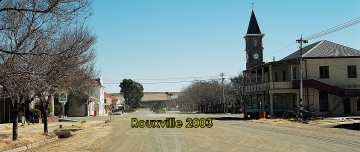
The establishment of Rouxville presented new opportunities for traders. I believe that Henry Bergmann may have had some interests in the new settlement. His cousin Jakob Seligmann and Leopold, a brother of Ludwig Reichenberger, who was working with Henry Bergmann in Aliwal, were both from Ichenhausen in Bavaria and amongst the earliest settlers in Rouxville. In 1873, Leopold married Henry Bergmann’s niece Mathilde Rosenfels who was a first cousin once removed of Jakob Seligmann. Her brothers, Julius, Max, and Jakob Rosenfels, also set up shop in Rouxville. By that time, both Jakob Seligmann and Leopold Reichenberger had both been significantly involved in the foundation of the new town.
The town of Rouxville was established officially in 1863, but it took several years to become the seat of a Magistrate – a ‘Landdrost’. The reason for this delay was opposition by the neighbouring town of Smithfield, north-east of Rouxville and across the Caledon River. One of the reasons given by Rouxville for wanting its own Magistracy was the difficulty of getting criminals to trial when the River Caledon was flooding.
In 1869, the town of Rouxville sent its first petition to obtain its own Magistracy to the Volksraad . Leopold Reichenberg, who was to become the town’s post-master, was among its 108 signatories. A second petition, containing 60 signatures, followed the first, and was written by Leopold Reichenberg in 1870. His petition included the information that already in 1870 Rouxville could boast of having three shops, a bakery, a slaughterhouse and two hotels with bars, and there were plans for much more growth. After Rouxville had been granted a magistracy, a committee of burghers was constituted to advise the Magistrate. The committee whose role was to ensure the execution of the town’s regulations included Leopold Reichenberg, who had become a ‘Heemraad’ , and Henry Bergmann’s cousin Jakob Seligmann.
Between the town’s founding date and 1876, the land on which it was built, Zuurbult Farm, was Church land. Until 1876, the town of Rouxville was run by a Committee of Management, which was independent of the Church. Between 1873 and 1876, the Church purchased all rights of management of the town from this Committee. Jakob Seligmann, vested with Power of Attorney, acted as an agent charged with selling the rights and claims of the Committee on the town to the Church . This is the first evidence that I have of Jakob’s involvement in the town’s legal proceedings.
I learnt from various documents in the National Archives of South Africa that Jakob acted as a ‘General Agent’ in Rouxville. This meant that he undertook legal work such as conveyancing properties, supervising contract writing, drawing up wills, and also defending the accused in court. His name appears frequently in the register of revenue stamps sold in Rouxville. He also appears often in the Register of criminal cases kept by the Police Station of Rouxville in 1877 and 1878, the latter proved to be a critical year in Jakob’s life.
The police Register contains summaries of cases presided over by the Magistrate of Rouxville. Some of those recorded for 1877 show Jakob acting in his role as an advocate. From the examples that I have seen, it seems that Jakob was good at his job. He defended those in the dock well.
Other cases showed Jakob in a less favourable light.
One of the cases in the police records shows that Jakob’s life did not run smoothly. On 30 March, 1877, he was standing outside his house in Rouxville speaking with a Mr Bachman from Paarl when, out of the blue, he was attacked by Mr Reed. The attacker asked Jakob whether he had made a deal with a Mr Chase, and then began hitting him with a whip. Mr Bachman managed to disarm Reed, but as he testified in court this did not put an end to the attack . Mr Reed, the accused, was found guilty, and both bailed and fined £50. Jakob had been saved by Bachman from serious injury, and maybe also from death. What Jakob had done to annoy Reed is not recorded.
On 2 November 1877, the Police Station Register records that in mid-August 1877 a prisoner, named Leuris, in Rouxville’s jail was accused of stealing the rations of a fellow inmate. That inmate was Jakob Seligmann. This happened during one of several occasions when Jakob was locked up in jail. The stolen rations had been left uneaten by Jakob, who received his food whilst in jail from elsewhere. It was likely that his food was brought to him by his wife. She was Hendrina (né Hendricks), a Christian lady of Dutch descent from Graaff Reinet. Jakob had married her in 1873.
Most Jewish men, including many of my mother’s relatives, who arrived in South Africa during the first six or seven decades 19th century, preferred to marry Jewish women, but they were in ‘short supply’ below the Equator during that time. Often, they married Jewish ladies from Germany who sailed out to Africa specially to be wed . Jakob Seligmann was unusual amongst the South African German Jews of the time; he married someone whom he had met in South Africa and who was not Jewish.
Almost a year after the Reed incident, in September 1878, the Police Register recorded that Chief Constable Henry Röttchers had been accused of being drunken and disorderly whilst on duty. During his trial it emerged that he had left the door of the jail unlocked . Worse than this, Jakob appeared to have had the run of the place: he was able to unlock the door and was not confined to his cell . Röttchers was found guilty and fined 15 Shillings Sterling. Clearly, security arrangements at Rouxville jail were far from satisfactory.
Jakob was incarcerated several times. Once when Leuris stole his rations in August 1877. He must have been released after that because only four days before the Röttcher incident on 31 August 1878, Jakob – at that date a free man – was in court defending someone who had been accused of hitting a ‘white’ farmer. Therefore, Jakob must have been incarcerated again in the last few days of August ‘78.
Two months later on 9 October 1878, the Gouvernements Courant, a newspaper published in Bloemfontein reported a jailbreak in Rouxville. Sometime during the night of 5 October and the early morning of the next day Jakob Seligmann escaped from the jail at Rouxville. A ‘wanted’ notice was published in the same issue of this newspaper, both in Dutch and in English. It reveals why Jakob was being held:
“WHEREAS PRISONER JACOB SELIGMANN, charged with the crime of FORGERY and FRAUD, did, in the night of the 5th and 6th of October, 1878, escape out of the Prison at Rouxville, with the assistance of one or more persons, Notice is hereby given, that a REWARD OF TWENTY-FIVE POUNDS STERLING will be given…”
The authorities were concerned that Jacob Seligmann would try to escape from the Orange Free State. On 10 October, a letter was sent from Bloemfontein to Natal, the neighbouring British colony. It was believed by the authorities that Jakob might head for the coast of Natal, the closest seashore to the landlocked Orange Free State. The letter begins by saying that a copy of the warrant of Seligmann’s arrest was attached, and it continues to say that Jakob was being held in jail awaiting trial at the Circuit Court in late November.
It was the second time that Jakob had been in jail in 1878. The first was three months beginning in May, and the second had begun in late August . The letter included the information that Seligmann had been accused of defrauding several persons of a large amount of money. By mid-October, ten days after Jacob had escaped from prison, the police authorities in Natal had been ordered to look out for the escapee. In November 1879, the authorities in Natal wrote to the Home Secretary of the Orange Free State, reporting that efforts made to apprehend Seligmann were in vain.
At first, I had little idea why Jakob was in trouble, but eventually I ‘unearthed’ an informative document. This revealed that on 28 of June 1877, the High Court of Justice of the Orange Free State ordered the sequestration of Seligmann’s assets , following the issue of a bankruptcy against him by Nathaniel Adler & Co. of Port Elizabeth. The sequestration order affected all his assets including household possessions. An inventory of these included two children’s bedsteads and one baby’s cradle. Jakob’s family needed these items because by June 1877, Jakob and Hendrina had two small infants and a five-month-old baby .
After his escape, Jakob disappeared from South Africa. By the time that he disappeared from prison and reappeared across the Atlantic, he and Hendrina had produced four sons, the eldest of which was only 6 years old and the youngest a baby. They all appear in the yellowing pages of the 1880 Census of the USA: they were living in Springfield in Sangamon County, Illinois .
It puzzled me how Jakob – a wanted man – and his young family managed to reach the USA from South Africa without being captured. Two clues are contained in an unpublished account of a long trip that Jakob’s son Arthur (born 1878) made from the USA to Europe and South Africa in late 1904 and early 1905. Arthur never mentions his father’s colourful past in South Africa anywhere in his detailed, but dryly written, travel diary. He wrote that he arrived at Victoria Station in London, and:
“…was soon located at Kleins Hotel in Finsbury Square as this Hotel is a very old German house and a great rendezvous for the German Commercial travellers. It is the same hotel that my father stopped at when he visited London during his journey from South Africa to America about 30 years ago.”
In connection with this hotel, Arthur mentions his father but not the rest of the family. Elsewhere, he wrote:
“Upon my arrival in Graaff Reinet, … I made inquiries about the whereabouts of the Bartletts and soon an elderly gentleman introduced himself as Mr Bartlett, and I was then certain that it was Uncle Richard who 26 years ago escorted mother and the four of us boys including myself as far as Mount Stuart previous to our departure to Port Elizabeth where we embarked on the steamer for America.”
As the family is not mentioned in connection with Kleins Hotel in London and Jakob is not mentioned in connection with the journey to Port Elizabeth, I speculate that Jakob, a fugitive, might have found it safer to travel to the USA separately, without his young family who would have made their own way there .
In contrast to the mystery about of Jakob’s movements in late 1878 and early 1879, the reason that he chose to go to Illinois is less enigmatic. First, he had at least two brothers already living there: Julius (born 1843) who married in Illinois in 1869; and Daniel (born 1854). Secondly, he would have learnt something about life in Illinois while he was still in South Africa from another of his brothers Sigmund (1856-1939), who had lived with Julius in Illinois (see: https://activeauthor.substack.com/p/sigmund-migrated-from-germany-to ) briefly before coming to Rouxville whilst Jakob was still there.
The lives of both Jakob and his ill-fated cousin Henry Bergmann illustrate that life in a new country had its pitfalls. Both of them would have enjoyed the less constrained atmosphere of South Africa compared with that which they had left behind in Germany, but they also discovered that life could throw up unexpected difficulties.

