A pianist in London’s National Gallery during wartime

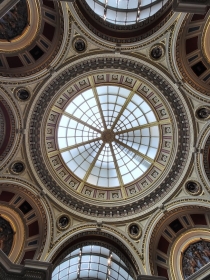
THE SAINSBURY WING of London’s National Gallery is stark, almost clinical, compared with the older nineteenth century rooms in the rest of the place. Although the pictures in the new wing can be seen without the eye being distracted by the rooms’ decorative features, I found that the paintings felt more ‘at home’ in the older, highly decorated galleries. One of these rooms, Room 36 has a central octagon topped by circular, glazed dome. In contrast to the Sainsbury Wing, this octagonal and the rooms leading of it, the Barry Rooms, are gloriously decorative in a Victorian baroque style. This and the rooms adjoining it were designed by the architect Edward Middleton Barry (1830-1880). His creations in London include The Royal Opera House and the Charing Cross Hotel.

There are several paintings by great artists such as Claude and Turner in the octagon. If you avert your eyes from these masterpieces, you might notice a small commemorative plaque that reads:

Dame Myra Hess. On 10 th October 1939 in this room the pianist Myra Hess performed the first of many music concerts for the enjoyment of Londoners during wartime”.

Myra Hess, who was born in South Hampstead in 1890, died in London in 1965. She studied music at the Guildhall School of Music and at the Royal Academy of Music. Her concert debut was in 1907. During WW2 when most concert halls were out of action, she organised almost 2000 lunchtime concerts in the National Gallery: Monday to Friday for six years. She played in 150 of them, and never took a fee for her playing. In recognition of her work in keeping up the morale of those who heard her, King George VI made her a Dame Commander of the Order of the British Empire in 1941.

At the time of her death in 1965, Myra Hess was residing at 48 Wildwood Road in Hampstead Garden Suburb. Although I lived not far from her in the Suburb during my childhood, then I was unaware of both her existence and the fact that she was almost a neighbour. It was only during the twenty-first century that I spotted her creeper covered commemorative plaque on the house in Wildwood Road. Although I am glad that I did not have to live through WW2, I would have enjoyed listening to a concert in the gloriously decorative octagonal room at the National Gallery.

When German bombs rained down on Hampstead and a pub that no longer exists

DURING MY CHILDHOOD in the 1960s, there was a concrete platform on Hampstead Heath Extension. It was close to Hampstead Way. Today, where it used to be visible, there is a mound of impenetrable bushes and weeds surrounded by a fence. The concrete structure was a base for anti-aircraft guns during WW2.  Although, many German aircraft were knocked out of the sky by guns such as these, many of them caused a great deal of damage all over London. Recently, while sorting through some books, I came across a slender volume called “Hampstead At War”. It was first published by Hampstead Borough Council in 1946, republished by the Camden Historical Society in 1979, and then again in 1995.  The book contains many photographs of the terrible destruction caused by bombs dropped by the Luftwaffe over Hampstead.

One of the photographs in the book struck a particular chord with me. It shows the badly damaged Hare and Hounds pub after it had been bombed in 1940. The pub, which was almost next door to the famous Old Bull & Bush pub, was established in about 1751. However, the building that was destroyed was built a long time after that.

Between 1965 and 1970, I used to travel From Golders Green station to Highgate School on the bus (route 210). Every school day, the bus would pass the Old Bull & Bush and its neighbour, the Hare and Hounds. When passing the latter in those days, I always wondered why the pub looked so recently built. When leafing through the “Hampstead at War” book today, more than 50 years after leaving the school, I found the answer. The book contains a photograph showing the extensively damaged pub.

The Hare and Hounds was rebuilt during the years I studied at Highgate. Although I can only faintly recall its appearance and can find only one photograph of it after its rebuilding, its presence remains firmly fixed in my memory. Finding the book certainly jogged my memory, and seeing the photographs of war damaged Hampstead makes a great impression. One wonders why the Germans chose to waste their ammunition on an area that has always been mainly residential.

PS: The Hare and Hounds closed forever in 2000.

Do not throw it away because it might become valuable one day

AFTER MY DAD’S father died, his mother remarried Isaac, a merchant, who lived and worked in Port Elizabeth (South Africa).

In his holidays, both school and then later university, Dad, whose father had owned a general store (in Tulbagh, South Africa), helped his stepfather in his shop in Port Elizabeth. Once again, he was in an environment where he was acquiring first-hand experience of the workings of commerce, one of the foundations on which the study of economics is based. By all accounts, including the fact that Isaac could afford regular holidays in Europe, the business prospered. Dad told me that during his vacations, he used to help Isaac compile annual inventories of his stock.

The shop owned by my father’s father in Tulbagh

One day, Dad came across many large glass bottles filled with boiled sweets that had become unsaleable because the candies had fused together to form huge masses. My father asked Isaac whether these bottles should be thrown out. He was told that they were to be retained. A few years later, WW2 broke out and there was a shortage of glass. Isaac sold the bottles filled with inedible sweets because the glass, now valuable, could be sold (for recycling) during the glass ‘famine’.

Was it experiences in his father’s and stepfather’s shops that might have led him to eventually become a professor of economics, and helped him to understand the concept of futures markets? I wonder.

Pierced by a bullet while praying in the pews

BEVERLEY IN YORKSHIRE is best known for its cathedral-like Minster. Our friend Colin recommended that while in Beverley, we should not miss visiting the church of St Mary. We went there and enjoyed exploring this magnificent medieval gothic parish church. We were shown around by a volunteer who pointed out something we had never seen in any other church.


The bullet hole

In WW2,  during an air attack on Beverley, a German aeroplane strafed the town. One of the bullets from the ‘plane made a hole in a stained glass window on the south side of the church, and went straight through one of the worshippers, killing him. The volunteer showed us the hole in the wooden pew made by the bullet after it had passed through the unfortunate parishioner. The wooden pew behind the one with a hole has a hollowed out spot caused by the bullet after it had penetrated the pew in which the victim had been seated.


Years later, the volunteer related, a woman from Australia visited St Mary’s,  and when she saw the damage caused by the bullet, she burst into tears.  The man who had been killed while praying had been her grandfather.

Discovering a garden in London’s Piccadilly

WE HAVE WALKED along Jermyn Street and visited Christopher Wren’s church of St James (Piccadilly) innumerable times without being aware that right next to both, there is an attractive public garden. It was only today (the 10th of September 2024) that we first became aware of its existence. The place in question is Southwood Garden. It lies west of the church and along part of the north side of Jermyn Street.

For 200 years the plot to the west of the church was used as a burial ground. At the end of WW2, the newspaper proprietor and Labour politician Viscount Southwood (1873-1946) paid to have the burial ground made into a garden to commemorate the bravery and courage of the people of London. The garden was opened in 1946 by Queen Mary (the wife of King George V).

The garden is approached by short flights of steps, which flank a small pond with a fountain. The pond is flanked by bronze sculptures of two children, each riding on the backs of a pair of dolphins. There are two other sculpted children, one on each side of the steps. At the top of the steps, there  is a stone inscribed with “Viscount Southwood”. The few steps lead to a paved area, at the back of which there is an inscribed plaque explaining that Viscount Southwood provided the garden that stands on what had been a bomb-damaged burial ground. Another couple of steps at the southeast corner of the paved area lead up to the well-tended grassy, rectangular garden.

In addition to the sculptures of children astride dolphins, there is another bronze sculpture in the garden. It depicts a standing woman holding some leaves in her right hand. It is called “Peace”. All the sculptures at Southwood Garden were made by the English sculptor Alfred Frank Hardiman (1891-1949).

How could we have missed this delightful garden? There are two possible reasons. First, you cannot see it from Jermyn Street. Second, the fountain and entrance to the gardens are almost hidden behind the food stalls, which are set up during the day in the paved courtyard on the north side of the church. Well, I am pleased that we have ‘discovered’ it at last.

About Space at an exhibition in a gallery in south London’s Bermondsey

THE TROUBLE WITH temporary exhibitions is that they come to an end. So, if you miss it, you might never see the same works of art together again. I am very pleased that we just managed to catch a superb exhibition at the White Cube gallery in Bermondsey on its final day (1st of September 2024). Called “About Space”, it is a show of paintings by an artist, of whom I had not come across before: Al Held (1928-2005).

Al Held was born in Brooklyn (NYC). His Jewish family was impoverished during the Great Depression and had to survive on welfare payments.  Having served in the US forces during WW2, he was eligible (under the terms of the GI Bill) for financial assistance with his education after the war. He studied painting first in New York City, and then in Paris (France). Over the years, he explored different styles of painting, and after exhibiting at major art museums in the USA, his work began to be shown at prestigious galleries outside the USA.

The paintings on display at the White Cube date from the 1960s onwards. Many of them are huge, dwarfing the viewers. A few are smaller. All of them are visually spectacular. Although two-dimensional, they depict complex three-dimensional abstract imaginary constructions. Viewing these amazing compositions is like looking through a huge window at the kind of fantastical geometric abstracted landscapes that might now be produced by digital means. As the title of the exhibition implies, Held’s paintings are literally about space. Painted with precision, these compositions explode with energy.

I am glad that we did not miss the exciting experience of seeing these paintings created by a man, who had shown no interest in art until he left the US Navy in 1947. It was his friend the artist Nicholas Krushenick (1929 – 1999), who inspired him to take up art, and I am very pleased that he did.

Salvation in Sandwich

THE HIGH STREET runs through Sandwich (Kent) from south to north. At its northern end, it runs beneath an archway next to a former toll bridge across the River Stour. After 1977, the toll was abolished. Under the archway, which is part of the mediaeval barbican (built c 1470) that used to be a gateway through the town wall, there are several notices of interest.

One of the notices records the fact that tolls were collected from users of the bridge from 1759 to 1977, and the last toll was collected from the Mayor Councillor on the 30th of September 1977. Near this memorial, there is a table of tolls dated June 1905. Interesting as these two signs are, it is the third one that was a complete surprise to me. It read:

“This plaque is to commemorate Richborough Transit Camp 1939-1940 where 5000 men found refuge from Nazi persecution on the Continent. During the Second World War most of them volunteered to fight for the Allied cause.

Erected in gratitude to the citizens of Sandwich and East Kent who, as in the past, welcomed the refugees.”

I noted that this brief notice made no mention of the identities of the refugees. However, another plaque, attached to the nearby Bell Hotel, clarified the situation. The hostelry was:

“… A meeting place for Jewish refugees from the Kitchener Camp, Richborough, Sandwich 1939-40”

The Kitchener Camp was a former army barracks located north of the Stour, not far from the toll bridge, on the west side of Ramsgate Road. There is now no trace of it because it was demolished after the end of WW2. During 1939, 4000 mainly German and Austrian Jewish men were accepted for accommodation in the camp on condition that they would not be granted UK citizenship or work, and must emigrate to the USA. The camp received no government funding. It was paid for by Jewish organisations including The Central British Fund for German Jewry (founded 1933).  At the start of WW2, 887 of these men volunteered to join the Pioneer Corps, which carried out light engineering projects at the battle fronts. After the Dunkirk episode in May 1940, the British public became suspicious of German speaking refugees because they were worried about the possibility that some of them might be involved in spying and sabotage. So, those, who were not enrolled in the war effort, were shipped out to internment camps in Australia and Canada, and then Kitchener was closed.  

During its brief existence, the Kitchener Camp, which began accepting refugees on the 20th of January 1939, became a hive of cultural activity as can be discovered by looking at the highly informative website – https://kitchenercamp.co.uk/   There were concerts and a cinema provided by the Odeon Cinemas, run by it’s the  Jewish founder Oscar Deutsch. I had never heard of the Kitchener Camp (aka ‘Richborough Tansit Camp’) until I spent a few days in Sandwich recently. Regarding the plaque commemorating it beneath the arch of the barbican, it mentions 5000 men, but reliable sources always refer to 4000 Jewish men. This puzzles me, as it was placed by the Jewish Community of Great Britain ( according to https://www.warmemorialsonline.org.uk/memorial/263444/).

Remembering victims of war in Sandwich, Kent

Some of the WW1 names and the Falklands victim below

IN THE HEART of Sandwich in Kent, near to the deconsecrated Church of St Peter, there is a war memorial that was erected to commemorate those from the town who died in the ‘War to End All Wars’ – the First World War (1914 – 1918). Roughly 100 names are recorded on the lists of people who died during WW1. However, they are not the only people listed on this monument because ‘The War to End All Wars’ did not live up to its name.’

The memorial lists about 15 people who were killed in WW2 (1939-1945). In addition, three of Sandwich’s population perished in the Korean War (1951), and more recently, one of the townsfolk was killed in the Falklands Conflict (1982).

I sincerely hope that no more names need to be added to this war memorial as a result of the conflict in Ukraine, or any future wars.

Safe and sound under the ground

DURING WW1, THERE were German Air raids over the town of Ramsgate in Kent. Many were killed by relatively few bombs.

In the late 1930s, the forward thinking Mayor of Ramsgate and his Chief Engineer designed a series of tunnels deep below the town to be used as air raid shelters. Over three miles of tunnels were dug into the chalk far below the town. The digging was carried out by miners from the (now closed) coal mines of East Kent.

Bunks in the tunnel shelter

Except for a short section about 25 feet below the ground, which was reinforced with thick concrete, the rest of the tunnel system, which was on average 75 feet below the surface, was self supporting. The tunnels could accommodate up to 60000 people, but because many of Ramsgate’s population were either evacuated or serving inthe armed forces, the town’s population was about 15000 during WW2.

The tunnels were fitted out with electric lighting; bunk beds; benches; first aid stations; and chemical toilets. People were allowed to spend the night there or when air raids were in progress. Given that Ramsgate was the last place that German bombers flew over when returning to mainland Europe, they tended to drop any remaining bombs on the town. In addition, the Germans had heavy long-range guns at Cap Gris Nez just across the English Channel from Ramsgate, and shells capable of destroying buildings fired from these could arrive in the town without prior warning.

In short, the tunnel system saved innumerable lives. Today, excellent guided tours allow visitors to explore it. Today, the 24th of July 2023, we joined one of these tours. Everything was beautifully and interestingly explained. Although not as well furnished and comfortable as the huge nuclear bunker built at Gjirokaster in Albania in the 1960s, what was constructed in quite a hurry at Ramsgate is remarkable.

Having just seen the not too brilliant film “Oppenheimer”, I could not help wondering how many people might have been saved had Hiroshima and Nagasaki been supplied with deep shelters like that at Ramsgate.

The Poles in London’s Marylebone

IT ALMOST GOES WITHOUT saying that wherever you are in central London, you are never more than a few footsteps away from a spot that has played a role in significant historical events. Most of these historical spots have been recorded, and therefore are not unknown to at least a few people. However, when walking around London, I often come across a memorial which I had not noticed before despite having passed it several times. Such is the case with number 51 New Cavendish Street – a brick building in Marylebone, which we have walked past several times recently.

Number 51 bears a commemorative plaque which has the following information:

“This building housed the headquarters of the Polish navy during 1939-1945”.

Underneath this, but in much smaller letters, are sixteen Polish names. From an informative website (https://wartimelondon.wordpress.com/2018/12/12/new-cavendish-street-and-the-free-polish-navy/), I learned that these are the names of Polish naval vessels -ships and submarines.

Poland became an independent country at the end of WW1. By 1920, then with only 90 miles of coastline, Poland began to construct a navy. This was based in Gdynia, near to the ‘free port’ of Gdansk (Danzig), which was not under Polish control. In 1939, with little chance of withstanding attack by the Germans, Polish naval vessels began leaving the Baltic, and heading for British waters. In late 1939, Polish Naval Headquarters were established at 51 New Cavendish Street. Although the Poles had administrative control over their vessels, operational control was dictated by British military requirements. Between 1939 and 1945, the number of men working in the exiled Polish Navy increased from 1000 to 4000.

After the end of WW2, in September 1946, the Polish Naval Detachment in the UK was disbanded. One of its warships was handed back to the new Communist government of Poland. Only a few of the naval personnel felt able to return to their native land now that it was under Communist rule.

Well, I knew a little about the exiled Polish Air Force and have visited Audley End House, where Polish Special Operations Executive personnel trained before being dropped behind the lines in German-occupied Poland. I have even eaten dinner at a Polish Airman’s Club in South Kensington, but this place’s restaurant might well have closed since then. However, until my most recent visit to New Cavendish, I did not know anything about Poland’s navy and its role in WW2.