
Wood as art and the art of woodwork

DURING THE EASTER weekend, we visited two exhibitions. Unlike many exhibitions I have written about lately, neither of them finish soon. Both shows relate to wood and trees. One is being held at the Serpentine South Gallery in Kensington Gardens and it ends on 7 September 2025, and the other is at Japan House in High Street Kensington and continues until 6 July 2025. So, there is plenty of time to see both exhibitions.

By Giuseppe Penone

The show at the Serpentine is of artworks by the Italian artist Giuseppe Penone. I have already written a bit about him (https://adam-yamey-writes.com/2025/04/15/boulders-lodged-in-trees-at-a-park-in-london/). I did this after seeing those of his works that are on display near the outside of the Serpentine Gallery. I have now seen what is on display within the gallery, and was pleasantly surprised. Penone is fascinated by the intricate relationships between humans and nature, and this is what inspires his artworks. Many of the artefacts (paintings, installations, and sculptures) on display relate to trees and their leaves. The walls of the central hall of the Serpentine Gallery are lined with containers that hold thousands of dead laurel leaves. Another exhibit consists of semi-abstract sculptures that resemble human forms, and these are entwined with living plants growing out of large flower pots. Other works are formed from pieces of wood and twigs. One particularly effective work consisted of living branches with leaves and twigs. One of the twigs has been forced through a hole cut in a photograph of a man’s face in such a way that the twig seems to have grown from within the centre of the eye. I like this piece because it encapsulates what Penone does: he sees nature through his eyes and is inspired by what he sees.  

In contrast to Penone’s work at the Serpentine, which is art for art’s sake, the exhibition at Japan House is designed to illustrate how man can create artistic yet functional artefacts from wood. Called “The Craft of Carpentry: Drawing Life from Japan’s Forests”, the show sets out (successfully) to illustrate the amazing skills of traditional Japanese carpentry. This informatively labelled exhibition has exhibits showing the variety of tools used, the types of wood employed, the range of joinery methods, templates for cutting shapes, and some of the final products including a life-size replica of the Se-an teahouse in a temple in Kyoto. Although everything on display is related to creating functional products, each exhibit is so beautiful that it could be considered a work of art in its own right. As with every exhibition I have seen at Japan House, the exhibits are displayed imaginatively and beautifully. The exhibitions themselves are works of art.

I recommend visiting both exhibitions not only because they are fascinating but also because they illustrate two completely different approaches to dealing with trees and their wood.
Woodwork or Latin

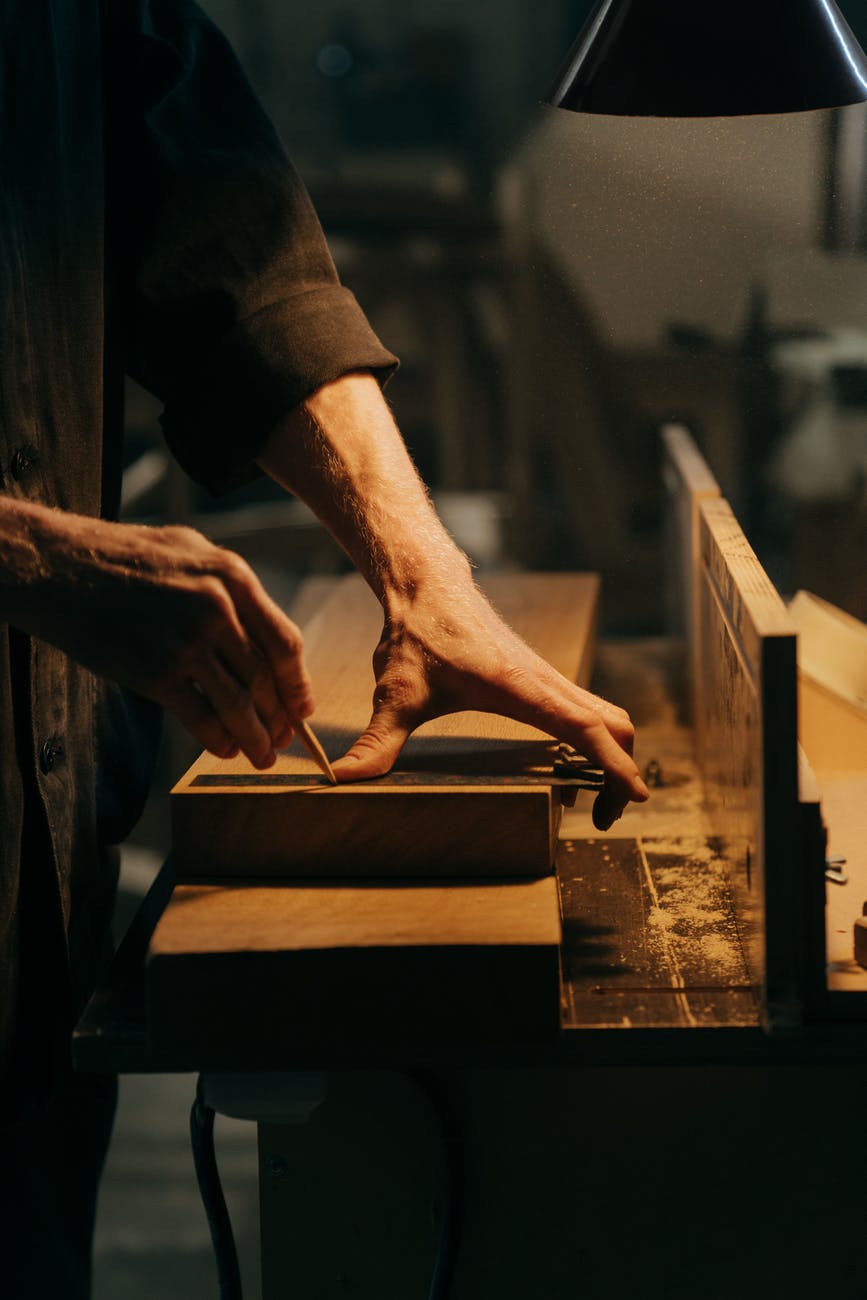
A FRIEND POSTED A PICTURE of something he had created in wood at school when he was about 14 or 15 years old. It looks to be an extremely competent creation. Seeing this, reminded me of when I had to attend woodwork classes at roughly the same age at my secondary school, Highgate in north London.

Photo by cottonbro on Pexels.com

Once a week, under the watchful eye of the woodwork teacher, Mr Bowles, I participated in a woodwork class in the school’s specially equipped workshop. Mr Bowles was well-known for saying of the timber he supplied in the class:

“Don’t waste it. You know that wood does not grow on trees.”

Although many years later, I was able to perform complex manual tasks whilst practising dentistry, in my early teens I was not skilled at performing three-dimensional manual exercises. I could draw and paint reasonably well, but model-making and woodwork were not amongst my skills.

I struggled with a tool called the sliding bevel when trying to create dovetail joints, which seemed to be of great importance to Mr Bowles. We were set what he regarded as simple tasks. With great difficulty, I completed two of these. I produced a tea tray, which was next to useless as it was only able to rest on two of its four corners at any one time. The bookshelf which could hold up to eight average thickness paperbacks suffered the same problem. Somehow, I had managed to introduce a twist into it so that its two ends were not in alignment. My parents, for whom it was suggested by our teacher that these would make fine gifts, were totally unimpressed. It would have been dishonest of them to have been otherwise.

My prospects of becoming a skilled carpenter were not looking great. Then, my fate changed suddenly one afternoon. I had just finished the school day and was walking across a polished wooden floor, when I slipped and fell. As I began to get back on my feet, I noticed that my left wrist was bent in an unnatural way and was a bit painful. Having recently completed a first-aid course, during which we were taught to tie complicated bandages instead of learning resuscitation and life support, I realised that I had most probably broken a bone.

I walked over to the caretaker’s home across the school’s quadrangle and found him. He said that he would ring my parents and while we were waiting for them to arrive, he gave me a cup of tea and biscuits. This kind gesture meant that I had to wait several hours before it was safe for me to have a general anaesthetic for setting my arm at the nearby Whittington Hospital.

My arm was encased in plaster, which remained in place for six weeks or longer. This accident was a lucky break for me. First of all, my popularity rating rocketed. Prior to my accident, many of my school fellows believed that I was rather unexciting and unadventurous, not even a ‘nerd’. Seeing my arm in plaster, suggested to these classmates that I must have been up to no good. Maybe, I had fallen out of a tree or had an accident on roller skates or on a bicycle. I kept quiet about the innocuous cause of my fracture and enjoyed experiencing the increase in my ‘street cred’. Even after my plaster was removed, my schoolmates retained their improved opinion of my personality.

Doing woodwork with one arm in plaster was not thought advisable. So, I was excused from the second and final term of woodwork classes. Actually, I doubt that using only one arm would have affected my woodwork much, as it was already appalling with two arms. 

At the end of the school year during which we had to study woodwork, we had to make subject choices. Basically, the choice was to follow the ‘arts’ or the ‘sciences’. The choices were history or physics; geography or chemistry; and … wait for it … Latin … or  … woodwork.  To be honest, the latter was a ‘no brainer’ of a choice. Woodwork did not get my (or my parents’) vote. But, as it is good to be truthful, my Latin was barely better than my woodwork. Although I struggled with Latin at school, it has proved useful especially when studying anatomy and, also, when wandering amongst tombstones. As for woodwork, Mr Bowles might be pleased to learn that over the years I have put up several shelves that were able to carry heavy loads. Now, as you read this, do not get any ideas about getting in touch with me to put up shelving in your homes.