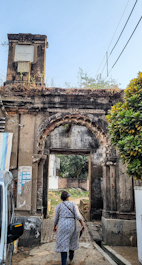
ALL THAT REMAINS OF A MAHARAJAH’S PALACE … IS ONLY A FEW ARCHES.
Not marked on Google maps, but mentioned in a guidebook to Murshidabad (in West Bengal), this remnant of a palace is extremely difficult to find. Our toh-toh (electric autorickshaw) driver asked many locals for directions. To my surprise, all knew about the small remains of a former palace, once a home of Maharaja Nanda Kumar (1705-1775), a tax collector for the British East India Company [see: https://en.m.wikipedia.org/wiki/Maharaja_Nandakumar ], who fell foul of the Company’s law. The guidebook did not mention this or the fact that he, a friend of Warren Hastings, was hanged by the Company for alleged fraud.
AS EARLY AS THE SEVENTEENTH century, the French, Dutch, and English set up factories (trading stations) at Cossimbazar, which is beside the Hooghly River in the north part of West Bengal. It existed before what is now Murshidabad became capital of Bengal. Today, what was once an important trading centre, where European merchants acquired goods to bring from India to Europe, is now no more than a rustic village.
Cossimbazar is home to a small cemetery, the Old English Cemetery, which contains the graves of about 30 Brits who died between 1730 and about 1800. Within this small graveyard, which is maintained by the Archaeological Survey of India, there is one above the burial place of Mary Hastings and her young daughter Elizabeth. The gravestone has been restored and is legible.
Mary, who died in 1759 (as did her daughter), was the first wife of Warren Hastings (1732-1818). He was a senior British East India Company administrator: the first governor of the Presidency of Fort William (Bengal), the head of the Supreme Council of Bengal, and so the first governor-general of Bengal in 1772–1785. He lived in Cossimbazar for a short time.
“Prager had come to Calcutta in 1786 on behalf of a London firm of Israel Levin Salomons, an Ashkenazi Jew. Diamonds were just one of the things Salomons traded in his India business; pearls and drugs were others.”
Stones cut in Benares by experts from Gujarat were sent down the Ganges to merchants and traders at Cossimbazar and other places further down the Hooghly. Most probably when Lyon Prager took ill at Cossimbazar he was there for undertaking business dealings.
Unlike Mary Hastings’s gravestone, the writing on Prager’s is now illegible. I have seen a photograph of his monument that is surmounted by an obelisk, which was taken when the grave was still identifiable. Without knowing that it was Prager’s grave, I photographed it when we visited the cemetery in January 2025.
When I was researching my book about Jewish migration to South Africa, I learned that the Dutch East India Company did not permit Jewish people to travel to their trading stations in the Cape of Good Hope and elsewhere unless they had converted to Christianity. The presence in India of a Jewish trader, such as Lyon Prager suggests that in the eighteenth century, Jews were not barred from joining trading expeditions by the British East India Company.
WINDSOR CASTLE IS well-known to many people and much visited. However, what came before the castle was built is less known. Recently, we visited the place near Windsor which used to be the home of Britain’s royal rulers well before the Normans invaded the British Isles. Our trip began at the car park close to where the Magna Carta was signed in Runnymede in 1215.
Beaumont House
We slithered through the mud and wet leaves on the path running along the bank of the River Thames from Runnymede to Old Windsor. The path runs past the large gardens of homes along the river and provides views of the occasional barges moored on both sides of the stream. We caught glimpses of a couples of swans but remarkably few other forms of bird life. Birds might have been in short supply, but not aeroplanes. Despite the decrease in air travel that has resulted from the covid19 pandemic, there seemed to be a ‘plane flying low over us every one or two minutes because we were walking beneath the flight path along which aircraft descend as they near Heathrow Airport. The low clouds meant that although we could hear them, we could not see all of the ‘planes.
We left the riverside path after having walked about a mile and followed a footpath to the church of Saints Peter and Andrew on the edge of Old Windsor. This lovely church with a sharp pointed steeple and flint walls is set in a graveyard with many picturesque funereal monuments and a tall redwood tree. The present building was constructed in 1218 to replace an earlier wooden church that was burnt down by French mercenaries in 1215 in response to King John’s recent somewhat reluctant signing of Magna Carta at nearby Runnymede (www.oldwindsorchurch.org.uk/history.html). I do not know who was paying these incendiary Frenchmen and wonder if President Donald Trump might not employ some people to create similar mayhem following his election defeat. Since 1218, the church, which was locked when we visited, underwent various modifications over the centuries including an extensive restoration in 1866 by the architect Giles Gilbert Scott (1880-1960).
Most of the present village of Old Windsor is of little interest to the visitor. However, its history is. Old Windsor existed before the formerly named ‘New Windsor’ or ‘Windsor’ as we know it today. The name ‘Windsor’ might be derived from Old English ‘Windles-ore’ or ‘Windlesora’ (meaning ‘winding shore’). The place now known as ‘Old Windsor’ is recorded in the 9th century Anglo-Saxon Chronicle, an early history of the Anglo-Saxons. During that pre-Norman Conquest era, there was a royal palace at Old Windsor. The old palace continued to be used until the castle, the present Windsor Castle, began to be constructed in the reign of William the Conqueror. According to James Thorne in “Handbook to the Environs of London” (published in 1876), the royal residence at Old Windsor continued to be used, maybe occasionally, until the reign of King Henry I, that is until between 1100 and 1135. The old palace has long since disappeared. Some archaeological remains of the palace were discovered in the 1950s and are kept in the Reading Museum.
We walked from the church to a main road (the A308) along a long road (Church Road) through Old Windsor. Apart from a few mildly picturesque old cottages near the church, it was lined with suburban dwellings lacking in architectural merit. The main road along which we walked back towards Runnymede is appropriately named ‘Straight Road’ because it is straight in comparison to the river that runs its sinuous course close by.
When we reached a short thoroughfare named Ousely Road, we noticed what looked like the gatehouse to a large estate at its far end. We walked up to what was definitely once a gatehouse, and which, to prove it, is named ‘Front Lodge’. Beyond it, a vast lawn ascended a slope towards a large house that was barely visible. By walking a short distance from the lodge, we reached the entrance to the Beaumont Estate on Burfield road to which Ousely Road leads. This estate is currently owned by the De Vere hotel group, but in the past, it had a far more celebrated owner.
The estate, which was originally called ‘Remenham’ after Hugo de Remenham, who owned the land in the 14th century, was renamed ‘Beaumont’ in 1751 by the son of the Duke of Roxburghe. In 1705, the then owner, Lord Weymouth, had a mansion built. It was designed by James Gibbs (1682-1764), who also designed St Martin in the Fields in London and the Radcliffe Camera in Oxford. Sadly for us, in the early 19th century, the building was rebuilt and extended for its then owner, an ‘Anglo-Indian’ (i.e. a ‘Brit’ who had lived and worked in India) named Henry Griffiths, by Henry Emlyn (1729-1815), an architect based in Windsor. The impressive neo-classical portico on the present building was Emlyn’s work.
In 1786, the mansion was acquired (for £12000) by another man who was associated with India, Warren Hastings (1732-1818). Hastings had been the first Governor of the Presidency of Fort William (Bengal) and along with Robert Clive (1725-1774), he was one of the founders of the British Empire in India. When Hastings returned to England in 1785, the House of Commons attempted to impeach him for misdemeanours he was alleged to have perpetrated whilst he was in India. He was eventually acquitted in 1795. During the first three years of his trial, Hastings lived in Beaumont House. In 1789, he sold it to Griffiths, already mentioned.
After several others had owned the estate, in Beaumont became a college, Beaumont College, run by the Society of Jesus and established in 1861. This institution flourished until it was closed in 1967. After becoming a computer training centre and then a conference centre, the estate was acquired by the company that owns the De Vere hotel group. When we wandered into the estate, there seemed to be nothing much happening there.
From Beaumont, it is a short walk to the National Trust Runnymede car park, from which we set off for nearby Datchet, which I will write about separately. If it had not been for the slippery state of riverside footpath, we would have returned along it and thereby would have likely never have come across Beaumont and discovered its interesting connections with British India.



 yamey
yamey 