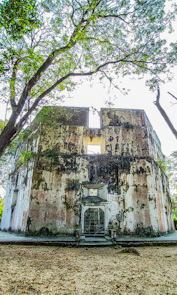
There was trouble in the Indian Ocean

EVER SINCE ROMAN times (and probably before), people in Europe yearned for products from Asia. Before 1498, highly prized goods such as spices and precious stones reached Europe from India and places further east via the Indian Ocean, and then overland, passing through places in the Middle East like Egypt and Turkey, before crossing the Mediterranean. Another route used for transporting these wares between India and Europe involved the use of rivers and overland caravan trails that carried them to the Caspian and Black Seas, and thence to Europe. At many points along these routes, the goods attracted taxes, which greatly increased the prices that people in Europe had to pay to purchase them.

In 1498, the Portuguese explorer Vasco da Gama (c1460s – 1524) discovered a sea route from Portugal to India via the Cape of Good Hope. This discovery allowed Portuguese vessels to carry the highly prized goods from India to Europe by sea without having to pass through the lands where hitherto they had attracted high taxes and customs duties. Thus, the Portuguese were able to import the spices and other precious goods from the Orient at much lower prices than prior to Vasco’s discovery of the Atlantic route.

However, the Portuguese found that they were not the only traders making use of the Indian Ocean during the 16th century. Their competitors included Gujaratis, Egyptians, Arabs, Turks, and many others. It was not long before the Portuguese instituted measures to stifle competition and monopolise trade in the Indian Ocean. Naturally, this upset the merchants of other nations who traded in this sea. To stifle competition, the Portuguese resorted to harsh measures designed to make it almost impossible for their competitors to trade by sea. Over many years during the 16th century, attempts were made to oppose the monopolistic measures being forcibly imposed by the Portuguese, whose military and naval prowess was very formidable.

In 1508, a man called Khwaja Safar travelled from Egypt to begin trading in the Sultanate of Cambay (now ‘Gujarat’). Born in the south of Italy, his parents were Albanians. Having fought in armies in Europe in his youth, he was well-informed about the latest military techniques of European armies. By 1530, he began offering his services and military advice to the Sultan of Cambay. It was not long before he became involved both with negotiating with the Portuguese in India whilst simultaneously plotting against them. With the military experience he had gained as a young man in Europe, he became the commander of forces that repeatedly attacked the Portuguese, particularly in their important stronghold on the island of Diu – a place from which the Portuguese were able to watch and exert control on shipping to and from India.

My book, “An Albanian in India”, follows Khwaja from his birth in the ‘Heel of Italy’ to Egypt, then to Yemen, from there to Gujarat where he became a man of importance, and then to his untimely end during the attack on a Portuguese fortress on the coast of Gujarat. My book is available from Amazon, e.g.: https://www.amazon.co.uk/dp/B0D7HX2B8Q

A refreshing breeze in Goa

I SHOULD NOT BE TELLING you about a wonderful place in the heart of Panjim in Goa, but I will.

The Clube Vasco da Gama is situated on the first floor of a building beside Panjim’s lovely Municipal Garden. Founded in 1909, it occupied other buildings before it moved to its present site. With a pleasant decor, which evokes times long past, the Clube serves a wide range of drinks and superbly prepared Goan food. Today, we enjoyed baby squids stuffed with minced vegetable and chopped up squid, served in a tasty sauce. We also ate croquettes filled with a mildly spiced prawn purée. In addition, we consumed fried fish served in a very spicy sauce. Everything tasted wonderful, and as we will be in Panjim for several days, we will work our way through the menu.

We first came across the Clube in April 2018, when the weather was almost unbearable: extremely hot and humid. Quite by chance we came across the Clube and decided to enter it. We discovered that it has two small balconies, each overlooking the Gardens. Each of them has a small table with three chairs. All day long, there is a lovely, cooling breeze blowing across these two tables, making them the coolest places to sit in central Panjim (without resorting to finding places with air-conditioning).

It is because there are only two of these wonderfully positioned tables, it is with some trepidation that I am telling you about them. I do not want to turn up at the Clube to find them occupied by those who have just read this!