
Rabindranath Tagore in Hove and Hampstead

FROM HOVE TO HAMPSTEAD

THE NOBEL PRIZE winning Rabindranath Tagore (1861-1941) was born in Calcutta (Kolkata). Raised in a culturally rich, wealthy household, he began writing poetry when he was eight years old. His family wanted him to join many of his compatriots, who travelled to England to become barristers. By becoming barristers, many Indian men were able to begin on the pathway to wealth and/or political influence both within the British colonial system, or against it.
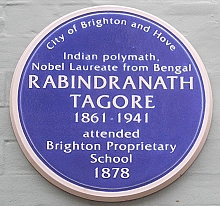
Tagore was enrolled in a school in Brighton in 1878. Whilst there, he resided in Medina Villas in Hove. His biographers, Krishna Dutta and Andrew Robinson, wrote in their book (published 1996) that one of Rabindranath’s (‘Rabi’s’) nieces:

“…retained fresh memories of Rabi Kaka (Uncle Rabi) in the family house at Medina Villas, between Brighton and Hove, where he settled for several months.”

Tagore wrote:

“Our house at Hove is near the sea. 20/25 houses stand in rows and the name of the complex is Medina Villas. When I first heard that we would be living in Medina Villas, I imagined a lot, such as there are gardens, big big trees, flowers, fruits, open space and lakes etc. After coming to my place I found houses, roads, cars, horses and no sign of Villas” (http://rabitalent.blogspot.com/2017/06/rabindranath-in-england.html).

The school that Tagore attended briefly, for about two months, was in Brighton’s Ship Street, close to the town’s famous ‘Lanes’ and a few feet from the seafront. Recently, a commemorative plaque was attached to the building which housed the school and is now part of a hotel, which used to be its neighbour. The plaque named the educational establishment “Brighton Proprietary School”.

I attended a preparatory school before moving on to a high school, but until I saw the plaque in Brighton I had never heard of proprietary schools. It seems as if they were private schools that were run as businesses, rather than not-for-profit organisations. A note on the National Archives website (https://discovery.nationalarchives.gov.uk/details/r/b1c290ea-4580-4c52-962b-10c0d281ac2a) revealed:

“The school was opened on 18 July 1859 under the title of the Brighton Proprietary Grammar and Commercial School for the Sons of Tradesmen. The proprietors … each had a share in the school and were entitled to take up places there. The education given had a Protestant bias and the first headmaster was the Rev John Griffiths, formerly of Brighton College.”

Brighton Proprietary School later became the Brighton, Hove and Sussex Grammar School (www.britishmuseum.org/collection/term/BIOG250324). Dutta and Robinson wrote:

“After spending a short time in a school in Brighton and Christmas with his family, he was taken away to London by a friend of his elder brother, who felt he was making little progress towards becoming a barrister. There he would stay during most of 1879, with a break to visit Devon, where his sister-in-law had taken a house, and, most probably, time spent with some cousins…”

Fast-forwarding to 1912, Tagore, by then a world-famous cultural figure, visited London. During his stay, he resided in Hampstead’s Vale of Health, as I recount in my book “Beneath a Wide Sky: Hampstead and its Environs” (available from  https://www.amazon.co.uk/dp/B09R2WRK92). Here is a brief extract from what I wrote:

“The only vehicular access to the Vale is a winding road leading downhill from East Heath Road. This lane is bordered by dense woodland and by luxuriant banks of stinging nettles in spring and summer. At the bottom of this thoroughfare, there are houses. Most of the expensive cars parked outside them suggest that the Vale is no longer a home for the impoverished. At the bottom end of the road, there two large Victorian buildings whose front doors are framed by gothic-style archways. They have the name ‘Villas on the Heath’. One of them bears a circular blue commemorative plaque, which has leafy creepers growing over it. It states:

“Rabindranath Tagore 1861-1941 Indian poet stayed here in 1912.”

I have visited the palatial Jorasanko where Tagore was brought up in Calcutta. The large (by London standards) ‘villa’ in the Vale is tiny in comparison. An article published in a Calcutta newspaper, The Telegraph, on the 13th of September 2009 reported with some accuracy:

‘In Hampstead, north London, regarded as a cultural “village” today for left-wing but arty champagne socialists, there is a plaque to Rabindranath Tagore at 3 Villas on Vale of Heath.’”

I have known about Tagore’s stay in Hampstead for a long time, but it was only during a recent visit to my wife’s relatives in Hove, that we first learned of the plaque commemorating Tagore’s brief educational experience in Brighton.

Hunting for Hunt: poets in Hampstead

I MUST CONFESS THAT I knew nothing about Leigh Hunt (1784-1859) until I became interested in the history of Hampstead in North London. What triggered my interest in Hunt was seeing a house named Vale Lodge in a part of Hampstead called The Vale of Health. Vale Lodge, a late Georgian (early 19th century, pre-1831) house modernised in the 20th century, is difficult to see from the lane by which it stands because it is surrounded by a high wall.

Vale Lodge

People, who have lived in Vale Lodge include the writer Edgar Wallace (1875-1932); the Russian-born industrialist Sir Leon Bagrit (1902-1979); and the banker Sir Paul Chambers (1904-1981). One source (https://historicengland.org.uk/listing/the-list/list-entry/1379083) mentions that Vale Lodge was:

“… home of Edgar Wallace, writer, and probably also the residence of Leigh Hunt, poet.”

Well, that got me interested because I had read that Leigh Hunt lived in the Vale of Health from 1816 onwards for a few years.

Hunt, a radical, was a critic, essayist, and poet. He was a co-founder and/or collaborator of several periodicals including “The Examiner”, “The Reflector”, “The Indicator”, and “The Companion”. In about 1812/13, Hunt and his two brothers, also involved with “The Examiner”, were imprisoned for libelling the Prince Regent (the future King George IV). Whilst incarcerated in the Surrey County Jail, Hunt was visited by his eminent friends including:

“…Lord Byron, Thomas Moore, Lord Henry Brougham, and Charles Lamb … When Jeremy Bentham called on him, he found Hunt playing battledore.” (https://en.wikipedia.org/wiki/Leigh_Hunt).

On his release from prison in 1815, Leigh:

“… went to live in the Vale where he stayed until 1819, returning again for a brief period in 1820-1.” (www.british-history.ac.uk/vch/middx/vol9/pp71-73)

Hunt’s home in the Vale of Health not only inspired him to write some poetry extolling the virtues of Hampstead, but also attracted several of his contemporaries who were notable literary figures. These included the poets Percy Bysshe Shelley (1792-1822), Bryan Waller Procter (1787-1874) and John Keats (1795-1821) as well as the painter Benjamin Robert Haydon (1786-1846) and the essayist William Hazlitt (1778-1830). When I was studying at University College, I read some of Hazlitt’s essays. Some words he wrote about the fear of death made a great impression on me:

“Perhaps the best cure for the fear of death is to reflect that life has a beginning as well as an end. There was a time when we were not: this gives us no concern – why then should it trouble us that a time will come when we shall cease to be? I have no wish to have been alive a hundred years ago, or in the reign of Queen Anne: why should I regret and lay it so much to heart that I shall not be alive a hundred years hence, in the reign of I cannot tell whom?” (from “Table Talk”, published in 1821).

The poet Keats, who had slept in Leigh Hunt’s home in the Vale of Health, took a great liking to Hampstead and settled there in 1817. He lived in Wentworth House, which was later renamed ‘Keats House’. The house was built in about 1815 (https://keatsfoundation.com/keats-house-hampstead/) and divided in two as is common with modern semi-detached houses. One half was occupied by Charles Armitage Brown (1787-1842), a poet and friend of Leigh Hunt and the other half by Charles Wentworth Dilke (1789–1864), a literary associate of Hunt and a visitor to his home in the Vale of Health. Keats became Brown’s lodger. Keats had first visited the house when the poet and playwright John Hamilton Reynolds (1784-1852), who was part of Leigh Hunt’s circle of friends, introduced him to Dilke, Brown’s friend and neighbour.

While living in Hampstead, Keats wrote much poetry including “Ode to a Nightingale” (and other “Odes”), “Isabella”, Hyperion”, “St Agnes”, “La Belle dame sans Merci”, and began working on “Endymion”.  It has been suggested that Keat’s poem “I Stood Tiptoe Upon a Little Hill” was inspired by his experience of Hampstead (www.hamhigh.co.uk/lifestyle/heritage/rare-keats-handwritten-poem-inspired-by-hampstead-heath-goes-up-3438636). Another of his works, “Dedication. To Leigh Hunt esq” relates directly to his friend Hunt (words: www.bartleby.com/126/1.html). His poem “Sleep and Poetry”, according to Leigh Hunt (http://spenserians.cath.vt.edu/TextRecord.php?textsid=36069):

“… originated in sleeping in a room adorned with busts and pictures … ‘On Sleep and Poetry,’ was occasioned by his sleeping in one of the cottages in the Vale of Health, the first one that fronts the valley, beginning from the same quarter.”

The house was that of Leigh Hunt (https://www.bartleby.com/126/1000.html#31).

There is no doubt that many now famous literary and artistic people congregated around Leigh Hunt while he has living in the Vale of Health, but there appears to be some uncertainty as where exactly he resided. One suggestion, already mentioned, is Vale Lodge. However, a 19th century writer, William Howitt, wrote of Hunt’s residence in his “The Northern Heights of London” (published in 1869):

“The house, which he occupied … was pulled down to make way for the great hotel just mentioned.”

The site of the hotel, which has also been pulled down, is now occupied by a block of flats called Spencer House. If that is the case, then Vale Lodge can be remembered for at least one literary figure, Edgar Wallace, if not also Leigh Hunt.